It’s almost New Year now and a time when friends have their regular get together discussing the hits and misses of their lives over a dinner or a couple of drinks. This year also marks 10 years when I left my school to enter a new world .While contemplating a meeting to celebrate this, I realized that I am among the rare species of my batch who’s decided to not to pack my bags and flee India. There are just so many guys out there in the US that a get together there makes so much more sense than here.
What is that makes the average Andhraite so obsessed with the idea of going abroad or more precisely the US of A? He may not have any great visions on what to do when he goes there but he sure wants to land there, irrespective of the kind of work he does there. I have had friends working in petrol pumps and in bars in US which they would have never thought of doing in India. I attribute this to the mindset and the upbringing that has led them to believe that a Green Card ensures that the grass on the other side is always green.
I remember when I had given my job interview in ICICI Bank, I was asked how come I had done engineering and then moved over to MBA. I had answered that as a proper South Indian, I had become an engineer. May not be the best answer to give in an interview but that was the truth. South India generally suffers from a certain genetic disorder which forces them to become either engineers or doctors and I guess the problem is more accentuated in Andhra Pradesh.
The peer pressure of becoming an engineer and going to US is pretty high for the Andhraite. Right from childhood, he is constantly fed the mantra of “IIT” into his ears and by the time he is through with his primary school, he is ready to enter the haloed corridors of the IITs. In Andhra, students join coaching classes who tutor them to join Ramaiah or Krishnamurthy IIT coaching factories. These institutes then coach this select group of students for the IIT entrance exam. So, the crème-le-crème of the state is selected to train them into becoming IITians. For all those who do not enter IIT, we have a host of other engineering colleges which cater to this huge demand for engineers.
Post-engineering, most of the students take their GRE exam to do their M.S. abroad. Now this is of course a laudable attempt at higher education but you realize that the idea in many cases is not inspired by the concept of higher education but by the mere idea of going abroad and fulfilling the dreams that have been sown in their minds, for all these years, by their friends and family. They could be forgiven for assuming that it was for quality higher education. This argument must have made sense sometime back but now?
When one of my classmates had come down recently from Canada, he gave me gyan saying that the problem here is that people do not recognize you for your efforts unlike in the West and that there’s no strong incentive to work in such an environment. Nonsense, I say, what the hell am I doing here then? With a thought process like that and an outlook which fails to understand the progress we have made, I am really not surprised at such a remark.
The dowry amount is a strong incentive that drives parents to dream of their kids ensconced safely in California and elsewhere, while they spend days waiting for them to come back one day. So a B.Tech guy who commands a dowry price of say, Rs 10 lakh, would probably move into the 25 lakh+ category once he carries the “American abbayi” tag. I have seen palatial houses here constructed on the basis of the dollars sent back home but just a lonely couple waiting for their loved ones to come back one day and share their moments with them.
Friends tell me that this kind of exodus of people from one’s state is not a solitary case and they cite the classic example of Kerala where at least one member of every family works in the Gulf (more than 2 million of them in the Gulf). Numerically and statistically, the argument works but honestly, there’s no comparison between the 2 states when you look at the reasons for this. Majority of the Keralites employed in the Gulf work at lower strata in the Gulf society and do not represent the well-to do crowd there. This emigration is more to do with Kerala’s vehement anti-employment policy, which encourages people to look for other avenues for jobs.
But it is not my point that this flight of intellectual capital is wrong and that people should not leave our shores. After all, merely working in India does not make us any more patriotic. I am not even deriding the claims of subsidised technical education at the IITs though that can also be avalid point.Working outside India is a natural consequence of globalization where we export our most abundant natural resource-labour. This has also lead to a great deal of knowledge transfer that has been of immense utility to the country. The NRI remittances from there also contribute to a great deal in sustaining their families, though I also believe that this inflow (along with the IT pay packages) has fuelled to quite an extent Hyderabad’s inflationary real estate prices.
There’s something less tangible that we probably lose as we stay away from our roots; something I feel at a micro level when I am staying about 1500 odd km from my hometown. My point rests at a more emotional level about a sense of loss and erosion of identity that happens over a period of time.This becomes more pronounced as each generation goes by; somewhere akin to the loss of a certain genetic material found in us. Maybe it’s a purely emotional thought but as we go further away from our roots, there exists a certain loss of identity which is hard to regain as time passes.
Sitemeter

Friday, December 22, 2006


Friday, December 15, 2006
The Tata Singur Impasse
The Singur controversy has attracted a strange set of bedfellows-the Tatas and the Left Government on one side representing the so-called “capitalists” and Mamta, BJP, Medha Patkar on the other representing “people’s interests”. Politically, the Rajas and Yechurys are conveniently silent and the entire issue has become Buddha’s lone fight. It's best to ignore Mamta madam’s theatrical outbursts and so I am keeping aside the politics involved here, though the clincher in the deal may be politics.
Singur is a village about 50 km northwest of Kolkata and is predominantly an agricultural area. The Tatas want to set up their small car unit here and have estimated about 997 acres of land for this. 950 acres has already been agreed and the remaining 47 acres is still being negotiated, but we know what the result would be. The compensation agreement entails owners of single-crop land to receive Rs 8.4 lakh per acre and Rs 12 lakh an acre if the land was used for double-cropping.
The issues involved, broadly, as I understand are:
1.Agricultural land for industrialization:
Most of the land acquired for the purpose of setting up the land is agricultural and fertile land. A pro-Left article claims that this is because of paucity of non-agricultural land at West Bengal. But Bengal accounts for only 3.8% of the total agricultural land in India, so that argument does not cut ice. Even if it is so, why are the Tatas insisting on acquiring this land? For a company known for its CSR, this seems like an aberration unless they take pains to explain their decision. Is the locational advantage so tremendous that the company has to set up base there or is it because of the sops being offered by the West Bengal Government?
2.Total Land Area Required:
If a Maruti Udyog with an installed capacity of 3.5 lakh cars a year requires a total land area of 300 acres, do the Tatas require three times that much land for producing only one lakh cars? Maybe they do but then shouldn’t they be transparent about it and tell the farmers and the public what they wish to do with this land? Surely, their PRO can do a better job about this rather than maintaining a dogged stance on this aspect and insisting on going ahead with the same plans.
3.Compensation payment:
There seems to be a fairly good consensus that the compensation package paid by the Government is more than adequate and more than 94% of the land owners have agreed to sell of the land because of this. But then, it’s not just the land owners who are involved here. After the land reforms instituted here under Operation Barga, most of the land rests in the hands of land owners while the revenue/produce is shared between the land owners and the share croppers (who get the land cultivated). There are also the farmers who do the actual tilling on the land and work as daily wage earners – all this makes it a more elaborate sub-contracting set-up among owners, croppers and workers. It needs to be ensured that all the three concerned parties are compensated for this sale adequately and not just the land owners.
4.Employment opportunities for the displaced:
As mentioned earlier, there are several daily wage workers who would lose out when this land goes to corporates. This loss of livelihood may have to be compensated by the company in terms of employing them in the company or elsewhere and would again require them to train the workers in other skills. The Tatas reportedly plan to train workers for this but past records of most land acquisitions do not give us much of a comfort. We do not have a system to evaluate the effectiveness of the compensation provided and the aftermath of such acquisitions. There have been cases where the displaced receive monetary compensation but their future remains uncertain due to lack of investment knowledge and absence of any other skill sets.
Currently, agricultural land in India cannot be sold for non-agricultural purposes, so such sales happen only when the government comes into the picture by a back door approach of acquiring land from rural areas and selling it to corporates. But should they involve themselves in such transactions only for public utilities like roads, flyovers etc. or should they do this even for sale to private individuals? There may be people who do not wish to sell the space but are forced to do so because the Government thinks it is for the “greater good”.
Do we give farmers the right to sell their land to anyone they wish to? Since right to Property is not a Fundamental right (it was removed under the 44th amendment Act in 1978 by the Janata Party), it becomes an arbitrary call by the government. This naturally depresses the land prices due to lack of buyers and becomes a liability for farmers who want to move out of agriculture. The very idea of this law was to prevent reduction of agricultural land and acquisition of land by loan-sharks and corporates.
However, freeing land sales may also lead to the land going back to the hands of money lenders and zamindars – again a reversal of the process of democratization of land. Moreover, we cannot reduce the worker’s dependence on agriculture suddenly without adequately training him otherwise. And if you train him, will he be gainfully employed?
At a more macro-level, there’s a school of thought which believes that since agricultural productivity is low, the land should be utilized where it gives the best revenue. An argument for effective utilization of resources but I’m not too sure about this approach. A blogger has accused the middle class of romanticizing the notion of rural agriculture when it is totally a loss making concept.
Is agriculture a viable option, especially, considering the dependence of farmers on so many extraneous factors in agriculture like monsoon, price fluctuations, seed quality etc? With stagnant agricultural growth and lack of governmental interest (except in WTO forums and election manifestos), we may require providing farmers with this freedom to sell so that farmlands are easily disposable. This ease of disposal also brings in more buyers and increases the land rates.
However, any such decision must also take into account the social and environmental fallout of rapid and massive industrialization. Somewhere, we need to take a middle path between environmental and economic considerations. We cannot look at either of them in isolation and the challenge is to marry the two interests such that any “collateral damage” is limited. Future wars may be fought on energy and food security, as the Iraqi wars and African conflicts show and we need to be ready for that.
Singur is a village about 50 km northwest of Kolkata and is predominantly an agricultural area. The Tatas want to set up their small car unit here and have estimated about 997 acres of land for this. 950 acres has already been agreed and the remaining 47 acres is still being negotiated, but we know what the result would be. The compensation agreement entails owners of single-crop land to receive Rs 8.4 lakh per acre and Rs 12 lakh an acre if the land was used for double-cropping.
The issues involved, broadly, as I understand are:
1.Agricultural land for industrialization:
Most of the land acquired for the purpose of setting up the land is agricultural and fertile land. A pro-Left article claims that this is because of paucity of non-agricultural land at West Bengal. But Bengal accounts for only 3.8% of the total agricultural land in India, so that argument does not cut ice. Even if it is so, why are the Tatas insisting on acquiring this land? For a company known for its CSR, this seems like an aberration unless they take pains to explain their decision. Is the locational advantage so tremendous that the company has to set up base there or is it because of the sops being offered by the West Bengal Government?
2.Total Land Area Required:
If a Maruti Udyog with an installed capacity of 3.5 lakh cars a year requires a total land area of 300 acres, do the Tatas require three times that much land for producing only one lakh cars? Maybe they do but then shouldn’t they be transparent about it and tell the farmers and the public what they wish to do with this land? Surely, their PRO can do a better job about this rather than maintaining a dogged stance on this aspect and insisting on going ahead with the same plans.
3.Compensation payment:
There seems to be a fairly good consensus that the compensation package paid by the Government is more than adequate and more than 94% of the land owners have agreed to sell of the land because of this. But then, it’s not just the land owners who are involved here. After the land reforms instituted here under Operation Barga, most of the land rests in the hands of land owners while the revenue/produce is shared between the land owners and the share croppers (who get the land cultivated). There are also the farmers who do the actual tilling on the land and work as daily wage earners – all this makes it a more elaborate sub-contracting set-up among owners, croppers and workers. It needs to be ensured that all the three concerned parties are compensated for this sale adequately and not just the land owners.
4.Employment opportunities for the displaced:
As mentioned earlier, there are several daily wage workers who would lose out when this land goes to corporates. This loss of livelihood may have to be compensated by the company in terms of employing them in the company or elsewhere and would again require them to train the workers in other skills. The Tatas reportedly plan to train workers for this but past records of most land acquisitions do not give us much of a comfort. We do not have a system to evaluate the effectiveness of the compensation provided and the aftermath of such acquisitions. There have been cases where the displaced receive monetary compensation but their future remains uncertain due to lack of investment knowledge and absence of any other skill sets.
Currently, agricultural land in India cannot be sold for non-agricultural purposes, so such sales happen only when the government comes into the picture by a back door approach of acquiring land from rural areas and selling it to corporates. But should they involve themselves in such transactions only for public utilities like roads, flyovers etc. or should they do this even for sale to private individuals? There may be people who do not wish to sell the space but are forced to do so because the Government thinks it is for the “greater good”.
Do we give farmers the right to sell their land to anyone they wish to? Since right to Property is not a Fundamental right (it was removed under the 44th amendment Act in 1978 by the Janata Party), it becomes an arbitrary call by the government. This naturally depresses the land prices due to lack of buyers and becomes a liability for farmers who want to move out of agriculture. The very idea of this law was to prevent reduction of agricultural land and acquisition of land by loan-sharks and corporates.
However, freeing land sales may also lead to the land going back to the hands of money lenders and zamindars – again a reversal of the process of democratization of land. Moreover, we cannot reduce the worker’s dependence on agriculture suddenly without adequately training him otherwise. And if you train him, will he be gainfully employed?
At a more macro-level, there’s a school of thought which believes that since agricultural productivity is low, the land should be utilized where it gives the best revenue. An argument for effective utilization of resources but I’m not too sure about this approach. A blogger has accused the middle class of romanticizing the notion of rural agriculture when it is totally a loss making concept.
Is agriculture a viable option, especially, considering the dependence of farmers on so many extraneous factors in agriculture like monsoon, price fluctuations, seed quality etc? With stagnant agricultural growth and lack of governmental interest (except in WTO forums and election manifestos), we may require providing farmers with this freedom to sell so that farmlands are easily disposable. This ease of disposal also brings in more buyers and increases the land rates.
However, any such decision must also take into account the social and environmental fallout of rapid and massive industrialization. Somewhere, we need to take a middle path between environmental and economic considerations. We cannot look at either of them in isolation and the challenge is to marry the two interests such that any “collateral damage” is limited. Future wars may be fought on energy and food security, as the Iraqi wars and African conflicts show and we need to be ready for that.
Friday, December 08, 2006
The Great Indian Retail Mela
Ending months of speculation, Bharti has, finally, decided to hitch in with the largest company in the world, Wal-Mart, for its maiden foray into retailing. The American giant beat the British retailing numero uno, Tesco, in this venture- its first ever on Indian shores. The Tesco deal did not come through due to difference in roll-out plans between the two parties. Moreover, Wal-Mart's expertise in running a sophisticated $1.6bn (£830m) sourcing operation in India also helped it to clinch the deal.
All of a sudden, the papers are all about The Great Indian Retail Boom and everyone is vying for a share of the Indian retail pie. This sector is the 2nd largest employer, after the agriculture sector, employing 21 million people, roughly 6% of the country’s total workforce and contributing 13% of the GDP. After being stagnant for years with Lifestyle, Shopper’s Stop, and Pantaloons etc., we are witnessing big players entering the market. The Tatas have recently floated their retail chain, Infiniti Retail, and are collaborating with Australian retailer Woolworth to start their multi-brand durables store, Croma.
The Aditya Birla Group, like Reliance, is going alone and I believe that they have bought space in Punjab for their retail venture. Reliance has, in its characteristic fashion, come up with huge plans – one store in the radius of every 2 km. Its new venture, Reliance Fresh, is currently stocking only vegetables, fruits and diary products but is expected to increase its base slowly, just as Food World had done.
The Indian organized retail market accounts for only 2% of the total retail market as compared to 20% in China. The industry is quite regulated and foreign players cannot directly enter the market. Current norms allow foreign retailers to set up shop in India via the franchisee route, as has been done by the likes of Marks & Spencer and Mango. Foreign retailers are allowed outlets if they manufacture products in India (Benetton) or source their goods domestically. FDI is also permitted in cash-and-carry outlets, where goods are sold only to those who intend using them for commercial purposes (Metro, Shoprite) (Source: The Hindu Business Line).
Retail outlets are, in terms of size, primarily of three types, – you have supermarkets, hypermarkets and the kirana general stores. A hypermarket, pioneered by France’s Carrefour chain, is a supermarket departmental store which carries a huge range of products under its roof, like Giant and Big Bazaar. They occupy huge space and are few in number. Supermarkets, like Reliance Fresh and Food World, are generally smaller and sell primarily household items. They are generally based in residential centres with a decent purchasing power. Kirana stores are the small unbranded departmental stores which are spread everywhere and require less investment.
Returning to the Wal-Mart story, its overseas strategy has been a mixed bag and its struggles in Germany, Japan and Korea have been a cause of concern. A sluggish retail US market has forced it to look overseas, especially the giant Indian and Chinese markets. It has done pretty well in China and is bullish about India too. The market regulations have forced it to enter India as a faceless partner, something it would never have done a few years back.
Wal-Mart’s JV with Bharti entry gives it an opportunity to explore the Indian retail market without too much investment. Bharti has no retail expertise to run this business and therefore, would serve as the front end to the back end logistics support provided by Wal-Mart. This will help Wal-Mart set up shop in future, whenever it chooses to venture out alone and also help in understanding the local culture, which has been its Achilles heel in other markets.
The fear of foreign retailers threatening the local stores is probably unfounded because of the difference in their value propositions and customer segments they cater to. Their entry threatens the bigger Indian players and not the kirana stores. So, the loss of labour point does not stand good; local stores face greater competition from Indian retailers than foreign ones.
For the Indian retailers to succeed, they need to invest in more efficient supply chains, cold chains and increased farmer relationships which call for greater investment which can come through FDI. Increasing real estate prices also calls for heavy investment and the inflows are slow. Footfalls need not translate into revenues and margins are low because of the competition involved and the high fixed costs.
The Food Worlds and Big Bazaars still count on the small base of higher middle classes and upper classes as their customers. While brand loyalty is not a strong factor in the grocery industry, local stores are able to retain their customers because of their personal relationship and rapport with customers. They provide goods on credit to customers and also do free home deliveries. This customer relationship differentiates them from branded retail outlets which are generally frequented by customers, who are willing to pay for the convenience of one-stop shop, the brand value, high end products and the scope for window shopping.
The consumer would eventually benefit because of the choices available to him. There are, of course, fears of predatory pricing (another Wal-Mart’s legacy) and labour problems caused by the entry of foreign players. Wal-Mart’s strategy of “Everyday Low Pricing” has caused a lot of heart-burn not only among local retailers which try to attract customers with promotional strategies and differential pricing but also its suppliers by squeezing them relentlessly. A lot of criticism has also been levelled against the labour and market practices of these big retailers, including low wages, poor work conditions and unhealthy monopolistic practices.
The problems that Indian retailers face would be in finding the right kind of format for the Indian consumer. The Indian consumer is himself not a one-dimensional entity; he has varied tastes dictated by substantial geographical and cultural differences. A Food World in Mumbai may not stock the same products as a Food world in Hyderabad and this may filter down to differences even within its outlets in Hyderabad, say Banjara Hills and Habshiguda. There are also infrastructural problems in terms of parking space, poor logistics and a low focus on CRM which have to be addressed by them.
E-retailing has not caught the fancy of retailers here and the expertise of foreign retailers will help in bridging this technology and supply chain gap. There are also very few players in the semi-urban and rural markets despite all the talk about the fortune at the bottom of the pyramid which clearly suggests a huge untapped market.
So, is there a successful Indian retail model which can be used as the benchmark for all further retailing activities? There may never be so and this, probably, presents the biggest challenge for the Indian retail industry.
All of a sudden, the papers are all about The Great Indian Retail Boom and everyone is vying for a share of the Indian retail pie. This sector is the 2nd largest employer, after the agriculture sector, employing 21 million people, roughly 6% of the country’s total workforce and contributing 13% of the GDP. After being stagnant for years with Lifestyle, Shopper’s Stop, and Pantaloons etc., we are witnessing big players entering the market. The Tatas have recently floated their retail chain, Infiniti Retail, and are collaborating with Australian retailer Woolworth to start their multi-brand durables store, Croma.
The Aditya Birla Group, like Reliance, is going alone and I believe that they have bought space in Punjab for their retail venture. Reliance has, in its characteristic fashion, come up with huge plans – one store in the radius of every 2 km. Its new venture, Reliance Fresh, is currently stocking only vegetables, fruits and diary products but is expected to increase its base slowly, just as Food World had done.
The Indian organized retail market accounts for only 2% of the total retail market as compared to 20% in China. The industry is quite regulated and foreign players cannot directly enter the market. Current norms allow foreign retailers to set up shop in India via the franchisee route, as has been done by the likes of Marks & Spencer and Mango. Foreign retailers are allowed outlets if they manufacture products in India (Benetton) or source their goods domestically. FDI is also permitted in cash-and-carry outlets, where goods are sold only to those who intend using them for commercial purposes (Metro, Shoprite) (Source: The Hindu Business Line).
Retail outlets are, in terms of size, primarily of three types, – you have supermarkets, hypermarkets and the kirana general stores. A hypermarket, pioneered by France’s Carrefour chain, is a supermarket departmental store which carries a huge range of products under its roof, like Giant and Big Bazaar. They occupy huge space and are few in number. Supermarkets, like Reliance Fresh and Food World, are generally smaller and sell primarily household items. They are generally based in residential centres with a decent purchasing power. Kirana stores are the small unbranded departmental stores which are spread everywhere and require less investment.
Returning to the Wal-Mart story, its overseas strategy has been a mixed bag and its struggles in Germany, Japan and Korea have been a cause of concern. A sluggish retail US market has forced it to look overseas, especially the giant Indian and Chinese markets. It has done pretty well in China and is bullish about India too. The market regulations have forced it to enter India as a faceless partner, something it would never have done a few years back.
Wal-Mart’s JV with Bharti entry gives it an opportunity to explore the Indian retail market without too much investment. Bharti has no retail expertise to run this business and therefore, would serve as the front end to the back end logistics support provided by Wal-Mart. This will help Wal-Mart set up shop in future, whenever it chooses to venture out alone and also help in understanding the local culture, which has been its Achilles heel in other markets.
The fear of foreign retailers threatening the local stores is probably unfounded because of the difference in their value propositions and customer segments they cater to. Their entry threatens the bigger Indian players and not the kirana stores. So, the loss of labour point does not stand good; local stores face greater competition from Indian retailers than foreign ones.
For the Indian retailers to succeed, they need to invest in more efficient supply chains, cold chains and increased farmer relationships which call for greater investment which can come through FDI. Increasing real estate prices also calls for heavy investment and the inflows are slow. Footfalls need not translate into revenues and margins are low because of the competition involved and the high fixed costs.
The Food Worlds and Big Bazaars still count on the small base of higher middle classes and upper classes as their customers. While brand loyalty is not a strong factor in the grocery industry, local stores are able to retain their customers because of their personal relationship and rapport with customers. They provide goods on credit to customers and also do free home deliveries. This customer relationship differentiates them from branded retail outlets which are generally frequented by customers, who are willing to pay for the convenience of one-stop shop, the brand value, high end products and the scope for window shopping.
The consumer would eventually benefit because of the choices available to him. There are, of course, fears of predatory pricing (another Wal-Mart’s legacy) and labour problems caused by the entry of foreign players. Wal-Mart’s strategy of “Everyday Low Pricing” has caused a lot of heart-burn not only among local retailers which try to attract customers with promotional strategies and differential pricing but also its suppliers by squeezing them relentlessly. A lot of criticism has also been levelled against the labour and market practices of these big retailers, including low wages, poor work conditions and unhealthy monopolistic practices.
The problems that Indian retailers face would be in finding the right kind of format for the Indian consumer. The Indian consumer is himself not a one-dimensional entity; he has varied tastes dictated by substantial geographical and cultural differences. A Food World in Mumbai may not stock the same products as a Food world in Hyderabad and this may filter down to differences even within its outlets in Hyderabad, say Banjara Hills and Habshiguda. There are also infrastructural problems in terms of parking space, poor logistics and a low focus on CRM which have to be addressed by them.
E-retailing has not caught the fancy of retailers here and the expertise of foreign retailers will help in bridging this technology and supply chain gap. There are also very few players in the semi-urban and rural markets despite all the talk about the fortune at the bottom of the pyramid which clearly suggests a huge untapped market.
So, is there a successful Indian retail model which can be used as the benchmark for all further retailing activities? There may never be so and this, probably, presents the biggest challenge for the Indian retail industry.
Friday, December 01, 2006
Latin America Marches Left
As somebody who takes active interest in world politics, it is impossible not to notice the sweeping change in the world of Latin American politics – the Left is making its strongest ever showing in recent times. Veteran leader Fidel Castro has been replaced by the charismatic Hugo Chavez as the poster boy of this anti-Americanism and this could have interesting implications for the world, especially considering the diminishing stature of the American democracy.
An attempt for an alternate economic and political vision is emerging in the fields of Latin America. A vision which has contempt for American policies, IMF and World Bank strategies is gaining ground and it’s an exciting movement, fostered by the grassroots and people’s movements rather than corporate lobbying. The definition of Leftism, of course, varies from country to country. It probably makes sense to look at this trend not as a Left vs Right issue but as a shift away from a more capitalistic stand, characterized by elitist policies, to an economics dipped in socialism, driven by pro-poor concerns.
Fidel Castro, the old friend of the Yankees, has been its torch bearer for several decades now and has survived more than 50 odd assassination attempts, sponsored by the CIA. But as he grows old, Venezuelan President Hugo Chavez has taken over his role as the flag bearer of an alternate economic order, which is different from those dreamt at the corridors of global financial powerhouses. But what has caused this to happen?
The US pumps in a lot of effort and time in promoting US-friendly “democracies” by doling out funds liberally or through coercion (as in Iraq). But the last few years have seen it putting a lot of its energies into tackling Middle East issues. Osama, Saddam and Islamic states, being in the US radar, has meant that Latin America has not been prioritized by them (except for its paranoia towards Chavez). This has resulted in the creation of many groups in Latin America, formed by small farmers, human rights activists, and trade unionists etc. who have a fundamentally different agenda as compared to the industrialized nations - an agenda dictated by local people rather than MNCs.
Moreover, the failure of the US administration policies in fighting drugs and expanding free market reforms have provided further impetus to this. The US administration’s controversial coca eradication strategy, to eliminate the cultivation of coca, as part of its “War on Drugs” policy has alienated people in coca growing areas like Peru, Bolivia and Columbia and the rise of Evo Morales in Bolivia (its first democratically elected indigenous head of state), who is essentially a coca farmer, is testimony to this.
There’s a general disillusionment with the way US has gone about using institutions like World Bank and IMF to further its economic and political interests. More than 30 years back, General Augusto Pinochet overthrew the elected President of Chile, Marxist Salvador Allende, in a bloody coup, covertly backed by the CIA because it would be a blow to Washington's international prestige if an avowed Marxist won a fair presidential election in South America. He held power for the next 17 years, relinquishing control in 1990 only after arranging immunity for himself and his top generals.
The Bush administration’s animosity towards Hugo Chavez (and the other way around) is quite well known. While US uses all opportunities to paint him as “anti-democratic” (despite winning 2 democratic elections) and uses this as an excuse to foment hatred for him, the world sees it clearly as a combustible conflict being fuelled by America’s vulnerability over Venezuela’s massive oil reserves. It's an open secret that there have been behind the screen attempts by US to rock the Chavez boat, though denied repeatedly by the administration.
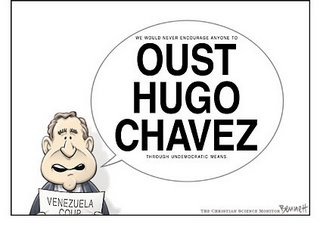
The World Bank and IMF are not exactly the most popular institutions in the minds of developing nations. Rather than being seen as welfare financial institutions, they are increasingly being perceived as Shylock styled-creditors out to extract their pound of flesh. Nobel Laureate and former Chief Economist at the World Bank, Joseph Stiglitz, says one of the main problems with IMF is that it believes in a one-stop shop treatment for all economic problems facing the world and blasts it for being every bit as secretive, undemocratic and indifferent to the poor as its critics claimed.
All that the IMF seems to be bothered is fiscal deficit management through decreased govt. spending on social programmes, greater privatization and facilitation of international trade, irrespective of the problem. They conveniently forget that any such kind of reduced government spending affects the poor the most. UN estimates say that Latin America has the most unequal wealth distribution of any region in the world, despite religiously sticking to the prescriptions given by the IMF and World Bank. This kind of increased intolerance to the local needs has led to countries veering away from these institutions.
Argentina, under Nestor Kirchner, has recovered remarkably after its economic collapse in 2001 by greater public investment, hard bargaining with private creditors and has gone to the extent of prepaying its entire debt to the IMF by borrowing from Venezuela, to free itself from the IMFs clutches.
Under pressure from the World Bank, the Bolivian government in 2000 sold off Cochabamba's (its third largest city) public water system to Bechtel subsidiary Aguas Del Tunari. Within weeks of taking control of the city's water, Bechtel hit poor families with huge increases in their water bills, enough to spark a popular rebellion and chase Bechtel out of the country. This was followed by another controversial deal in 2003 where the country’s natural gas was sold off to California through a private consortium, Pacific LNG, at a pittance. The great civil conflict that arose because of this led to the resigntion of two Presidents and eventually the nationalization of all gas reserves in Bolivia in May 2006.
All these changes have seen a dramatic shift in world politics, currently dwarfed by the events in Middle East and parts of Asia. Countries like Argentina, Brazil, Venezuela and others are working together to foster a spirit of Latin American unity to fight the might of US and other global financial powerhouses. The focus is moving to the state and people determining the economic policies being framed rather than being dictated by colonial powers and private lobby houses which have their own vested interests.
There will always be conflicts when corporations try to use their clout and lobbying power to bag contracts heavily skewed in their favour and neglect the needs of the local population. The resultant exploitation of local conditions for greater profit making will eventually lead to a backlash against the company. Closer back home, Coca-Cola signed a deal with the Kerala Government to extract water at very low prices. The result was depletion and contamination of ground water in Plachimada in Palakkad District; so while agriculture suffered due to paucity of water, Coke was making heavy profits by selling at about 10 Rs per bottle. Hopefully, we would learn from the Latin American countries and standing up for the rights of our people.
Will this movement change the way the world moves? Can problems of poverty and malnourishment be solved by these countries by giving a human face to economic reforms or is this an aberration driven by a few leaders? Only time will tell but this is a transition we must observe carefully and it has wide repercussions in the global balance of power. As Atila Roque, Executive Director of ActionAid USA, says, “Democracy must go beyond elections of the President and Parliament. Democracy is the freedom to make innovative economic decisions that will improve people’s lives”.
As I began writing this article, news came in that Ecuador has also elected a Leftist Government led by economist Rafel Correa. One more state down.......
An attempt for an alternate economic and political vision is emerging in the fields of Latin America. A vision which has contempt for American policies, IMF and World Bank strategies is gaining ground and it’s an exciting movement, fostered by the grassroots and people’s movements rather than corporate lobbying. The definition of Leftism, of course, varies from country to country. It probably makes sense to look at this trend not as a Left vs Right issue but as a shift away from a more capitalistic stand, characterized by elitist policies, to an economics dipped in socialism, driven by pro-poor concerns.
Fidel Castro, the old friend of the Yankees, has been its torch bearer for several decades now and has survived more than 50 odd assassination attempts, sponsored by the CIA. But as he grows old, Venezuelan President Hugo Chavez has taken over his role as the flag bearer of an alternate economic order, which is different from those dreamt at the corridors of global financial powerhouses. But what has caused this to happen?
The US pumps in a lot of effort and time in promoting US-friendly “democracies” by doling out funds liberally or through coercion (as in Iraq). But the last few years have seen it putting a lot of its energies into tackling Middle East issues. Osama, Saddam and Islamic states, being in the US radar, has meant that Latin America has not been prioritized by them (except for its paranoia towards Chavez). This has resulted in the creation of many groups in Latin America, formed by small farmers, human rights activists, and trade unionists etc. who have a fundamentally different agenda as compared to the industrialized nations - an agenda dictated by local people rather than MNCs.
Moreover, the failure of the US administration policies in fighting drugs and expanding free market reforms have provided further impetus to this. The US administration’s controversial coca eradication strategy, to eliminate the cultivation of coca, as part of its “War on Drugs” policy has alienated people in coca growing areas like Peru, Bolivia and Columbia and the rise of Evo Morales in Bolivia (its first democratically elected indigenous head of state), who is essentially a coca farmer, is testimony to this.
There’s a general disillusionment with the way US has gone about using institutions like World Bank and IMF to further its economic and political interests. More than 30 years back, General Augusto Pinochet overthrew the elected President of Chile, Marxist Salvador Allende, in a bloody coup, covertly backed by the CIA because it would be a blow to Washington's international prestige if an avowed Marxist won a fair presidential election in South America. He held power for the next 17 years, relinquishing control in 1990 only after arranging immunity for himself and his top generals.
The Bush administration’s animosity towards Hugo Chavez (and the other way around) is quite well known. While US uses all opportunities to paint him as “anti-democratic” (despite winning 2 democratic elections) and uses this as an excuse to foment hatred for him, the world sees it clearly as a combustible conflict being fuelled by America’s vulnerability over Venezuela’s massive oil reserves. It's an open secret that there have been behind the screen attempts by US to rock the Chavez boat, though denied repeatedly by the administration.

The World Bank and IMF are not exactly the most popular institutions in the minds of developing nations. Rather than being seen as welfare financial institutions, they are increasingly being perceived as Shylock styled-creditors out to extract their pound of flesh. Nobel Laureate and former Chief Economist at the World Bank, Joseph Stiglitz, says one of the main problems with IMF is that it believes in a one-stop shop treatment for all economic problems facing the world and blasts it for being every bit as secretive, undemocratic and indifferent to the poor as its critics claimed.
All that the IMF seems to be bothered is fiscal deficit management through decreased govt. spending on social programmes, greater privatization and facilitation of international trade, irrespective of the problem. They conveniently forget that any such kind of reduced government spending affects the poor the most. UN estimates say that Latin America has the most unequal wealth distribution of any region in the world, despite religiously sticking to the prescriptions given by the IMF and World Bank. This kind of increased intolerance to the local needs has led to countries veering away from these institutions.
Argentina, under Nestor Kirchner, has recovered remarkably after its economic collapse in 2001 by greater public investment, hard bargaining with private creditors and has gone to the extent of prepaying its entire debt to the IMF by borrowing from Venezuela, to free itself from the IMFs clutches.
Under pressure from the World Bank, the Bolivian government in 2000 sold off Cochabamba's (its third largest city) public water system to Bechtel subsidiary Aguas Del Tunari. Within weeks of taking control of the city's water, Bechtel hit poor families with huge increases in their water bills, enough to spark a popular rebellion and chase Bechtel out of the country. This was followed by another controversial deal in 2003 where the country’s natural gas was sold off to California through a private consortium, Pacific LNG, at a pittance. The great civil conflict that arose because of this led to the resigntion of two Presidents and eventually the nationalization of all gas reserves in Bolivia in May 2006.
All these changes have seen a dramatic shift in world politics, currently dwarfed by the events in Middle East and parts of Asia. Countries like Argentina, Brazil, Venezuela and others are working together to foster a spirit of Latin American unity to fight the might of US and other global financial powerhouses. The focus is moving to the state and people determining the economic policies being framed rather than being dictated by colonial powers and private lobby houses which have their own vested interests.
There will always be conflicts when corporations try to use their clout and lobbying power to bag contracts heavily skewed in their favour and neglect the needs of the local population. The resultant exploitation of local conditions for greater profit making will eventually lead to a backlash against the company. Closer back home, Coca-Cola signed a deal with the Kerala Government to extract water at very low prices. The result was depletion and contamination of ground water in Plachimada in Palakkad District; so while agriculture suffered due to paucity of water, Coke was making heavy profits by selling at about 10 Rs per bottle. Hopefully, we would learn from the Latin American countries and standing up for the rights of our people.
Will this movement change the way the world moves? Can problems of poverty and malnourishment be solved by these countries by giving a human face to economic reforms or is this an aberration driven by a few leaders? Only time will tell but this is a transition we must observe carefully and it has wide repercussions in the global balance of power. As Atila Roque, Executive Director of ActionAid USA, says, “Democracy must go beyond elections of the President and Parliament. Democracy is the freedom to make innovative economic decisions that will improve people’s lives”.
As I began writing this article, news came in that Ecuador has also elected a Leftist Government led by economist Rafel Correa. One more state down.......
Friday, November 24, 2006
Riding the Chinese Dragon

A few days back I watched Karan Thapar’s show “India Tonight” on CNBC-TV 18 which discussed Indo-China relations and the presence of Tibet in our “cold” relationship. It set me thinking as to why despite all this hype about our catching up with China’s economic growth, we act like a “banana republic” ( that maybe harsh but that's a more emotional statement) in our foreign and political affairs. The two most crowded countries in the world cannot sit across the table as equals because we act in such a subservient fashion with the Chinese.
China’s supreme dictator. Hu Jintao, recently stepped on the Indian shores and a few days before that, we heard not-so subtle statements, emanating from Beijing, on Arunachal Pradesh and Tibet. And what is our response? We issue a press statement reiterating that Arunachal is an integral part of India but do not even reprimand the Chinese ambassador, Sun Yuxi, who told Indian television last week: "The whole of what you call the state of Arunachal Pradesh is Chinese territory, and Tawang is only one place in it, and we are claiming all of that." How diplomatic can an ambassador get and how pacifist can we be?
The position of Tawang, on the flanks of the Tibetan plateau, and its cultural affinity to Lhasa are at the root of a decades-old dispute between India and China. Historically, China says, the region was part of outer Tibet. Today it is part of the Indian state of Arunachal Pradesh - but China lays claim to it in its entirety.
India's Foreign Minister tersely responded by reiterating that Arunachal Pradesh was an "integral part of India". The Chinese say that Tawang is a part of Tibet and since Tibet belongs to them, by extension of that logic, they have control over the place. Thousands of monks stay there as they try to sustain its unique culture from being marauded by imperialistic designs of Mainland China.
One of the primary tenets of democracy is the right to dissent peacefully but democratic India decided, last week, that this is dispensable. First, the police ordered Friends of Tibet activist, Tenzin Tsundue, to stay put in Dharamsala until Hu Jintao returned to Beijing. Then, the police asked Tibetan exiles to stay away from the city centre, fearing them to be a security threat - “Atithi Satkar” of the highest level that will surely make the Chinese happy.
Not only has the Indian Govt. accepted the Chinese claim of recognizing Tibet as a part of China, but it is also bending backwards to make them feel at home. Should a democracy like ours stoop to such levels to curb the rights of civil society, from protesting against Chinese aggression? Just imagine - I can protest against Manmohan Singh and Co. in New Delhi but not against Hu and his mandarins.
Our foreign policy follows a simple policy of status quo. Therefore, we neither do anything remotely out of the box nor stand up for anything (WTO was an exception) for fear of ruffling feathers. This does not bode well for a country standing on the threshold of world leadership and desiring to stand up for developing nations.
When ex-Defence minister, George Fernandes, proclaimed China as India’s “Enemy No. 1” a few years back, he was echoing the truth. But he was pilloried for raising the China bogey unnecessarily (India Today’s headline was “George in the China Shop”). While Beijing goes about wooing Africa and the rest of the world, building rail links with Tibet, supplying arms to Pakistan and fanning anti-India sentiments in Burma and Bangladesh, the Indian polity rests in peace, unaware of the changing geo-political realities that are dictating various foreign policies world-wide. We have no policy on Kashmir even after all these years, no idea how to tackle Bangladesh population infiltration and a total ignorance on the problems in the North-East.
Our home grown communists’ romance with China, however, continues despite all these “friendly overtures” by China. They are quick to pounce upon any human right violations of the rest of the world but silent when it comes to the Chinese. Our comrades refuse to break from the umbilical cord joining them to China, though there has not been any reciprocation of such interests from the other side. Wonder what Comrade VS and Comrade Hu have in common? Beijing has shed all pretensions of Marxism and gone capitalistic in a big way but messers Raja and Yechury continue to go gung-ho about communism.
Despite all their evident economic progress, China has a morally bankrupt leadership. It has built its wealth on the altar of thousands of coffins, without shedding tears for any of them. It is among the fastest growing economies but is also the world leader in death penalties with a conviction record of about 99%.A country that is so heartless that it steamrolls tanks to mow down thousands of its students, when they protest, cannot bring peace in the world.
I found this article in the Amnesty International Site (dated May 2003) which mentions that in an effort to improve cost-efficiency, Chinese provincial authorities have introduced mobile execution vans and the article goes on to give the advantages of this system over general execution systems!!! Economies of scale in mass murder!!! It would have been funny if it were just not so tragic and perverse.
It’s not just India but the entire world that stops shy of dictating terms to them. In business circles, Walmart, the world’s largest company, had to bow down to official dictates in China and allow the creation of trade unions there (their only trade union in the world). Google, the champion of free information, had to submit itself to censorship and remodel itself to survive in China.
Despite the Dalai Lama’s popularity and the entry of celebrities espousing the cause of Tibet, the movement is losing its steam and His Holiness has himself toned down his demand from “independence” to “autonomy” for the region. Its human rights violations may hog headlines occasionally but it has not stopped the Chinese juggernaut from rolling and crushing all its detractors on its way to capitalistic freedom.
Hu’s next stop is Pakistan where he’s expected to further the nuclear relations between the two countries by announcing the sale of nuclear reactors to them. The West knows this but remains a passive spectator while continuing to urge India to maintain restraint (as if we needed someone to say that). The American electorate did to Bush what the Iraqis could not but who will stop the Communist Party of China's hegemonistic plans???
Wonder if I am a bit too paranoid about the entire thing. The Chinese have a strong leadership unlike us and so I fear they may succeed. God forbids that this will be emulated else where as a workable administration model....
China’s supreme dictator. Hu Jintao, recently stepped on the Indian shores and a few days before that, we heard not-so subtle statements, emanating from Beijing, on Arunachal Pradesh and Tibet. And what is our response? We issue a press statement reiterating that Arunachal is an integral part of India but do not even reprimand the Chinese ambassador, Sun Yuxi, who told Indian television last week: "The whole of what you call the state of Arunachal Pradesh is Chinese territory, and Tawang is only one place in it, and we are claiming all of that." How diplomatic can an ambassador get and how pacifist can we be?
The position of Tawang, on the flanks of the Tibetan plateau, and its cultural affinity to Lhasa are at the root of a decades-old dispute between India and China. Historically, China says, the region was part of outer Tibet. Today it is part of the Indian state of Arunachal Pradesh - but China lays claim to it in its entirety.
India's Foreign Minister tersely responded by reiterating that Arunachal Pradesh was an "integral part of India". The Chinese say that Tawang is a part of Tibet and since Tibet belongs to them, by extension of that logic, they have control over the place. Thousands of monks stay there as they try to sustain its unique culture from being marauded by imperialistic designs of Mainland China.
One of the primary tenets of democracy is the right to dissent peacefully but democratic India decided, last week, that this is dispensable. First, the police ordered Friends of Tibet activist, Tenzin Tsundue, to stay put in Dharamsala until Hu Jintao returned to Beijing. Then, the police asked Tibetan exiles to stay away from the city centre, fearing them to be a security threat - “Atithi Satkar” of the highest level that will surely make the Chinese happy.
Not only has the Indian Govt. accepted the Chinese claim of recognizing Tibet as a part of China, but it is also bending backwards to make them feel at home. Should a democracy like ours stoop to such levels to curb the rights of civil society, from protesting against Chinese aggression? Just imagine - I can protest against Manmohan Singh and Co. in New Delhi but not against Hu and his mandarins.
Our foreign policy follows a simple policy of status quo. Therefore, we neither do anything remotely out of the box nor stand up for anything (WTO was an exception) for fear of ruffling feathers. This does not bode well for a country standing on the threshold of world leadership and desiring to stand up for developing nations.
When ex-Defence minister, George Fernandes, proclaimed China as India’s “Enemy No. 1” a few years back, he was echoing the truth. But he was pilloried for raising the China bogey unnecessarily (India Today’s headline was “George in the China Shop”). While Beijing goes about wooing Africa and the rest of the world, building rail links with Tibet, supplying arms to Pakistan and fanning anti-India sentiments in Burma and Bangladesh, the Indian polity rests in peace, unaware of the changing geo-political realities that are dictating various foreign policies world-wide. We have no policy on Kashmir even after all these years, no idea how to tackle Bangladesh population infiltration and a total ignorance on the problems in the North-East.
Our home grown communists’ romance with China, however, continues despite all these “friendly overtures” by China. They are quick to pounce upon any human right violations of the rest of the world but silent when it comes to the Chinese. Our comrades refuse to break from the umbilical cord joining them to China, though there has not been any reciprocation of such interests from the other side. Wonder what Comrade VS and Comrade Hu have in common? Beijing has shed all pretensions of Marxism and gone capitalistic in a big way but messers Raja and Yechury continue to go gung-ho about communism.
Despite all their evident economic progress, China has a morally bankrupt leadership. It has built its wealth on the altar of thousands of coffins, without shedding tears for any of them. It is among the fastest growing economies but is also the world leader in death penalties with a conviction record of about 99%.A country that is so heartless that it steamrolls tanks to mow down thousands of its students, when they protest, cannot bring peace in the world.
I found this article in the Amnesty International Site (dated May 2003) which mentions that in an effort to improve cost-efficiency, Chinese provincial authorities have introduced mobile execution vans and the article goes on to give the advantages of this system over general execution systems!!! Economies of scale in mass murder!!! It would have been funny if it were just not so tragic and perverse.
It’s not just India but the entire world that stops shy of dictating terms to them. In business circles, Walmart, the world’s largest company, had to bow down to official dictates in China and allow the creation of trade unions there (their only trade union in the world). Google, the champion of free information, had to submit itself to censorship and remodel itself to survive in China.
Despite the Dalai Lama’s popularity and the entry of celebrities espousing the cause of Tibet, the movement is losing its steam and His Holiness has himself toned down his demand from “independence” to “autonomy” for the region. Its human rights violations may hog headlines occasionally but it has not stopped the Chinese juggernaut from rolling and crushing all its detractors on its way to capitalistic freedom.
Hu’s next stop is Pakistan where he’s expected to further the nuclear relations between the two countries by announcing the sale of nuclear reactors to them. The West knows this but remains a passive spectator while continuing to urge India to maintain restraint (as if we needed someone to say that). The American electorate did to Bush what the Iraqis could not but who will stop the Communist Party of China's hegemonistic plans???
Wonder if I am a bit too paranoid about the entire thing. The Chinese have a strong leadership unlike us and so I fear they may succeed. God forbids that this will be emulated else where as a workable administration model....
Friday, November 17, 2006
The Fourth Estate Trials
Sometimes, real TV can be so much more thrilling and entertaining than “Reality TV”. So, forget Rakhi Sawant’s attempts to milk a bovine and watch Ram Jethmalani’s performance on CNN-IBN as he makes mincemeat of a hapless Sagarika Ghose during a Jessica Lal case interview. He raves, rants and goes berserk in a no holds barred performance which would do any octogenarian proud and get him to replace Big B as the “Angry Old Man”. Though he is known to be a controversial lawyer and a rabble-rouser, this time, his outburst attracted a fair deal of publicity, especially among the blogging and journo world (Who else would discuss?)
Ram Jethmalani, in the course of the interview, raised a few pertinent points, albeit in his own inimitable whiplash style. He pounced upon Sagarika’s lack of legal know-how and ridiculed her claim of going against public opinion. He also blasted the media for passing pro-active judgments and undermining the judiciary.
We all, probably, believe that Manu Sharma deserves to be punished but can we advocate that he does not deserve the best defence available because of our opinion. Whether he should stand for the accused or not is his prerogative and not the press’s. The strength of the Indian judicial system is in its ability to provide a free and fair trial to both the accused and the victim and not discriminate on the basis of “informed” public opinion.
The now forgotten ISRO spy scandal represents in many ways the worst example of a case that was created and sustained by an overzealous media. What started of as an innocuous arrest of a Maldivian woman, Mariam Rasheeda, went on to become the biggest spy scandal in the history of independent India. The media (especially the vernacular one) in association with the police and political class weaved a thriller script, adding dollops of sex, money and flesh to make it a scandalous affair. A few top scientists, an IPS officer and few others were implicated without any iota of evidence until the case was eventually handed over to the CBI.
After its report and the subsequent Supreme Court judgment, the matter was finally laid to rest and everyone was acquitted. But the tattered reputations and the mental agony of the people involved can never be restored. No one has ever apologized to the people whose dignity was stripped in the public and all this from the “educated free press of Kerala”.
Remember the arrest of His Holiness Jayendra Saraswathi, where the press hauled his reputation across the coals without any evidence at all to support the accusations hurled upon him. He was accused of being a womanizer, a corrupt god man and so much more that would have put any self-respecting man to shame. While the Tamil Nadu Government was vindictive about the entire affair, the scribes went all the way exhibiting their “secularism” by making a villain out of him. Can you imagine the Pope being subject to such abuse? And where’s the case now? The Andhra Pradesh High Court had remarked in its judgment that there is no prima facie evidence against the accused despite malicious attempts by the press and the Tamil Nadu Government to do so. The press continues to be silent about this.
Of course, it’s no one’s case that the Indian press plays only a “super-judicious” role in our democracy. For years the media snuggled upto the State and ignored its primary role. After the Emergency, L K Advani had famously told journalists “You were asked to bend and you chose to crawl”. But times have changed and a free global economic order has also seen the media get down and ask questions – some relevant and some which were hitherto considered as too sacred to touch.
The Jessica Lal, Priyadarshini Mattoo and Manjunath cases are there in the judicial space thanks to the active role of the media in bringing these issues to the public domain. A running democracy requires an active press that highlights issues and brings to focus all things hidden from public view. In fact, Amartya Sen says that a Free Press can play an important role in the mitigation of natural disasters by their active reporting. The RTI Act was not amended largely due to the role played by the media in highlighting the government’s intentions and attempts in sabotaging the law.
But what happens when the press decides to arrogate many of the State’s powers to itself. Many of us fed on a regular diet of news bytes do not question them and go by what is told to us by news anchors. We all know that there’s a thin line between bringing out an exclusive story and playing to the gallery. With so many channels fighting it out in the broadcasting and newsprint domain, there is always a temptation to go one up for exclusive “breaking news” at the expense of genuine news. Like various blogs, each channel carries its own subjective interpretation of facts and the casualty is the veracity of the news item. While everyone wants a well-researched story, what do you do in case it’s too tiresome to do so? Probably come up with “confidential leaks” or “reliable sources” and present it as “Flash News”.
The horrendous massacre of Dalits in Kherlanji went unreported for about a month till they took to the streets and lead massive protests in Nagpur. Is it that their stories do not carry the same shock value or they are not worth reporting? Sanjay Dutt has been accused of a very serious crime like possession of weapons but he gets a lot of sympathy in the media – recollect his visit to the Siddhi Vinayak temple and his “reformed” existence- but there are many others like Prof. Geelani (represented by Ram Jethmalani in the Supreme Court) who are subjected to the piercing eyes of media because they represent “no one”.
A vibrant democracy requires the media to act as a watchdog for the 3 legs of policy in India – the executive, the legislature and the judiciary. But it is tempting for the Fourth Estate to go overboard and try to dictate terms because of the unbridled power it has. This restraint is difficult to come by because at the end of the day, it is not answerable to anyone except maybe its shareholders. In defence of the press community, it must be stressed that is not enough to be fair but also important to appear to be fair, which is where many of our journalists have failed. Journalism should not be treated as an exercise in blogging where any smart alec who has an opinion (like me) decides to express it without checking out the facts of the case.
Tail piece: The sadistic streak in me enjoyed the Ram Jethmalani interview despite his haughty behaviour. I recommend it to people to watch it and judge for themselves the “entertainment” value in it, especially those tired of “Big Boss” antics.
Also watch the video of Ram Jethmalani's interview conducted by Karan Thapar in CNBC-TV 18 posted on Nov 19th for another slice of the action. The action never stops!!!
Ram Jethmalani, in the course of the interview, raised a few pertinent points, albeit in his own inimitable whiplash style. He pounced upon Sagarika’s lack of legal know-how and ridiculed her claim of going against public opinion. He also blasted the media for passing pro-active judgments and undermining the judiciary.
We all, probably, believe that Manu Sharma deserves to be punished but can we advocate that he does not deserve the best defence available because of our opinion. Whether he should stand for the accused or not is his prerogative and not the press’s. The strength of the Indian judicial system is in its ability to provide a free and fair trial to both the accused and the victim and not discriminate on the basis of “informed” public opinion.
The now forgotten ISRO spy scandal represents in many ways the worst example of a case that was created and sustained by an overzealous media. What started of as an innocuous arrest of a Maldivian woman, Mariam Rasheeda, went on to become the biggest spy scandal in the history of independent India. The media (especially the vernacular one) in association with the police and political class weaved a thriller script, adding dollops of sex, money and flesh to make it a scandalous affair. A few top scientists, an IPS officer and few others were implicated without any iota of evidence until the case was eventually handed over to the CBI.
After its report and the subsequent Supreme Court judgment, the matter was finally laid to rest and everyone was acquitted. But the tattered reputations and the mental agony of the people involved can never be restored. No one has ever apologized to the people whose dignity was stripped in the public and all this from the “educated free press of Kerala”.
Remember the arrest of His Holiness Jayendra Saraswathi, where the press hauled his reputation across the coals without any evidence at all to support the accusations hurled upon him. He was accused of being a womanizer, a corrupt god man and so much more that would have put any self-respecting man to shame. While the Tamil Nadu Government was vindictive about the entire affair, the scribes went all the way exhibiting their “secularism” by making a villain out of him. Can you imagine the Pope being subject to such abuse? And where’s the case now? The Andhra Pradesh High Court had remarked in its judgment that there is no prima facie evidence against the accused despite malicious attempts by the press and the Tamil Nadu Government to do so. The press continues to be silent about this.
Of course, it’s no one’s case that the Indian press plays only a “super-judicious” role in our democracy. For years the media snuggled upto the State and ignored its primary role. After the Emergency, L K Advani had famously told journalists “You were asked to bend and you chose to crawl”. But times have changed and a free global economic order has also seen the media get down and ask questions – some relevant and some which were hitherto considered as too sacred to touch.
The Jessica Lal, Priyadarshini Mattoo and Manjunath cases are there in the judicial space thanks to the active role of the media in bringing these issues to the public domain. A running democracy requires an active press that highlights issues and brings to focus all things hidden from public view. In fact, Amartya Sen says that a Free Press can play an important role in the mitigation of natural disasters by their active reporting. The RTI Act was not amended largely due to the role played by the media in highlighting the government’s intentions and attempts in sabotaging the law.
But what happens when the press decides to arrogate many of the State’s powers to itself. Many of us fed on a regular diet of news bytes do not question them and go by what is told to us by news anchors. We all know that there’s a thin line between bringing out an exclusive story and playing to the gallery. With so many channels fighting it out in the broadcasting and newsprint domain, there is always a temptation to go one up for exclusive “breaking news” at the expense of genuine news. Like various blogs, each channel carries its own subjective interpretation of facts and the casualty is the veracity of the news item. While everyone wants a well-researched story, what do you do in case it’s too tiresome to do so? Probably come up with “confidential leaks” or “reliable sources” and present it as “Flash News”.
The horrendous massacre of Dalits in Kherlanji went unreported for about a month till they took to the streets and lead massive protests in Nagpur. Is it that their stories do not carry the same shock value or they are not worth reporting? Sanjay Dutt has been accused of a very serious crime like possession of weapons but he gets a lot of sympathy in the media – recollect his visit to the Siddhi Vinayak temple and his “reformed” existence- but there are many others like Prof. Geelani (represented by Ram Jethmalani in the Supreme Court) who are subjected to the piercing eyes of media because they represent “no one”.
A vibrant democracy requires the media to act as a watchdog for the 3 legs of policy in India – the executive, the legislature and the judiciary. But it is tempting for the Fourth Estate to go overboard and try to dictate terms because of the unbridled power it has. This restraint is difficult to come by because at the end of the day, it is not answerable to anyone except maybe its shareholders. In defence of the press community, it must be stressed that is not enough to be fair but also important to appear to be fair, which is where many of our journalists have failed. Journalism should not be treated as an exercise in blogging where any smart alec who has an opinion (like me) decides to express it without checking out the facts of the case.
Tail piece: The sadistic streak in me enjoyed the Ram Jethmalani interview despite his haughty behaviour. I recommend it to people to watch it and judge for themselves the “entertainment” value in it, especially those tired of “Big Boss” antics.
Also watch the video of Ram Jethmalani's interview conducted by Karan Thapar in CNBC-TV 18 posted on Nov 19th for another slice of the action. The action never stops!!!
Friday, November 10, 2006
To Hang or not to Hang???
 A young lawyer from Delhi, a Kashmiri militant and an Iraqi leader – nothing in common among themselves until very recently but now their fates are linked by the Hangman’s noose and a slender ray of hope. All of them have been convicted of different kinds of crimes and sentenced to the gallows. The circumstances relating to their punishment and their crime is quite different but most people agree with the verdicts decided in all the three cases ;what is not consensual is the sentence which has been given. These sentences have once again brought into focus the debate on capital punishments.
Afzal Guru, the militant, has been sentenced to death for his role in the attack on the Indian Parliament – an attack which not only disturbed the Indo-Pak peace talks (arguably) but also struck at the centre of India’s authority. It is a crime that we all agree deserves to be punished and other than his immediate family and supporters, there are no takers on his innocence (that aspect is of course beyond the scope of this post). Afzal has himself not asked for mercy; it is only the human rights groups have asked for clemency (wrongly reported in parts of the press as seeking pardon).
Santosh Singh, currently a lawyer in Delhi, had been stalking a young girl Priyadarshini Matoo for a long time before he finally raped and killed her. He was acquitted by a Sessions Court Judge saying that though he knows he’s guilty he cannot be punished due to the lack of evidence produced by the police and prosecution. The media uproar and the subsequent public outcry lead to the case being reopened at the higher court where he has now been convicted. He has been awarded “death penalty” for a crime which does not fit into the “rarest of cases”.
Saddam Hussain faced trial for his role in the slaughter of Shiites in 1982 in Dujail, in retaliation for the failed assassination attempt on him. The case was dogged by controversies right from the beginning. Two of Saddam’s lawyers were killed while the first judge quit. He was not given enough time and space to prepare his defence. Ironically, the conviction would have been welcomed had it followed proper legal and moral protocols and been conducted under the auspices of an international tribunal. The timing of the verdict – just before the Senate polls – and the judge’s conspicuous animosity towards the accused has also raised questions on the fairness of the trial.
The vast majority of democratic countries in Europe and Latin America have abolished capital punishment over the last fifty years, but United States, most democracies in Asia, and almost all totalitarian governments retain it. As per Amnesty International's latest figures, a total of 129 countries (including Canada, Mexico, Australia, Russia, South American nations and most European nations) have abolished the death penalty in law or practice. Of these, 88 countries and territories have abolished the death penalty for all crimes, 11 countries have abolished the death penalty for all but exceptional crimes (such as wartime crimes) and 30 countries can be considered abolitionist in practice, i.e., they retain the death penalty in law but have not carried out any executions for the past ten years or more and are believed to have a policy or established practice of not carrying out executions. Though 68 countries retain and use the death penalty, the number of countries which actually execute prisoners in any one-year is much smaller. In 2005, 94 percent of all known executions took place in China, Iran, the USA and Saudi Arabia (US and Iran on the same stage, interesting, right?)
Beyond the statistics, we need to ask ourselves what is the purpose of the death penalty?
--Is it to remove from society someone who would cause more harm?
-- Is it to remove from society someone who is incapable of rehabilitation?
-- Is it to deter others from committing murder?
-- Is it to punish the criminal?
-- Is it to take retribution on behalf of the victim?
Death is not merely a legal undertaking but has a strong social, religious and moral angle to it. It is not just priests or saints who look at birth and death as God’s handiwork; many of us also do so. There is also a strong religious notion that the act of suffering has a purifying effect on the human spirit allowing for salvation in God. The concept of death as a retribution for the sins committed is slowly losing ground. It has been argued that the person must be given an opportunity to repent for his sins and so death cannot be the way out. Is the idea behind a punishment to reform the person or to set an example in the society? Probably both and we need a more humane solution.
Death penalty supporters argue that it is a powerful deterrent to crime but there are no statistics to support this assertion. If death penalty were a proper deterrent, there would have been a reduction in crimes in such places and eventually their number would die out because the crime rate would have fallen to such an extent. On the contrary, these penalties seem to be on a rise in several countries, undermining the very rationale given for it. Death penalty sentences in India have been on the rise lately compared to the almost non-existent cases in the 60s and 70s. These are supposed to be given in the rarest of cases as per the Supreme Court ruling in 1983 but there’s a danger of the judiciary becoming “trigger free” in handing out capital punishments, especially under greater media glare (The Santosh Singh case is a clear example of that). Moreover, terrorist crimes, serial killer crimes or crimes of passion are not dictated by pure logic, so the rationale of using death as a deterrent does not work.
The next argument is one of infallibility of judgment and the irrevocability of the death sentence. The Liebman Report in 2000, concluding a 23-year study conducted by Columbia University, USA, found that 68% of all death sentences awarded were reversed due to serious legal error. In countries like India where the judiciary is over-burdened and cases drag on for years, would it be a surprise if the number of judicial errors is high. If a person is executed because of miscarriage of justice which is subsequently discovered the extinguished life cannot be restored. An innocent life lost due to callousness on the part of the law would be too heavy a price to pay.
Finally, at a slightly more emotional level, just think about the executioner who has to carry out the death penalty. It’s a profession which caries with itself the social stigma of killing someone but there are people who have to carry out this task. Leaders may take decisions but the final blood is in the hands of the executioner who has to act on behalf of the State. I strongly recommend readers to read Shashi Warrier’s soulful book “Hangman’s Journal” in which he brilliantly chronicles the agony that a hangman goes through when he has to carry out an execution. Similarly, Adoor Gopalakrishnan explores this theme in his movie “Nizhalkuthu”. In the words of Adoor, “The Hangman is conventionally considered to be one with no fine feelings. The public does not expect him to behave like a human being, the law wants him to be neutral, the State sees him just as an instrument of its operation.”
Should a civilized society use death as a tool to counter crime? It is arguable and when you consider the plight and sorrow of the victims, it is difficult to advocate the abolition of death penalty. It is an emotional issue but law must take a firm stance on this. In the Indian context, we could look at increasing the tenure of the life imprisonment since 12-14 years may seem on the lower side for extremely heinous crimes. The media must also be careful in its coverage of events. Repeatedly bombarding visuals of the crime and upping the ante for action can lead to public pressures on judiciary to hand out “populist” verdicts.
Is the Right to Life absolute? I certainly think so but then if I were to put myself in the shoes of Priyadarshini Matto’s father, would I feel the same??? Maybe yes or maybe no….
Subscribe to:
Posts (Atom)