Sitemeter

Friday, September 29, 2006

Singapore Diary - Part 1

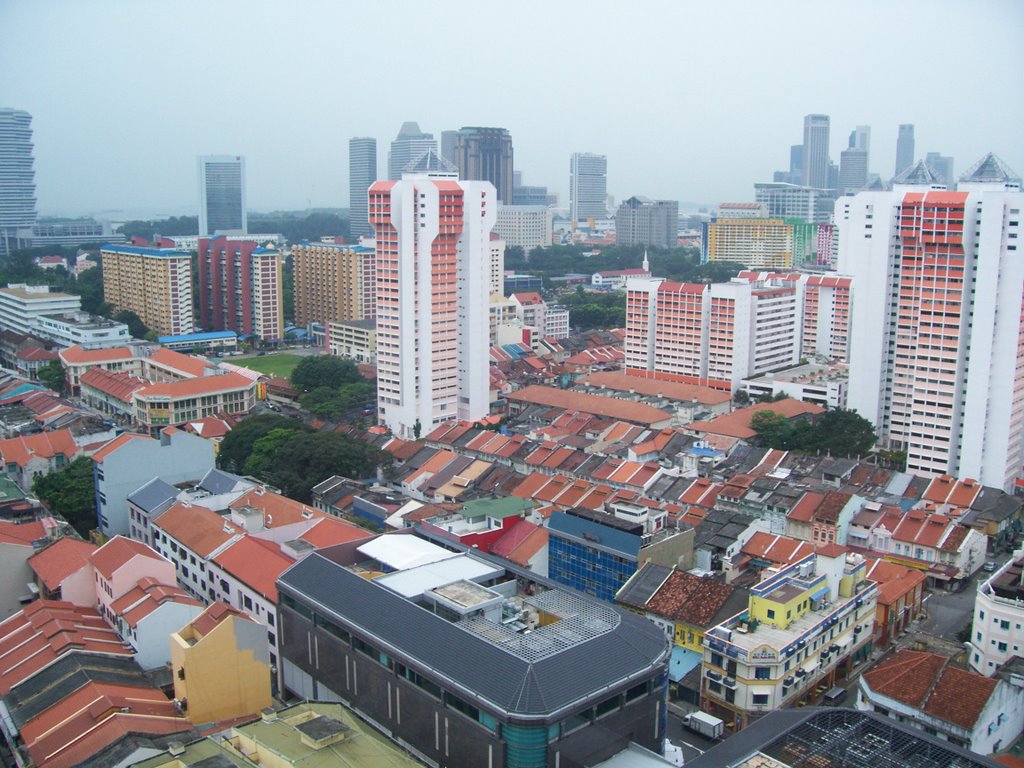
(The view from my hotel room)

I am taking a brief hiatus from my general blogging to venture into personal terrain, during my brief stay in Singapore. To be honest, I am not very keen on spending money and travelling abroad but if your employer wants to show you the world, can you say no? And so here I am jotting down my thoughts in the tiny island of Singapore- lost and confused as usual.

I reach the shores of Singapore, after a few weeks of visa related delays, at about 6:30 (4 AM IST) in the morning, with about 4 hours of sleep in Singapore Airlines. The Airlines is quite comfortable and I am escorted across without too many security checks, unlike how I had imagined it would be. I step out hesitatingly out of the plane(my confidence is always at a premium in a new environment)and bump into an old acquaintance who clearly knows the place and guides me across to the foreign exchange counter and subsequently to the taxi stand.

The taxi driver is a jolly man and gives me his visiting card, in case I wish to go for city darshan (I did not have a visiting card myself, how offending!!!). Anyway, he drops me off at New Park Hotel which is at a place called Little India. After a few hours of rest, I am summoned to office to meet my boss for the first time. And in the evening, I’m back to the hotel in the local train (they it call it MRT here). I stay next to a mall kind of place called Mustafa which has everything under the sun available.

I am glad to find that the place is inundated with Indians, especially from the south. My food is happily taken care of and I hear Tamil words wafting across the place. The Mallu in me, however, searches for a Kerala connection but I do not find any. Is the stereotyped Nair chai kada (tea stall) or thattu kada (roadside stall) just a figment of someone’s fertile imagination?

Singapore is full of streets and alleys. Every road/ street I see carries a name -something very important for us to learn; I often why India does not have proper signboards and notices everywhere rather than leaving us to the mercy of the public. Nevertheless, I lose track of my hotel briefly before relocating it after some local help (speaks volumes about my sense of direction, I guess).

The transportation scene is good with trains being the main system in this small country. The local train travel is pretty comfortable and I am at ease on the first day itself. It is similar to Mumbai with three different tracks operating through the city but there ends the similarity. The train has automatic doors; is well lit and is an indoor travel for most of the journey. The arrival of the stations is announced and displayed both in English and Tamil. If only Mumbai tried to emulate a few of these things…..But Delhites have told me that the MRT there is equally good.I assume it is but I cannot vouch for it...

Taxis are prevalent but difficult to get after about 8 pm, except of course if you call their service and book a taxi. The taxis are fairly hi-tech in the sense that they accept cards, provide bills and are connected to the local network through an interactive device always. A couple of nights back, I am given a small treatise on the call girls industry in Singapore by a friendly cab driver who wonders why India does not legalize this profession as in Singapore or Thailand.

I also learn that call girls here carry yellow employment passes and that this industry contributes about 2% of the GDP in Thailand. Wow, maybe they should think about starting a few SEZs- Special Entertainment Zones- then ? That's the in thing; ask Kamal Nath.I do not endorse the cabbie’s views but decide not to argue in an alien country and smile approvingly.

I am surprised that the office has no canteen here but looks like that’s the norm here. Everyone eats outside and I wonder if the concept of a cooking housewife is a misnomer here. With lots of hotels and joints spread across, we are spared of this chore as bachelors. I do not come across any animals here except in hotels. Maybe, no one’s ever told them that there are even other creatures on this planet. Thank God, the Holy Cow is still safe in India…

Of course, the work is no great shakes except that we are in a foreign country but then are we not living our dream of working outside India?(The quintessential Andhraite’s perennial dream). I refuse to divulge further details on innocuous things like job profile and work but if someone were to ask me about my job, I would say check the monster.com ad – Caught in the wrong job???

But where’s the poverty of Singapore? Are there no poor people here? I do not know but then this world is so different from the world I know and have seen sometimes. Once a while as I enjoy this luxurious life, I ask myself is the world between the haves and the have-notes unbridgeable? Being the pseudo-socialist that I am, whose exposure to poverty is limited to Sainath’s articles, I soon forget this troubled question and become a part of the conformist elite that lives on, ignoring how the other half lives…

Anyway, it’s a week down and three more to go before I’m back in MY COUNTRY

Thursday, September 21, 2006

Lalu in Wonderland


Railway to Jersey gai ke tarah hai, jitna dhyan doge, utna hee doodh milega

- Lalu Prasad Yadav, in IIM-A

Not maybe the most memorable quote you want to store in your diary. But then being no expert in the field of Bovines, I guess I should reserve my comments on the Jersey cow and stick to the Railways and Lalu, arguably India’s most colourfully articulate politician (Down the Vindhyas, former Kerala CM , Late E K Nayanar is a close competitor for his memorable one-liners like where are there women, there will be rape). His visit to the IIM-A has generated enough media noise on how a rustic shepherd politician from the hinterland is giving lectures in management to India’s creamy layer of MBAs.

It’s been a classic Bollywood story for a small time man who entered politics, at the same time as Nitish Kumar and others, enthused by Jayaprakash Narayan’s call to fight Indira Gandhi’s political hegemony. He later on became the self-proclaimed “Poor Man’s Messiah” before getting mired in a flurry of scandals (Thanks to him, fodder is no longer a rural item).

He cocked a snook at democracy by getting his wife to take over his reins as he cooled his heels in jail. His popularity has still held him in good stead, though not the same way as earlier. His latest avatar as “Management Guru” is of course, undoubtedly his most successful one as critics have suddenly woken up wondering what is it that Lalu has done to put the Railways on track.

The Railways turnaround is a big story and Lalu’s become a management guru, teaching how to revive ailing companies (How about Bihar now?). There are, of course, divided opinions on whether this has anything to do with Lalu’s management skills or due to other reasons? Some have suggested that the economic boom has fostered greater train utility and that it was a case of being at the right place at the right time but there are also pro-Lalu versions.

It’s quite possible but then if it’s the minister in charge who receives brickbats in case things goes wrong, should we hide the bouquets if things go on the right track. To be honest, I am not very sure whether he has changed things (considering his track record of democraticising Bihar) but maybe I should not pass a judgment without actually finding out the truth. But then where are the media stories on what Lalu has actually done?

There’s a certain class hypocrisy when the only reporting that is done about him is his “starched kurta pyjama”, “outlandish language” and other not so proud mannerisms. Every time he appears on screen, the media is hell bent upon playing up his “buffoon” image. Be critical about him and I’m sure that there are any enough points to score doing that.

But reducing a man to mere caricature and making fun of him at a personal level does no credit to the NDTVs and CNN-IBNs. This is not a Lalu-specific mentality but a kind of reporting which measures people on their “so-called” civilizational attributes and blissfully ignores the actual work done by the person. Maybe the English speaking media just does not enjoy the other class doing something that the elite struggle to achieve.

Indian democracy, unlike the American one, is a very grass roots democracy. The people who vote are those who are on the sidelines but find no voice in the non-vernacular media. Wasn’t “Shining India” a triumph of our democracy when the entire press, out of touch with rural India and their aspirations, wrote off the Congress and unilaterally anointed the BJP as the victor?

There’s a certain arrogance in the media which fails to understand the pulse of the nation and paints itself in the colours of the rich and the famous. Slum displacement in the name of development is in “everyone’s interest” but try shifting the people of Cuff Parade and the same story becomes a story of human oppression (and ofcourse, an interview with the ever dependable Mahesh Bhatt).

CNN-IBN interviewed a few IIM-A students (in their early 20s) who were part of Prof. Lalu’s sessions and asked them if they were interested to join Indian Railways. One of them quipped that he would not be interested to join as a bureaucrat but was willing to join if he were invited to be a part of the top management!!! Yes, ofcourse how modest can you get with a tag like IIM-A (is it Arrogance) plaguing you? No stories have come till now of what they think of Lalu’s speech and whether his sound bytes are a value addition to jargons like “core competency” and “SWOT”.

Has the “poster boy” of political entertainment actually grown up or is it just another media entertainment story??? Whatever it is, it is a demonstration of the power of democracy where English savvy media is reduced to pour in tributes to a rustic pastoral leader, albeit reluctantly.

Hopefully, Lalu’s management gyan will give all of us fodder, sorry, food for thought….

Thursday, September 14, 2006

9/11: The Wounded Fraction

Sanjay Dutt is facing trial for the Mumbai blasts case and he may or may not be convicted but he’s done more than anyone else in recent times in making the Mahatma India’s star icon. For a simple man, ironically manifested in all our currency notes, it has been a glorious non-violent comeback (A lesson for our Saurav Dada). “Gandhigiri” is also becoming the most popular political phrase slowly, thanks to Munnabhai. What better occasion to highlight this than while talking about the fraction that has changed the world – 9/11 (It has overtaken 22/7 – the humble pi in the popularity charts). 9/11 is America’s baby out and out but until I watched NDTV/CNN-IBN a few days back, I did not realize that 9/11 was also the centenary of the Satyagraha movement.

The 1st 9/11 in 1906 was used by the apostle of non-violence, Mahatma Gandhi, to launch the Satyagraha movement and it had wide sweeping repercussions not just here but across the globe too. Martin Luther King and Nelson Mandela endorsed it later on making it a very powerful metaphor for non-violent retribution. It presented a powerful case for morally legitimate ways to fight for justice.

The last 9/11 also had sweeping global effects but on a greater negative scale. The world has not changed for the better but is more polarized now, echoing Bush’s infamous statement – “Either you are with us or against us”. That does not leave us with much of a choice then but to be against him.

I don’t even think we need to ask ourselves whether the world has been enriched by American follies – Lebanon, Iraq, Afghanistan and the rest are all landscapes which are testimony to the bleeding that has happened in the glorious name of “democracy” and “peace”. 9/11 was unfortunate but what about these countries and many other African republics which are rotting because of liberal America. Incidentally, 9/11 is also the day (in the 70s) when the democratically elected President of Chile was overthrown and General Pinochet took over the country in a bloody coup killing thousands of people, ably supported by US. Anyone ready to shed tears for them?

Most news channels commemorating the fifth anniversary of the WTC bombing have been repeatedly driving home the claim “The world was never the same”. Quite true, since Americans decide how the world should be. We tried coining dates like 13/12 (Parliament attack) and 12/3 (‘93 Mumbai blasts) but who remembers these poor fractions (I had to search through Google to find these dates).The life of an average Indian is probably not worth that of an American and so terrorist attacks in India do not change the face of the world and in some ways, even the country too; after all, Mumbai’s “resilience” hogged more headlines than the actual blasts.

But then, this is not an entirely an international phenomenon. A blast in Delhi which kills two is given more coverage than the death of 30-40 odd in Tripura. Only when something happens close to our home, we come to realize the potential problem in store, but till that time, token coverage and lip service is all that we can afford.

Has the world changed?

General Musharraf is the US poster boy leading the battle in the Global War on Terror. Whoever thought the perpetrator of the Kargil War would be US’s main weapon against terrorism. Even a suave IIM graduate could not have been able to reposition a losing brand like Pakistan with such elan.

After years of Blairism, UK is finally throwing Blair out after acting as Bush’s stooge for long. The law of averages has finally caught up with him and he is leaving the stage just like Ms.Thatcher did.

The Taliban is regrouping (thanks to a bountiful opium harvest also) and President Hamid Karzai’s power does not extend beyond the boundary walls of his castle.

Iran and North Korea are twitching to test their nuclear arsenals.

Iraq is wallowing in the midst of extreme lawlessness and chaos and the US Govt. has admitted that Saddam has nothing to do with AL-Qaeda or Taliban.

Osama makes guest appearances in videos keeping his halo intact and his foes guessing.

The West makes polite noises about development and democracy and continues its own way while the Rest of the World ambles along.

Who has benefited from all this?

Most of the European companies have bagged contracts (rather snatched) for Iraq rehabilitation – telecom, innovative Food for Oil schemes and of course oil.

India’s former Deputy National Security Adviser, Satish Chandra, was heard on TV the other day saying that “US is probably its own worst enemy by pandering to the likes of President Musharraf”. Once the poster boy’s role is completed, US will try to bring democracy back to Pakistan and then it would be curtains for Musharraf but till that time, its happy honeymoon for him.

Global terror has a wonderful economic side to it and who better to utilize all this than multinational companies dealing with arms (one of the most powerful industrial lobbies in US). More terror means more customers for their weapons and how can a Government who cares for its domestic industry ignore this concern?

The day is not far of when George Bush will win the Noble Prize for Peace due to his untiring efforts in bringing “democracy to the world”. And what about us? We’ll probably continue our journey with a blast here and there occasionally testing our democracy and reminding us that “An eye for an eye makes the entire world blind”. Maybe we should revive Gandhigiri then....

A fraction is mathematical representation of representing a quantity based on splitting it into a number of parts – something that 9/11 can make a rightful claim of having done.

Thursday, September 07, 2006

Asian Travellers' Mid-Air Blues

A brown skin and a beard are not a felicitous (suitable) combination


– Rohinton Mistry, commenting on racial profiling

In about a month’s time, I would be travelling to Singapore on my first international trip. It’s an exciting prospect to see the world outside India but international travel worries me - I’m an Indian and these are troubled times for South Asians travelling in international flights. There have been quite a few incidents in recent times that have brought to focus racial profiling that Asians are being subjected to, in the name of national security and counter terrorism. The recent experiences of the 12 Mumbaikars who were returning via Netherlands, a Hyderabadi lad holed out in London on his way to US and two British Asians detained in an airport in Spain,after they were overheard conversing in Urdu, is unnerving.

The 12 Mumbaikars were innocuous businessmen who travelled frequently and had never got into any kind of trouble earlier. The Dutch side claims that these people exhibited suspicious behaviour on the flight – using mobiles on the plane, moving around frequently and talking in hushed tones. The Indian Government has asked for a full scale investigation into the incident and has just stopped short of asking for an apology. Maybe we were trying to be diplomatically nice with the Dutch authorities by not asking for an apology.

The public response has, of course, been much more vocal, accusing the Dutch officials of selectively targeting on the basis of race. Why would trained terrorists try to make their presence so evident in the flight? From when has fidgeting with mobiles become an international crime?Agreed that they did not exactly behave in the most gentlemanly fashion, but does that make them suspects who have to be handcuffed?

The West is pretty paranoid about this entire business of terrorists. I’m sure that it is a serious problem and we need to be very careful but when they get overboard as they have been doing in recent times, it gets to one’s nerves. It’s no one’s case that national security is to be treated with soft hands but when in the name of security, Asians who carry the stereotyped perceptions of terrorists, get grounded and often humiliated, it calls for serious concern.

Of course, not many remember that the most of the WTC accused were clean shaven, educated Islamic youth who would not have cleared the International Terrorism Exam, set by the Bush-Blair combine. How dumb would it be if terrorists were to stick to stereotypes and turn up at airports in the most conspicuous of manners? We are dealing with an intelligent group of terrorists who can outsmart the Pentagon and bring down WTC. A strategy which panders to such an ill-conceived notion and breeds on extreme Islamophobia is ridiculous. But then with the IQ of George Bush, should we even be surprised?

This situation is not going to change in the near future. To be fair to the airport authorities, we probably need to accept the fact that no one wants to take any chance and every possible danger is being addressed head on. Even for every 10 such incidents, if the authorities are successful in stopping at least one attempted sabotage, it is worth carrying out this effort.

But the flip side is that obviously, there would be a few people who would be rubbed the wrong way because of this. It has to be handled carefully and sensitively so that no one feels offended or atleast the offending factor is kept to minimum-something the Dutch did not do too well. Gallup poll surveys conducted post 9/11 have found that most people were uncomfortable with this blatant profiling of Middle Eastern or South Asian airline passengers; some sobering consolation for us, I guess.

Indians across have raised a hue and cry over this racial profiling, especially after the Mumbai incident, and quite rightly too. However, let’s step back for a moment and question our “holier than thou” attitude towards “cultural profiling”. We have our own set of prejudices that run deep down. We are a preachy nation who likes to tell others what’s wrong with their culture, while we wallow in a curious mix of self-pride and self-pity.

We also indulge in straitjacketing people here, probably not so much in terms of race but caste and religion (Of course there have been racial incidents here too like bars in Mumbai not allowing blacks on grounds of being suspected drug peddlers). There are so many people I have met who believe that reservations are bad for the simple reason that the backward castes are not good enough for studying and that any such idea will spell doom for us. So, while fretting and fuming is fine, it's also time for some self-introspection.

Maybe I should not be worrying too much. I do not fit the caricature of the terrorist designed by the West. I do not sport a beard (except for an occasional stubble) or wear a skull cap - supposedly, the latest fashion statement of all wannabe terrorists. I do not have a name with any religious connotations and do not speak Arabic/Urdu. Brown skin is the only dangerous sign I carry of being a terrorist.

P.S. I just came across a news item in BBC featuring the latest airport screener which shows passengers naked!!! This is really scary, wonder if this will enter the voyeuristic world of MMS someday. Time to bid goodbye to Right to Privacy???

Wednesday, August 30, 2006

RTI : Right to Democracy

Just imagine this situation. You apply for a water connection. It probably takes about 3 weeks to get one but its more than one month and no news about it. What can you do? Normally, nothing except making rounds of sarkari offices pleading for the connection and making the necessary payments to get it done. But the Right to Information Act (RTI) promises to actually resolve this problem. Under the act, you can file an application to the concerned department asking for an explanation for the time delay, the persons involved, the current situation etc. and they have to give a reply within 30 days or face salary deduction as a penalty. Since it is easier to provide the connection than give this information and acknowledge the delay, your problem is solved.

For years, we have been subjected to the opaque and mysterious ways of the Government. Any information that is sought is tendered classified. Ever wondered what is so confidential about the progress of Govt. projects or the utilization of funds under various schemes. We have also not questioned it because somewhere deep down, there was a feeling that the Government knows better and that it has the right to take a call on all these issues. But increasing media scrutiny and penetration is changing all that and people are questioning the relevance of all this secrecy exhibited by the Government.

In late 2005, the Indian Parliament passed the Central Right to Information Act, a watershed act in the history of democracy. This bill has made waves as the most powerful Right to Information Act in the world, despite over 60 countries already having a law on Freedom of Information. Nine other states in India also have their own regional RTI Acts. Ironically, this widely touted achievement of the UPA Govt. is now being subjected to dilution in the name of improvements in the law. The bureaucracy is up in arms against this law and has put across the following fears.

It will lead to victimization of officers and possible blackmails.
This would affect only tainted officers so why the fear? The Act will help in knowing what actually happened behind closed doors and if it is being used to blackmail dishonest officers, does it matter? Misuse may happen but then the fear of misuse cannot be a strong reason for non-implementation of any law. There are adequate norms to handle “sensitive” issues within the law itself like Section 8 (dealing with a set of issues that can be exempted from this like those that constitute breach of privilege, trade secrets, cabinet purposes etc) and Section 24 (lists Govt. organizations which cannot be probed).

Lack of infrastructure to handle the huge volumes of information expected to be sought under the law.
Well, if there’s an infrastructure constraint, the government needs to gear up for this and not complaint about “over burdening” our bureaucrats. Current statistics have shown that the Delhi Govt. has received on an average 7 RTI applications per Department per month and this is expected to increase. I am sure that our poor officers are capable of handling such huge volumes every month.

A large number of frivolous applications will be filed.
The Central Information Commissioner’s (CIC) RTI application has been widely quoted as one such example of frivolous activism. The CIC, O P Kejriwal, had sought information about officers who have been allotted official accommodation since last November because there was a delay in providing him accommodation. But then who is to determine what is frivolous and what is not? My application for a pending water connection may be frivolous for any babu but it is critical for me.

Allowing access to file notings may prevent honest officers from giving their advice or may lead to bad blood between the officers.
I’m not too sure what the logic behind this criticism is. On the contrary, it will encourage them to come forth with their honest views and many officers have vouched for that. File notings contain the decision making process – it contains the procedure followed in awarding contracts, the time taken for awarding contracts, the people involved, the recommendations and overruling that has happened whereas files contain only the final decisions without capturing the process information.

The law in its current shape, however, only addresses public institutions involved with the Government. The corporate world is no holy cow and it is imperative to ensure that the next step is to bring private institutions under the purview of this act. Ofcourse, we may see intense lobbying by corporates to prevent this, under the guise of “confidential information”. It is more so relevant now as the government seeks to withdraw from various businesses and hand over all such roles to private parties. Bureaucrats have among the lowest credibility in the country and rank just next to politicians when it comes to honest indices. This Act gives an opportunity for the cadre to redeem its reputation and improve its lackadaisical image. But they seem hell bent upon making the Act a lame duck tool by citing various technicalities.

Sonia Gandhi has managed to postpone the tabling of the revised amendment of the RTI Act which seeks at addressing these fears but actually dilutes the efficacy of the law. But with the Government and the bureaucrats keen on pushing this across somehow, there’s a real danger of the law being some other footnote on the history. Infact, the Cabinet cleared the amendment in less than 20 minutes without even a formal debate on this. Hopefully, the vigilant media and activists will ensure that we do not consign this act to flames.

It’s time we use this law ourselves and start making a difference. Organisations like Parivartan and Bhumi have been working on popularising this Act among people. Interested people may check the following site for more information on RTI - http://www.ndtv.com/rti/faqs.asp .

As a start, I plan to use this law to obtain information on my income tax refund which has been pending with the Government for more than a year now.

Thursday, August 24, 2006

Hair, Hair Go Away, Poor Asians want to play!!!


It’s just not cricket. Haven’t we heard this sentiment just too frequently? Every time there’s a new issue in the game, we hear this and realms of print go into expressing a sense of despair at the downward slide of the self-proclaimed gentleman’s game. How long can a game dealing in billions of dollars hold back itself and stick to maintaining this facade of holiness? This time it’s taken a bone headed Aussie’s (who else but an Aussie) hard nosed stance to question the game’s best traditions, once again precipitating cries of doomsday across the rather small world of cricket.

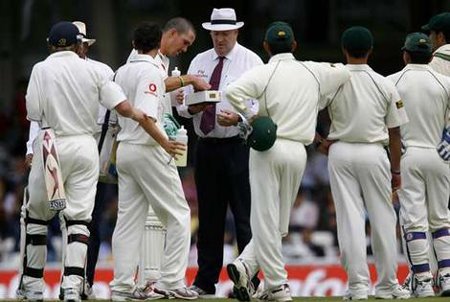
World cricket’s most (in) famous umpire Darrell Hair has always been in the midst of controversies right from when he made his debut in 1992 in Adelaide, in a game marred by controversial LBW decisions. In 1995, he no-balled Muralitharan seven times in three overs for “throwing” which resulted in the Lankan skipper Ranatunga staging a walk-off leading to arguably the most hot blooded series seen in recent times. In 1998, Hair’s autobiography Decision maker: An Umpire’s Story (Don't ask me who read it) was published in which he called Murali’s action diabolical and said that if he had a choice he would call have called Murali many more times for throwing. This embarrassed the ICC and he was dropped from the ICC’s panel of umpires briefly only to be recalled later. There have been a few more instances of Darrellgate but probably nothing weirder than what was witnessed last week in Lords when Hair declared that Pakistan had forfeited the match because of their apparent “refusal” to take to the field on the 4th day post-tea session– the first time ever that a team had forfeited a match in this manner in 129 years of cricket.

It all started after about 55 overs into the English innings on the 4th day of the test match when Hair felt that the ball had been tampered with. He then proceeded to award the English team 5 runs and replace the ball as per Law 42.3. No reason was given to Inzamam as to why this was done. The Pakis continued to play but in the post-tea session, they refused to come on to the field as a symbolic protest, as claimed by them. Later on after about 40 minutes they relented but this time, the two umpires were not willing to play ball. Citing Law 21.3 which deals with match forfeiture, Darrell Hair and Billy Doctrove, declared that Pakistan had forfeited the match and England was the winner. Technically, the umpires were right but then aren’t the rules meant to be played not only in the letter but also the spirit? If the umpires had agreed to continue, this mess could have been averted and the ball tampering issue could have been decided outside the field by the referee. Somewhere, they did not realize that the game has a commitment towards its legions of public across the world. In the midst of the entire din, match referee Mike Procter’s role was forgotten. He went silent throughout the entire debate making me wonder if the job is a mere rubber stamp.

The Pakistan team could have easily emerged unscathed had they not have botched up the situation by not taking the field. The Pakistani captain Inzamam owes moral responsibility for his team’s actions and the trigger happy (atleast Asians think so) ICC would only be too willing to oblige by punishing him under charges of bringing disrepute to the game. 26 cameras in the field did not see anything but our old friend Hair felt that there was something wrong with the ball. Hair seems to have gone by the Pakistani reputation when he decided against them. There has always been an element of mystery associated with reverse swing and the Pakistanis have not always helped their cause in their bowling with the likes of Waqar and Shoaib Akhtar being caught on camera for trying to tamper with the ball. But in this case, they have received extensive support from the playing fraternity and the public except for the Aussie media. The Aussie media and stalwarts like Steve Waugh and Mark Taylor have backed Hair (The Daily Telegraph called him the bravest person in cricket). But then, no one is surprised- Aussies have never made any pretensions of trying to be morally or politically correct.

There have been a few points raised regarding the role of ICC in the entire fiasco. Unlike FIFA, ICC has really no great powers. There are no proper laws created to handle such a situation. It has also been pointed out that Hair and ICC could run into trouble if Pakistan were to take the matter to the court of law. The failure of ICC is also in dealing with such umpires who have been repeatedly seen to needle the cricketers from the sub-continent.

There are quite a few issues which the ICC has to take care after this.

On what basis can the umpire decide that the ball has been tampered?

Is camera/video evidence necessary for this?


Shouldn’t umpires try to explore all possibilities to ensure that the game continues no play is possible and only then abandon the game?

Should the umpires or the Match Referee take decisions on matters like abandoning the match, which are outside the field of play?


Just when the Dean Jones controversy was dying down, another Aussie has brought to focus the other side of the game .There have been accusations of racism against Darrell Hair citing some of his other controversial decisions but personally, I am inclined to give him a slight benefit of doubt. It sometimes becomes an easy stick to beat the Western world with when we raise the bogey of racism. I would like to put his behaviour down to his overzealous, autocratic and dogmatic nature with a scant regard for cultural differences but he has been consistently erratic in this behaviour right throughout his career. He’s rubbed many people the wrong way throughout his career and got away with it but this time I think he’s chanced his luck a bit too far.

In the current situation when the Muslim world’s relations with the West is at an all time low , a crisis such as this could easily escalate into a polarized political situation. The fact that one man’s stubbornness and dogmatism could potentially have such repercussions is unfortunate but then history has always been dictated by the whims and fancies of individuals. Darrell Hair is among the most experienced umpires in world cricket now but he lacks the wisdom and maturity to handle such a situation.

Cricket carries the unfortunate burden of bearing the responsibility of being a "nice game" and every such incident is a reminder to us to stop romanticizing the sport and face the reality that George Orwell had once said about modern sport being–“ …war minus the shooting”.

Wednesday, August 16, 2006

Omkara: Shakespeare in UP


Let me start with a confession. I have not read Shakespeare’s Othello, so maybe I am starting with a handicap while reviewing Omkara. But then, good cinema is good cinema irrespective of the literary source. The closest that I have come to know regarding “Othello” has been through the enigmatic Malayalam film maker Jayaraj’s (1997) highly acclaimed Kaliyattam (Play of God). Jayaraj used the backdrop of Theyyam, a traditional North Kerala art form, to narrate the story while Vishal Bharadwaj juxtaposes these characters into the rugged plains of UP, in the midst of lawlessness.

The plot revolves around peer jealousy and suspected marital infidelity. Omkara is an outlaw chieftain who is nominated by his mentor Bhai Saheb (Naseeruddin Shah in a brief role) to stand for elections and so, he nominates Keshu to succeed him as ‘Bahubali” (chieftain). This angers Langda Tyagi who has been vying for that position and he plots to sow the seeds of Dolly’s(Omkara's wife) infidelity in Omkara’s mind. Through a series of manoueveres, Omkara is convinced of his wife’s treachery and it culminates in him killing her. However, he comes to know of his wife’s innocence through Langda’s wife and commits suicide. Langda’s wife also kills her husband and ends her life.

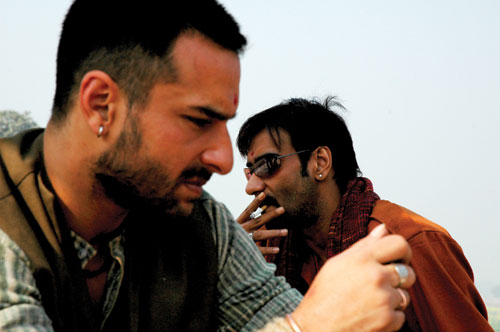
Vishal faithfully sticks to the play for most of the movie which makes comparisons easier. He also has his characters with names similar to the play. So, Othello becomes Omkara Shukla (Ajay Devgan), Desdemona becomes Dolly Mishra (Kareena Kapoor), Iago becomes Ishwar ‘Langda’ Tyagi (Saif Ali Khan) and Cassio becomes Keshu Firangi (Vivek Oberoi).The most striking aspect of “Omkara” is the language spoken. It is rustic, crude and laced with expletives but is realistic and is an unexplored terrain in Hindi cinema. The dialogues have an uncontrived sense of below the belt humour (eg. Konkana Sen’s comment “Meri Daadi to kehti thi ki Aadmi ke dil ka raste uske pet ke neeche se hai). But this also comes with its set of issues. The usage of a heavy UP dialect alienates many viewers not familiar with the nuances of the language. The liberal usage of expletives also ensures that it dissuades family audiences from watching the movie. Personally, I think the language could have been toned done a bit. The cinematographer Tassaduq Hussain’s lens roams the wide expanses slowly and beautifully. He captures the movements, the shadows and uses lighting haltingly to bring to life the high Shakespearen drama.

Ajay Devgan plays his usual, brooding self something that he’s been doing for quite a long time now.Vishal could have tried a different actor so that a different interpretation of Othello could be looked at. Ajay carries the “Been there, Done it” look without bringing any novelty to the character. Kareena is adequate but has nothing much to do except looking beautiful. She radiates a certain innocence and charm (Her singing of the Stevie Wonder hit “I just called to say I loved you” when Ajay comes home is cute) but she’s no Manju Warrier who tugs at our heart in the Malayalam version. Vivek Oberoi is ok but looks a bit lost in the midst of all the action taking place. Saif is truly “Langda Tyagi” and it is his most mature performance till date. He sports a mean look, carries a limp and pours invectives at will. It’s a remarkably controlled performance and he never goes overboard which is the biggest danger in such movies. It is even more credible considering his background and the kind of movies he has done so far. It is high time directors stop casting him only in the “Lover Boy” kind of roles. Konkana Sen as Saif’s wife pulls of an excellent cameo; she appears for only a few scenes but makes a definite impact.

The script has its share of anomalies. The Bard’s Othello was a Moor who suffers from insecurity due to his race and wife’s beauty which makes him easily susceptible to Iago’s comments. But what about Omkara! A hint is dropped occasionally of him being a ‘Half Brahmin” and not a proper match for the beautiful Dolly (Konkana remarks “Jaise Kaale Lote Mein Doodh”) but these are not explored further and so his insecurities do not come to the surface. Unlike Jayaraj’s protagonist Kannan Perumalayan, he’s not ugly but on the contrary comes across as a macho figure. Maybe Vishal could have exploited the Vivek-Kareena angle a bit more giving it a flirtatious connotation but he does not do so thus not providing compelling reasons for him to be swayed by Langda’s remarks. There is an element of sympathy towards Othello which is clearly absent in our feelings towards Omkara.

Iago, considered to be one of Shakespeare’s finest characters, maintains that numero uno position even here. But while we strongly despise Iago and Jayaraj’s Paniyan, we tend to partially empathise with Langda. He comes across as a better leader when compared to Keshu, thus softening our stance towards him. His handicap and lack of recognition despite many years of loyalty also serve in undermining his negative profile. Unlike Iago, he’s also not a professional schemer as there’s a strong element of luck in all his moves whether it pertains to Bipasha’s entry at the end, his conversation with Vivek on his mobile or spotting Vivek’s bike when he and Omkara return early from an election campaign. Maybe Vishal did not want to paint him totally in black.

The ending is a slightly prolonged sequence and does not culminate in the kind of flourish witnessed earlier. I am also not convinced as to why Konkana kills her husband Saif in the end. Vishal could have stick to the original text here where Othello kills Desdemona and commits suicide after Iago’s wife reveals the truth. There are also a couple of item numbers which do not serve much of a purpose and could have been done away with. Music was one of the strong points of "Kaliyattam" but not so in the case of "Omkara".

As per media reports, the movie is not doing too well and the producers would incur losses. It presents a strong case for bringing in sub-titles, especially for the audience in the south.Vishal should also take a leaf out of Jayaraj’s book; he succeeded in making “Kaliyattam” at a shoe string budget and also made money. That’s the price you pay when you make a movie with a lot of stars. Nevertheless, he succeeds in bringing to life Shakespeare in rustic India. I have always been a great fan of Gulzar and it’s nice to see his protege making such giant strides in the world of cinema.

Final verdict:

Highly recommended but not for family audience.