Sitemeter

Showing posts with label Travel. Show all posts

Saturday, December 05, 2009

A Journey to the Dhauladhars


One of the more immediate challenges after marriage is to organize the honeymoon. The pressures are high – it’s the first time you are organizing something and wifey is looking to you to pull it off without any hiccups. After a lot of creative inputs from anyone and everyone who’s trying to help, we decide to go on a trip to Himachal Pradesh. There are 2 couples – me and Sangeetha and Anil and Divya and we agree on an approximate budget of about 30-35 K for the entire trip.

The whole of Himachal has been divided by HPTDC in four circuits: Tribal, which mainly includes the Lahaul Spiti region, Sutlej, which is the region around Simla, Naldhera, Kufri, Beas, which is the Kullu Manali and surrounding region, and the Dhauladhar circuit, which covers Dalhousie, Chamba valley, Dharamsala, etc. HP, for all practical purposes, generally refers to Shimla, Kullu and Manali. Based on friendly advice, we decide to go for the seemingly less untrodden (by HP standards) Dhauladhar circuit. So the final plan is put on paper – 2 nights in Palampur, a night in McLeodganj and the last 2 nights in Dalhousie.

The journey begins on Nov 22nd when we board an Air India flight from Mumbai to New Delhi. Sangeetha and I do not get adjacent seats and so I request the gentlemen around me if they could adjust but sadly, none of them is willing to compromise. It is her maiden flight trip and I am slightly apprehensive of sitting apart but we manage, despite the rather inhospitable behaviour of the grumpy folk who sit around us in the plane.

Anil and wife join us (from Jamnagar) at the Old Delhi Railway Station (DLI in IRCTC) as we catch the Jammu Mail on a 10 hour journey to go to Pathankot, the nearest station to reach Palampur. We make the mistake of booking a second class ticket and the conditions are pretty cold; wiser counsel would suggest travelling by AC where the temperature is controlled and blankets are available. Thankfully, we are well-equipped to meet the cold and bring in a pair of sweaters, thermal wear, woollen gloves and socks and monkey caps to protect the ears but the cold is biting and we need to protect ourselves well enough.

Day-1 brings us to Pathankot, an hour and half behind schedule at about 8.30 in the morning. If you reach early, you could use the Kangra Valley train to go to Palampur (these trains have to be booked on arrival and are not available in IRCTC); this is called a Toy Train and is a major attraction for tourists as they travel across the beautiful valleys at such heights. Our stay is planned at Country Cottage, a family-run home stay type setup run by the Sarins. A pre-arranged cab picks us up from Pathankot Station and we travel for over 3 hours before we reach Palampur, a small town better known for its tea estates and the charm is the quiet British type plantations.

The Sarins had bought the place from the British about a century back and have been running their cottage for the past 20+ odd years. The place has 5 cottages and can house only as many families at any point of time. The hospitality is excellent (a tad pretentious possibly at times) and a special mention needs to be given for the food, though it is quite expensive. The cook serves you food hot and ensures that the eating experience there is truly a memorable one. The Country Cottage Stay is a leisure stay and not a typical tourist one – you can spend time primarily taking a walk across to the river, trekking along the hills and enjoying the solitude. The cottages are quite comfortable, but the heating facilities – water and room- were not upto the mark but I assume that this is to be only a temporary issue. There is an Adivasi temple about 4 km from the cottage, which is a nice and wonderful 3 hour trek – the temple has nothing to recommend but the walk is worth it.

On Day-2, we do the trek to the temple in the morning and return to visit 2 tourist spots suggested to us in the afternoon– the Baijnath temple and the Sherbaling Monastery. The Baijnath Temple is dedicated to Lord Shiva and was built in the 13th Century. But it’s kind of disappointing because to a Keralite, the temple would appear a rather small one, shorn of much tradition or culture. You can visit but we don’t recommend this; it is a small temple and has nothing much to offer.

Sherbaling Monastery is situated much higher and can be a more interesting place but without any form of guidance, it wouldn’t mean much. Our driver drops us in front of the Monastery and we are not sure how to proceed inside. There is a mediation class going on when we reach the place and the hall is out of bounds for us. The reverberations of the chanting reach us which has an impact but otherwise as tourists, we are lost inside, especially with no one to guide (but as Anil suggested maybe, they do not intend to treat it as a tourist place and do not refuse us only out of a sense of gratitude). Also, we do not intend to rake up an issue by straying into an unknown place and touching something which could be sensitive.

On Day-3 morning, we check out of the Country Cottage and head towards McLeodganj (Upper Dharamshala), located about 2000m above sea level. The drive from Palampur to McLeodganj is relatively short and takes about 1.5-2 hours (time taken is primarily due to the height that we travel here). We are put up at 8 Auspicious Him View Hotel, a small unpretentious 8 room hotel located at walking distance from the main temple. Each of the 8 rooms is decorated according to one of the 8 auspicious symbols of Buddhism; the hotel is comfortable, cheap and well-located. Special mention needs to be given to Mr Tsering Dorjee, who manages the hotel – a pleasant young man, who is very helpful and well-mannered. Mr Dorjee provides us a map of the place and explains to us the main places to visit and volunteers to help us show around the place, if required.

Armed with a map in hand, we trace our steps to the main temple where His Holiness The 14th Dalai Lama is addressing a group of Russians; unfortunately, the police do not allow us in and ask us to return after 4 pm to see the place. Since we have just a night to stay, we decide to leave the Main Temple and visit the Bhagsu Nag temple and Waterfalls, about 2 km from our hotel. The temple and waterfalls are also no great shakes (though the waterfall could be a delight when in good flow) but are ok if you are looking for a walk up the hills. Mr Dorjee also recommends the Naddi Village and the Norbulingka (a Tibetan Institute started by the Tibetans to ensure that traditional Tibetan art and culture would not die down) but one night would be enough to cover all these places. Nevertheless, for such a trip, we don’t fancy travelling more in McLeodganj.

Our Hotel serves only Tibetan food and so we settle down for some vegetarian momos (a form of Tibetan dumpling),Thukpa soup (a Tibetan noodle soup) and herbal tea. Can’t say we enjoyed it much but then doesn’t being a tourist require one to even try out the local cuisine. McLeodganj is famous for the Dalai Lama and I guess that’s the only thing I can think of – the entire place is littered with Tibetan markets and restaurants and inundated with foreigners, pouring in from all corners. If you are looking for a quiet place, McLeodganj is definitely not where you should be headed – looks more like a place where Tibetans run small markets and white men come in large numbers, in searching of mystic solutions to life.

Day-4 does not start exactly on a great note as there is a power cut in most of McLeodganj, meaning no hot water to bathe, except whatever is stored in the geyser!!! We manage to wash our way through and proceed towards our last halt – Dalhousie. Built around five hills, Dalhousie is located on the western edge of the Dhauladhar mountain range, at a height of about 2200 m above sea level and named after Lord Dalhousie who was the British viceroy in India at that time.

A 150 km long cab travel takes us to Hotel Grand View, an old British style hotel establishes in 1895. Grand View, true to its name, opens to a breath taking view of snow capped mountains and provides a wonderful and most comfortable stay. It has a rather spacious dining room with an attached imperial looking bar (called Viceroy Lounge Bar!!!), big rooms and very helpful staff, which make the stay a real delight. We retire to the night’s chillness after a brief walk, cut short by the constant and scary movement of vehicles at dizzy heights.

For Day-5, we decide to explore around Dalhousie and book a cab to visit Khajiar and Chamba town. The travel to Khajiar (24 km from Dalhousie) is beautiful with its pine and deodar trees and flakes of snow (from a snowfall of an earlier week). Khajjiar known as “Mini Switzerland” was officially baptized by the Swiss Ambassador on July 7, 1992 and as per records, a stone was taken here and forms part of the stone sculpture erected in Berne, capital of Switzerland. It is no longer as peaceful and serene as it used to be and we have vendors constantly rushing around to take your photos, give you a horse ride etc. but it still remains a beautiful patch of landscape in the entire area.

After a couple or more hours in Khajjiar, we proceed to Chamba town, where our driver first takes us to Bhuri Singh Museum (strictly for followers of history) and the Laxmi Narayan Temple. This temple houses 7 main temples dedicated to Shiva and Krishna and a few other smaller temples around it (do we have an English equivalent word for Upa devata???) and is atleast worth a visit after the 2-3 not so inspiring temples that we came across in the visit. On our way back, our driver halts at a couple of vantage points for us – one on the banks of River Ravi where the river bed was dry and we can see the magnificent flow of the river and secondly, at a point where we can see the Dam being constructed across this river (this is now being harnessed for hydro-electric power).

After all this travel, on Day-6, we hire a cab to go to Pathankot railway station. All Pathankot trains to Delhi are in the noon or night, so you’d have to plan accordingly on how to plan this day. Since most hotels have a check out time of 12 Noon, the evening 4.30 Muri Express is a comfortable one to catch. We had planned to have our lunch at the station but funnily, the only food available at the station is the quintessential burger at the IRCTC food stall – burgers in Pathankot!!! We get into the train only to realize that the seat numbering in the train is all goofed up, primarily because Laloo’s brainwave of 4 seats in the main berths and 3 in the side berth had been implemented and then revoked but the numbering had not changed. So, you had a situation of multiple seat numbers at the same seat and massive confusion everywhere. Anyway, with all this conundrum (including being woken up at 1 AM by a passenger claiming that I was sleeping in his berth), we manage to reach Old Delhi by 5 AM.

At the entrance of the Old Delhi Railway Station (next to the car park on the west exit), you can find a 24-hr Food Joint called ComeSum, from where we buy our breakfast before we catch our respective flights. Pre-paid cabs are not available at the station (the cops at the pre-paid counter ask us to talk to the taxi driver directly) and so we settle down for an auto to the Airport. The early morning ride in November in the auto is chilling but free of traffic and we reach the place in about half an hour before we catch a 10 AM flight to return to Mumbai and close our journey while Anil and Divya catch a 12 Noon flight to Ernakulam.

The trip was a memorable one and there were a few things that we learnt. Going alone is not necessarily the best idea; travelling with a friends’ group (especially couples) is a rewarding experience. The place gets pretty dark by 5.30 in the evening in winter and it’s a great idea to sit around a fire place and spend time together as a group. Off season travel helps in a great deal of cost-cutting and ensures that you face lesser crowds. Most hotels arrange cab pickups as and when you require so you do not have to worry about the travel at all. Travelling in winter (kind of autumn in our case) means that you need to be well-prepared in terms of clothing. When you travel by train to cold places in winter, book seats in AC and not in 2nd Class – this ensures a much higher degree of comfort.

Every journey has its high and low points - as long as the high outscore the low ones, you have done a good job. Be open-minded and nice to people and travelling becomes an experience that you can cherish for a long time...

Sunday, August 24, 2008

My Tryst with Vipassana

I’m back from my 10 day trip to Igatpuri, back to the realities of the world where people talk and human beings exist at a totally different plane. If I really have to write down my feelings, it would honestly be difficult; I have tried to structure my observations about the experience in the form of a private interview with my Self – more in keeping with the kind of life that we lived there.

(The Golden Pagoda at Igatpuri)
So, now that you are back, how does it feel?
What do you think? Like Keanu Reeves in the Matrix or the Monk who sold his Ferrari (Smiling) Actually, the only feeling that I can use to describe the event after the 10th day is the feeling of lightness. Maybe, somewhere, the heart has grown a bit soft, has melted and it feels a bit peaceful or maybe it’s a placebo temporary effect; can’t say.

You have got the answers to your questions??
Friend, I remain zapped; getting answers to my questions!!! I don’t think I know my questions clearly enough, forget the answers...There is probably a feeling of some change internally but I’d not like to sit on judgment on it now itself, let’s give it some time.

Fair enough, then let’s discuss the nitty-gritty a bit more. The 10 day silence – how awful was that?
Actually, it is a 9 day Arya maun (Complete silence – no gestures or actions or eye contact and not only an absence of words). During the 9 days, you can still talk to the assistant teacher or the management regarding any problems on the technique or the arrangements and all but you must avoid all communication with others.

On the 10th day, the silence is broken and you spend a day in the centre without the vow; the idea, as I understand, is that exposing oneself to the world immediately could be a bit of shock.

But a 9-day silence still seems quite a punishment. Wasn’t it tough?
Honestly, it was not that tough. You are in an environment where everyone is a stranger and silent and there is no external stimulus of any kind that could make you feel like talking – you know no TV, internet, books, magazines, music. But you do a lot of talking to yourself inside; you probably do that all the time but never realised it. Come to think of it, I think I did enjoy the silence – some challenges can be inspiring.

So, you’d have thought about family, friends and office???
Actually, it was a random flow – no, not flow, avalanche is a better word – of thoughts and nothing much in specific. I hardly ever thought of office which surprised me, considering that my world seems to start and end with it. Quite a few thoughts, on the first few days, on near and dear ones but otherwise it seemed only about myself. I know this sounds pretty selfish, but then I guess that’s the truth. Deep down, maybe that’s the only thing that matters (sighing)..

Alright, so, what was the daily routine like?
We were supposed to wake up at 4 AM in the morning and then do a 2 hour meditation from 4.30 to 6.30, either in our rooms or in the Group Hall. Breakfast was served from 6.30-7.15 and the next session commenced at 8. After an hour of meditation, you could choose to continue the same in your room or stay in the Hall. Lunch was served at 11 AM and then after the required break/siesta, the next session was to start at 1 PM. Again meditation and then snacks at 5 PM, followed by the next session at 6 o’clock. Then there was a must see/hear 1.5 hr video recording discourse by Guruji (Shri S N Goenka) at 7.15 and then you retire to your room by 9.30 night. The same schedule went on for 9 days.

So, you basically, eat, sleep and meditate that’s all?
Well, that’s all I suppose; I also walked a lot during the breaks, especially after the lunch. Other than the regular breaks, you also had a 5 minute break after an hour of meditation. Maybe if the schedule had much more time in between, it could lead to a lot of boredom.

The Ashram food; what about it?
Guess, it was a bit surprising; I kind of liked it. It was less spicy and not much masala (for obvious reasons) but it was pretty decent – tasted better than my office food. But there were quite a few people who did not like the food but then you can’t make everyone happy. The fact that there was no dinner served (the last food was served at 5 PM during the snacks) was a concern to a few but then since you are not actually doing any great physical work, ideally, that should not have been too much of a problem.

Tell me about the meditation – that was your only activity during this period!
For the first 3.5 days, we practised Aana-Pana meditation; involves focusing one’s attention first on the sensation of breath passing above the upper lip and in and out of the. Then the Vipassana technique was taught on Day-4 where you observe the various sensations in your body ranging from heat, cold, throbbing, vibrating, tickling and any possible reaction, which are sensitised by the Aana-Pana meditation. The idea is to merely observe the sensations and not react to them.

Sounds pretty trivial a thing to do for hours..
Breath and energy flow is considered trivial by most of us because education has never taught us the use and relevance of this activity. At a very high level, every reaction or emotion that you exhibit triggers a sensation in the body but you are not sensitive to realise that. As soon as the sensations are felt, we are supposed to move our attention from the top of the head to the feet, and so on until we have scanned each and every part of the body. Most important is that we cultivate a sense of impartiality and equanimity to all sensations.

If we experience pleasant, subtle sensations we crave for them while if we experience gross, unpleasant sensations we develop hatred towards these sensations. We need to observe these experiences and treat them impartially; all things are impermanent and our suffering is because of our sense of attachment towards these feelings- negatively or positively.

And did you feel that magical power or whatever it was during this period?
Actually, I struggled for close to 6 and half days to figure out what I was doing and it was only after the teacher (an affable French gentleman named Yves Guichard) corrected my technique that there was a change. I did feel a lot of energy flow (gross and subtle) after that and that felt great but of course, the point is that the flow may be great but you must never develop any ego because of that; it kills the very purpose of the entire sadhna. Maybe being a Reiki practitioner, it may have helped but even then, it did take 7 days to make some progress.

Actually, there’s no point in discussing the sensations or the experience and calling it magical and all that; subtle behavioural changes are not very evident immediately but have a much lasting effect and merely taking about seeing light, vibrations, and energy is purely superficial. Each person’s experience is different and these cannot and should not be compared, otherwise you’d have people searching for mysterious electric, electromagnetic, vibrating, thermal and what not effect without understanding the final purpose.

You think this could make a change to your life and that more and more people should actually learn this...
It is too pompous a presumption that I have changed (when I can’t even explain the change) and henceforth, things would be different. I guess, the seeds for some change have been put but nurturing them is upto the student and that’s what determines any progress in this regard. I think more people should try this out and experience and then decide whether they want to go ahead with it or not.

But let’s be clear, the 10 day experience is not easy. You need to leave your family behind, stay alone like a bhikshu and follow a grind of early morning waking up, no talking, meditating for a greater part of the day – not exactly what you describe as a holiday. I myself had this urge a few times to run away from there during this period but then jaon bhi to kahan? I used to look at each Day waiting for the Day 10 to arrive but eventually, you kind of accept it. In hindsight, you kind of feel so much better but can’t say the same during this period. Anyway if you are determined, you can do it, if so many others can, why not you?

How was the crowd there? Mostly of a higher age group maybe..
Funnily no..There was a few guys fresh out of college, somebody doing his PG, quite a few employed and about my age, a few couples and all kinds. My neighbour was a young Australian who had his own bakery business in Navi Mumbai; there was this 45+ Muslim guy, the son of an Imam, who looked just 25 and was some kind of a fitness freak; another guy in his late twenties who was broke and just travelling to various places; another guy was a filmmaker who had co-founded an organisation to promote social change, a media manager with a private TV channel – all an interesting assortment of characters with nothing much in common.

Ok. But how would someone sit for hours, close the eyes and meditate? That easy??
(Laughs) Sorry, no such pretensions at all. Lots of thoughts went around in the mind during the first five days during meditation in the hall with the eyes closed. And even after that the mind would keep wandering wildly from one place to another but then somewhere in the midst of all this wandering there are periods of powerful concetration too. The initial breath observation and the complete silence did play an important role.

Also, the sexes were segregated during the entire period and you actually did not see any female during this period except while walking towards the dining hall but for some reason, I abstained from looking in that direction during this period – some poor attempt at will power, I guess:)

You plan to go there again?
Actually, no plans for anything at all at this point of time; let’s take each day as it comes, who knows how much the world changes before I take another break. Monday and back to office and so back to reality; we will leave it at that.

My Closing thoughts...
This was a 10 day break from routine and eventually, it felt good. This could be due to a change in the routine or due to an actual change at the basic level where I suddenly felt, what should I say, connected with myself, a little bit. Maybe it was the exhilaration of lasting for 10 days and proving some kind of a point to oneself and others. Whatever, it is, the feeling is itself transient and needs to be understood – Trying to develop equanimity towards both happy and sad events; for me, this was one of the most important points that I picked up during this course.

There is also a spiritual ego or baggage that I have been carrying – I am a Reiki healer and have read a lot of books in this regard and all that – but this journey has managed to inject in a more sense of humility and reality. Reading and analysing spirituality does not make for any change or even if it does, it is purely at the top level, the inner feelings remain the way it always was and that needs much more hard work and practice deep inside to change. But then there’s nothing to despair, each journey has its own stream of joy; pick it up and proceed on the next journey...

Sunday, May 27, 2007

30 hours in Bangkok- Part 1

Life is never short of surprises and so in a matter of less than a year, I am transformed from a guy who has never seen the world beyond Mumbai on one side and Kerala on the other, to a South East Asia trotter, albeit on a small scale. After spending a couple of months in Kuala Lumpur and almost winding up my job (as of now), I am looking forward to return to my native place and see my cute little niece whom I have never set my eyes on. But as fate has it, I am told I need to extend my stay for about 10 days more. My Malaysia visa is about to expire, so I need to leave the country for a brief while and come back so that I can get an on arrival visa again. Since India is far away, I and another colleague of mine with the same visa expiry problem (let’s call her V) decide to travel to Bangkok for the weekend. Now, company paid holiday is something you don’t want to give up any day, do you?

V and I go to the KL Sentral (that’s the spelling) and book a couple of tickets to and fro Bangkok for the next day. The queue for the low frill Air Asia is very high and so we settle down for a Malaysian Airlines flight. The two way return for a single person comes upto 1270 RM (the Air Asia tickets would have come at less than 200 RM). The flight is at 9 AM on a Saturday and we manage to arrive at KL Sentral two hours in advance. For Malaysian Airlines, Cathay Pacific and Air Asia, you can check in at KL Sentral itself, without having to go to the airport. There is a train service (28 min journey) which further connects the airport to this place. I believe Hyderabad is also toying with this idea – a rail corridor, stretching 30 km to connect the Begumpet airport in the heart of Hyderabad to the upcoming international airport in Shamshabad, with estimated investments of Rs 2,500 crore has crossed the proposal stage.

After an event-free flight, we land at the Suvarnabhumi international airport in Bangkok- Asia’s so-called sleaze capital. The procedure to get an on-arrival visa is, however, not hassle-free, as in Malaysia. The visa costs 1000 Baht, requires a return ticket, a photograph and proof of currency worth 10,000 Baht (in cash or traveller’s cheques). Since we do not carry a photo with us, we pay 200 Baht for each of our photos at the airport. The ladies at the counter are not very friendly and seem to bear some unknown grudge against us.

V forgets her wallet at the desk and goes to another counter. We remember it later and approach the ladies for the wallet. They seem to have no idea what a wallet/purse is, so I take out my wallet and gesture to them and after about 5 minutes, they get the message and the purse is returned. Finally, after gesticulating and speaking broken English, they give us both on arrival visas valid for 15 days. We complete the immigration clearance and move to the nearest information desk.

The lady across the counter beams at us and offers us a set of hotels. V is very clear that she’ll do the talking because she’s scared that they’ll sell me a sleazy accommodation; the reputation of the city scares her. So, we eventually settle for a hotel named PJ Watergate at a place I cannot remember (Just searched in Google- the place is called Ratchatewee). The package includes a night stay at the hotel (including complimentary breakfast for the next day) and a tour of the royal palace and a few Buddhist temples. It costs us 4800 Baht for 2 rooms and the guided tour (excluding entry fees at these places). The lady also informs that we need to take a cab to the hotel and it will cost us another 300 Baht (the metered rate starts at 35 Baht here).

In about an hour’s time, the cab transports us to the hotel, where our guide is waiting for us to start the tour. We have a quick refreshment and start off on our journey in a comfortable cab. Evidently, the King (Rama IX) and the Queen are pretty popular in Thailand and the city is strewn with their posters. The coup against Thaksin Shinawatra had his blessings and the people accept that. Our guide is a young Vietnamese guy called Yakee (his name tag says something else, though). Yakee is a nice guy but that’s the best I can tell about him. The poor guy is clearly historically challenged and does not seem to have any idea about the temples and struggles to give us any form of historical insights. His language is also not very understandable and the only thing I can understand from his language is that there are different architectural styles involved in the temples – Thai, Chinese, Indian and Cambodian.

The entry fees to the palace and temples comes to about 350+ Baht totally for each person. V is disappointed and expresses her displeasure regularly in Hindi at the inability of our guide to tell us anything at all. Incidntally, Yakee tells us that there are different postures of the Buddha, based on the different days of the week – Monday Buddha, Tuesday Buddha etc.- and shows us the statues with the various postures in the temple. I am not too sure about the veracity of this claim, though. There are many statues that we see but the most prominent of these is the Reclining Buddha- a huge statue made up of solid gold, which stretches across 46 metres. This statue is housed in the temple Wat Pho.


(A photo of the reclining Buddha)
We also manage to visit the Wat Phra Kaew temple which contains the Thai version of the Ramayana in the temple walls. This temple is very sacred and does not allow visitors not dressed appropriately. Signs put up around the entrance show you are not permitted to enter wearing shorts, sleeveless shirts, singlets or any form of open ended shoes. Sarongs and long trousers are usually available for loan. The temple also houses a miniature model of the famous Cambodian temple complex Angkor Wat. After the temple, we visit the Grand Palace which is a ceremonial palace and used only occasionally by the royal family. This is in the same compound as the temple and provides a contrast with its European style of architecture (Yakee informs us that Italian marble was used). We also visit the Wat Arun temple but I am unable to recollect much about it. Honestly, temple travel is not my forte but then V is fascinated by history and is insistent on checking out all the temples (I fancy history for its politics than art).

By about 6 pm, we are through with all our temple/palace visits and return to our hotel. We decide to go to the Floating market the next day, about 70 km from the city. A private tour would cost us about 4000+ Baht, so we decide to take a group tour which would cost us about 700 Baht each but would mean that we would travel with a group of people and with a different guide. After seeing Yakee’s knowledge and the monetary deal, we decide to take the group trip. Meanwhile, I retire to my hotel room to take a rest while V decides to take a look around the place. Instead of taking rest in my room, I end up watching the Nicole Kidman starrer The Interpreter, in HBO in the room.

V returns after some time and we head towards an Indian restaurant nearby called “Mughal Darbar”, which seems the sole eatery nearby serving vegetarian food. It is run by a Sardarji and has a set of giggling red dressed Thai girls, not too keen to serve us a meal. We are offered salad and mineral water, along with the food but we decide not to have it lest we are charged for it. Amazingly, we are charged for this free offering given and reversed only when I protest. The Sardarji looks at us wondering where these Indians have come from, refusing to pay a paltry sum of 20 Bahts but gives in and reduces the bill.

It’s about 9.30 pm now and we go around the place but most establishments are shutting down and there’s nothing to do. Rather regretfully, we retire to our rooms. Tourists going to bed by 10 pm in Bangkok- either the place is too bad or we are lousy tourists. Probably the second part is true.

Sunday, March 11, 2007

Malaysia Diary - Part2

Finally, after 3 weeks of arriving here, I begin to live my karma of being a tourist. It would be blasphemous for a tourist in Kuala Lumpur to return without seeing the Twin Towers of Petronas. And so, I step out in the direction of Petronas, a 10 minute drive from my place to KLCC (Kuala Lumpur City Centre) with expectations of standing on the largest monuments in the world. Limited tickets are available to view the tower but they are free. So, we arrive at KLCC at about 10 in the morning and are issued tickets for a 2:30 noon viewing of the monument. To kill time, we end up watching The Pursuit of Happyness, a feel-good but genuinely warm Will Smith movie, in of the theatres inside the mall.

Eventually, it’s time to go and we are ready to check in. There’s a brief five minute video presentation on the Petronas, extolling its virtues after which our guide shows us to a lift, post-security checks. We arrive at the 41st floor in less than a second per floor (the elevator moves at 5 m/s) and find ourselves at the sky bridge which connects the Twin Towers. It gives a breathtaking view of the city (just like every other tall monument) and there, unfortunately ends the spectacle. We have ten minutes to ourselves as we spend time busily snapping photos from the place – a 50 m long bridge stretch, which connects the two towers. Above the 41st floors are offices of Petronas where we are not allowed which makes the entire thing so ridiculous. Imagine waiting for such a long time to go to the Petronas and all you get is a 10 min stint at the 41st floor (the Tower has 88 floors). Surely, they could have done much better than merely creating all this hype but no action!!!

Another tourist place which is well-known is the Genting Highlands which houses a set of Theme parks, almost a Malaysian equivalent of the Sentosa in Singapore. It’s a 45 minute drive from Kuala Lumpur city and you can get a bus or a taxi (“texi” in Malay) to the place. There are three bus terminals I know of where you can get the bus – KLCC, Hotel Puduraya or Pasar Rakyat. We take the Go Genting Travels, from the last mentioned place, because it comes as a packaged tour of 39 RM per person, including the bus ride, cable car travel and all outdoor entertainment facilities. The bus leaves every one hour and we hop onto the 10:30 AM bus which covers sufficient ground and reaches the place at about 11:15. From here, there’s a cable car ride to the Genting Theme Park, located high above. This is a long 20 minute ride (about 3.5 km) and gives a scenic, lush picturesque view of the rainforest below.

The Genting theme park has outdoor as well as indoor entertainment facilities. The Outdoor facility comprises a standard set of roller coasters and rides which is no longer a novelty for any of us. But there are two rides which you need to try for sure – the Space Shot and the Flying Coaster. The Space Shot consists of a set of hydraulically operated seats (12 at a time) which takes you to a height of more than 50 m and then they just drop you. It’s a free fall and you hurtle down the entire distance in less than 5 sec and by Jove, it’s an eerie feeling because as you fall, you realize that you are no longer sitting but levitating and falling rapidly. Too awesome a feeling for me to communicate but it’s worth all our gasping and screeching.

The Flying Coaster is not recommended for people with a weak heart as it has an amazing set of twists, turns and swoops, all meant to shake you. Unlike the other rides, you lie down here instead of sitting and the twirling starts. Not only does the roller coaster move but it also rotates 360 degrees on a couple of occasions as you wonder what’s going on, till you are finally delivered back to earth. This signature attraction of the Park is not part of the package and you have to pay 10 RM for it (2 rides) and we experience the coaster twice, one immediate after the other. It also goes without saying that none of these rides are to be tried out in a full stomach, otherwise…

The Indoor facilities are more for kids and do not hold too much of an interest, except for the casino. Having lost money previously in one of my attempts at learning Roulette in a Goa casino, I am not keen on investing money in this venture. But I still find it interesting to see hundreds of people sweating it with tensed faces playing in the slot machines, roulette, tai sai, three pictures, baccarat and a few other casino games- all an example of how people desperately want that shortcut to making a fast buck. The gambling and porno industry remain two industries immune to global industrial cycles and sustain themselves purely on human avarice and lust and what better place to house such a money-spinning venture than a tourist resort like this.

There’s also 4D motion picture, about 5 minute long that costs 8 RM. But trust me, this is worth a clear miss and it’s a total waste, especially if you have experienced this earlier in Sentosa. It can be a scary thing, especially when you feel crabs and insects feeling about you and attacking you in the dark. India does not have a 4D theatre, I think, but if you want to experience it, my advice is to give the Genting one a miss and try out it in Sentosa. This is a pathetic half-3D/half-4D meaningless movie and to think, you need to shell out 8 RM for this!!!

The packaged tour also includes the return trip back to Pasar Rakyat and so, finally, we leave the place by the 8:30 bus. It is a nice experience but you realise that you have'nt experienced anything new and that India's amusement parks do a fairly good job but maybe, we have not marketed it enough. Anyway,one long, tired day comes to an end....

There are a few other places on the standard tourism map which are to be covered but I’m not able to do so because of lack of time. Tourists can check out Malacca and Langkawi – both places known for their beaches. These places can be reached in less than 3 hours from the city and are worth venturing (as per feedback received). Batuk Caves is another known spot known for its Hindu temples and has a special religious significance.

By the end of next week, I’ll be back in India, just in time to catch the World Cup…Time to bid adieu to Malaysia then unless I come back....

Tuesday, February 27, 2007

Malaysia Diary: Part 1

As it happens in life, we plan something and it takes another turn. So, all of a sudden I find myself boarding a Malaysia Air flight to Kuala Lumpur (as usual at an odd hour). My blog writings have taken a beating and I’m searching for time to do my daily jobs, just because my company thinks that I can be of some utility in some alien country, without enough knowledge. To give that feel good factor, we are housed in a comfortable service apartment, from where we can see Petronas Towers.


(A view from my room)

My first impression of the city is fuelled by the cab drivers here. Tourists be warned that very few taxi drivers believe in using a meter and most of them ask for any rate that they want. That gives it a very Indian feel – I know that’s a very generic statement, after all, some places in India do not follow a meter while many do. As a company representative, this is not too much of an issue as I get my taxi bills reimbursed but as a tourist, that may be a cause of concern. You can try out the bus or rail services but without local knowledge, it may not be that easy.

Be careful while crossing roads here – the drivers seem to have a foot constantly on the accelerator here. Statistics on traffic accidents show alarming figures and the Govt. is looking at means to curb this, including launching an operation called Ops Sikap, to ensure safety on all roads in Malaysia during festive seasons. But the death rate in traffic is still a healthy 15 everyday.

Another crisis I have in life is in terms of food. I am served non-vegetarian food twice and return it twice mid-way in the meal. Now, why would egg fried rice contain chicken? Beats me, but the waiter informs me that egg biryani contains small chicken pieces while chicken biryani contains big pieces and asks me whether I am a vegetarian or a pure vegetarian? Egg consumption makes me an impure vegetarian, I guess. After reading Jabberwock’s tirade against food fundamentalism, I decide to experiment with food, albeit in a vegetarian way. So, in the previous week, I try out spicy Thai Green Curry and then Lebanese vegetarian fried rice (not exactly quintessential country food but then sometimes, vegetarians do have to pay a price).

Next on the anvil are German and Brazilian restaurants to ensure a global feel. Nevertheless, I must confess that the life of a veggie is not very cosy outside India. I feel an outcaste at dinners but I’d like to recommend a small Tamil hotel named Printha near Raja Chulhan Road (next to Maybank’s corporate office) for authentic home made South Indian food. It’s a daily banana leaf unlimited vegetarian meal for me at RM 4 (non-veg is also served there).

I land in Kuala Lumpur on an on-entry visa, which means you get the visa once you reach Malaysia but you need to show them your return ticket, otherwise, it’s no entry. I make a friendly personal trip to Singapore last week in a bus from here by bus. You can travel by bus or train but bus reaches faster and it is quite comfortable. It costs me RM 35 (about Rs 450) for a 5 hour trip from Kuala Lumpur to Singapore and it is a beautiful lush green sight. You need a Singapore visa before hand to reach there which can be arranged in 3 days time here by travel agencies.

I have a valid existing visa and land there but do not reckon for what would happen while returning. There is no bus or train that processes an on-entry visa to Malaysia from there and I am forced to return via a Singapore Airline flight which costs about Rs 5000 – 6000, though budget airlines like Tiger Airways and Air Asia may provide services at lower rates. There’s one way ofcourse, if you can reach a place called Tuas and cross the border and secure the visa. But I’m no adventure freak and without knowing the country, I’m no mood to experiment with international boundaries, so I stick to the safe option of an airline.

Last week was the Chinese New Year. A really wrong time to be here, I must say. Almost all establishments are closed making life difficult during holidays. You’d think that such celebrations will bring in more shoppers but the logic is turned on the head here. Singapore takes a step further by closing down even restaurants, so please ensure that you do not find yourself in these parts of the world during the Chinese New Year, unless you have a well-stocked up kitchen. Of course, there’s one more way, find your steps to Little India and you will be spared the agony of being a hungry tourist in an alien place. Our service apartment arranges a show of the traditional Lion Dance for us, where a group of persons dressed as lions move across poles, erected for the purpose. We also get an orange each – a token gift during Chinese New Year.

Malaysia, a nation of about 25 million people, will celebrate its 50th anniversary since independence this year. The state religion is Islam (60% of the population) and it has three distinct ethnic groups comprising the Indian, Chinese and Malay population. Religious conversion and intolerance are issues here that many do not want to talk about and the Prime Minister has asked people not to discuss sensitive religious issues in public. There has been a lot of debate in recent times over a case in which a Muslim woman converted to Christianity but the state has refused to accept the conversion. This kind of religious intolerance is nothing unique to the world it seems and is not a problem in any one particular geographical setup. I guess some things never change wherever you go, the only that changes is the extent to which the feelings persist.

It’s almost 3 weeks now and I still haven’t ventured beyond Kuala Lumpur because of my work. Need to visit a couple of places at least and behave like a good tourist and make up for last time. So, maybe the next article will focus on any travel spots that I manage to visit.

Friday, October 20, 2006

Singapore Diary – Part 3

A few days left before I am back in India and so my smileometer is beaming high signals in the midst of hazy Singapore skies (an annual haze in this part of the year caused by forest fires in Sumatra). A sign of confused times when you make money but wonder what exactly you want to do in life and is it worth troubling your mind but satisfying your pocket. As I ponder over this question and ask myself how much I can take all this, I decide to tread the conformist path of doing nothing but journeying along till you are forced to take up the less trodden path.

A vegetarian’s life is a difficult one outside India. Wherever I go, I find the meat of some animal or the other ornately decorated and put up for sale but very few restaurants catering to the needs of a herbivore like me (Fellow Indians think it blasphemous for a Keralite to even be a vegetarian). Since I stay in a predominantly Indian environment in Singapore, its fine but otherwise it can be a tough choice. Vegetables are at a pretty low priority here.

India is quite inclusive when it comes to such eating habits as it serves both the vegetarian and the non-vegetarian palate. I find it both amusing and outright crazy when I see a Kentucky Fried Chicken outlet in Singapore Zoo. How can a zoo which is meant to be a home for animals be a place for serving them hot? Of course, it may be a case of forward integration for the zoo!!!

I am shocked (an understatement) when I am told that it is a govt. policy that birds are not allowed into the city limits. Not allowed??? There are, supposedly, shooting squads to ensure this compliance. I cannot confirm the veracity of such a law/policy in force but honestly, I have never seen a bird here and the closest I have come to, is reading, in The Strait Times, of bird droppings being a menace for poor car owners. This would have been funny if not an example of insensitivity of the state towards anything that does not derive economic value.

We forget very conveniently that buildings and malls cannot substitute the beauty of nature and that co-habitation is the key to a greater and more fulfilling existence. Imagine a day when future generations here do not know what animals are and have to visit museums to see their remnants.

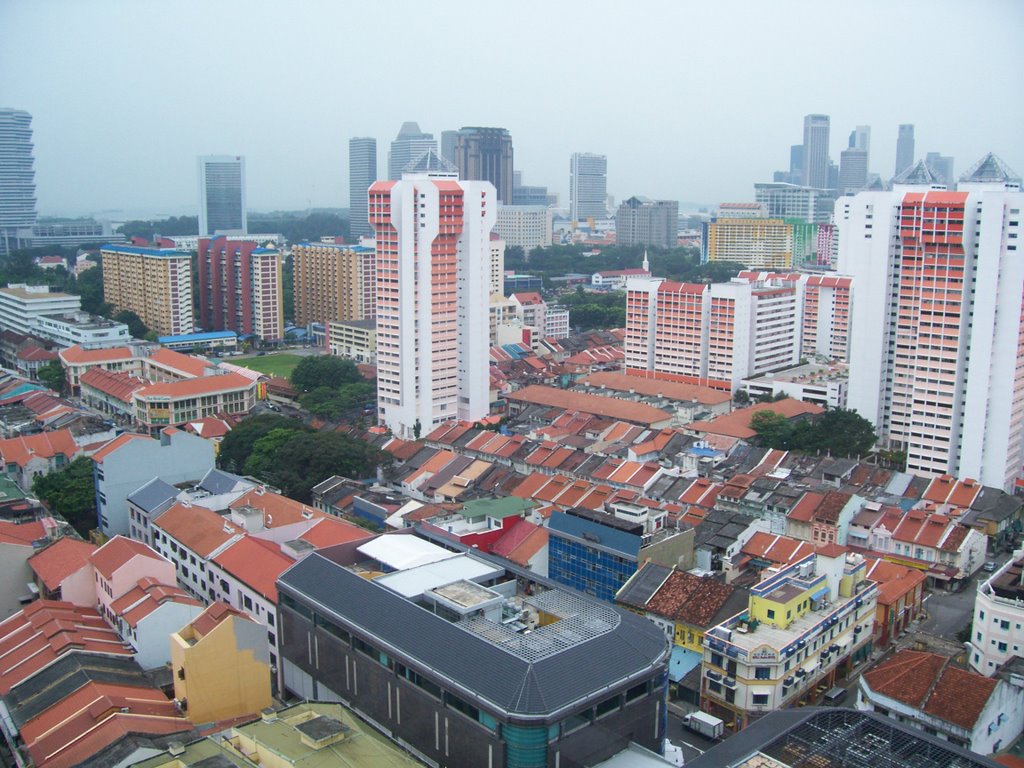
The Government plays an important role in the lives of people through the usage of subsidies. It taxes private transport and subsidizes the public transportation and housing sector. The railway tariffs are capped at a maximum value of about 3 Singapore dollars for a trip to encourage greater usage of the MRT. The surcharge on cars to increase the purchase and ownership costs (as mentioned previously), tolling on high congestion spots at peak hours (using Electronic Road Pricing) and Area Licensing Scheme (restricted zones in business areas) have eased the traffic which is fairly dense at peak hours. It has developed a system which even the Americans have tried to emulate but have not been able to do so far.

Urban development has not been given due importance in India and it is worthwhile for us to consider measures to reduce the movement of cars in cities and boost public transportation, like in London or Curitiba (in Brazil, considered as one of the best examples of urban development). Mumbai, Bangalore and other cities are all aiming to be Shanghai but they are all slowly choking and require urgent measures to get them back on track.

In the housing segment, there are two types of flats here – HDB (Housing Development Board) and Condors. The Govt. constructs and sells/leases out HDBs at lower than market rates and this serves a substantial portion of Singapore’s housing needs. Condors are private flats and are more elitist in nature. This is another example of the Govt.’s presence in a very commercial business which may be scoffed by believers of laissez faire.

A massive urban renewal programme which began in the 1960s resulted in the replacement of all slums with these housing units. The Govt. of that time required that a percentage of everyone’s wages be placed in a forced retirement account or be used to purchase a residence which resulted in everyone owning a property in the country. Slums and displacement is another serious issue that we face in India and there needs to be a further debate on how we address that issue.

Democracy is a virtue that we do not necessarily celebrate because we take it for granted. This is alien to Singapore but they do not mind it – probably a frog in the well syndrome. Singapore’s First Premier and principal architect, Mr. Lee Kuan Yew, believes that democracy is a primarily Western concept and not necessarily required for Asia and so they should not be judged on this yardstick. This has found its echo in various Asian countries with China, Malaysia and a few others endorsing this opinion. He had famously stated in a newspaper interview :

I am often accused of interfering in the private lives of citizens. Yes, if I did not, had I not done that, we wouldn't be here today. And I say without the slightest remorse, that we wouldn't be here, we would not have made economic progress, if we had not intervened on very personal matters - who your neighbour is, how you live, the noise you make, how you spit, or what language you use. We decide what is right. Never mind what the people think.

But as an Indian who sees and cherishes the ideals of a free world, I do not subscribe to this thought process. Economic freedom without political freedom is a very superficial freedom, something that has earned Singapore the dubious name of a “nanny state”. Policies like excessive fines, tax reliefs for sterilization, compulsory saving schemes, strong censorship and archaic draconian laws have diminished its position in terms of human rights but it's principle has been Greater Capitalism for Socialism, dubbed by Singapore University scholars as "meritocratic,elitist,Confucianist, bureaucratic state". The principle seems to work fine currently and the people are very much in favour of it but can it sustain in the long run??? Let's wait and watch.....

Tail piece: You would be surprised to know that chewing gum was banned in Singapore until a few years ago (2004) when the US Govt. negotiated, alongside the active lobbying of gum maker Wrigley’s, with the Singapore government for the lifting of the ban. Sticking of the gum in train doors and other public places was leading to a public nuisance, so the ban was imposed. Even now it is available here only in drugstores and that too on prescription!!!

Sunday, October 08, 2006

Singapore Diary - Part 2

The second week starts and my office work increases. I do not perform anything earth shaking except a lot of Control C- Control V job in the last few days, mostly not even aware of what is happening but hey, my targets are achieved by this simple movement of my two hands. That’s all work life has become – a monotonous drole which pays you, to show off to your peers. Stop cribbing I tell myself but then Dil Hai Ki Manta Nahin and so I log in and decide to do a bit of my blogging work again – a necessary outlet for my incessantly wavering mind.

We plan to go to a place called Sentossa but the rain gods play spoil sport and we reschedule our tour itinerary to travel to a couple of museums in Jurong East. It’s all child’s play out there and we get bored pretty quickly though I manage to capture an IMAX viewing of “Mars Travel”. But the good thing is that I see industries in this part of the world and travel by the bus for the first time. The railway pass I had bought can be used in the bus (called LRT here) also. That’s nice; I had heard of plans of a similar integrated multi-transport system in India(useful info available in the Indian Economy Blog) also but wonder what happened to it.

I am not the most active temple goer while in India but I decide to check out a temple in this island city. And so here, I am in front of Sri VeeramaKaliamman Temple, next to Veerasamy Road in Little India. It’s a busy Saturday evening and lots of people around but it feels reasonably good. I have doubts if I can use my camera inside but I see a few Europeans taking photos, so I enter. Seeing me, a Japanese tourist (he reminds me of the tourist in Munnabhai MBBS) asks me in gestures if I can get his snap taken in front of the temple. I oblige hoping to get the favour returned .He's, however, not too pleased with my photography skills in my first two shots but settles on my third attempt . He’s satisfied and leaves but I forget to get my photo taken.

As I step out of the temple, I hear "Apadi Poddu Poddu" from one of the hotels. I take a walk around and realize that there’s not a single non-Indian store in the place (99% Tamil). You’d think I may as well be in Coimbatore as I see Ananda Bhavan, Komalas, Meenas and many other such hotels. A North Indian could be equally bewildered as a Westerner seeing Tamil sprayed around in such quantity.

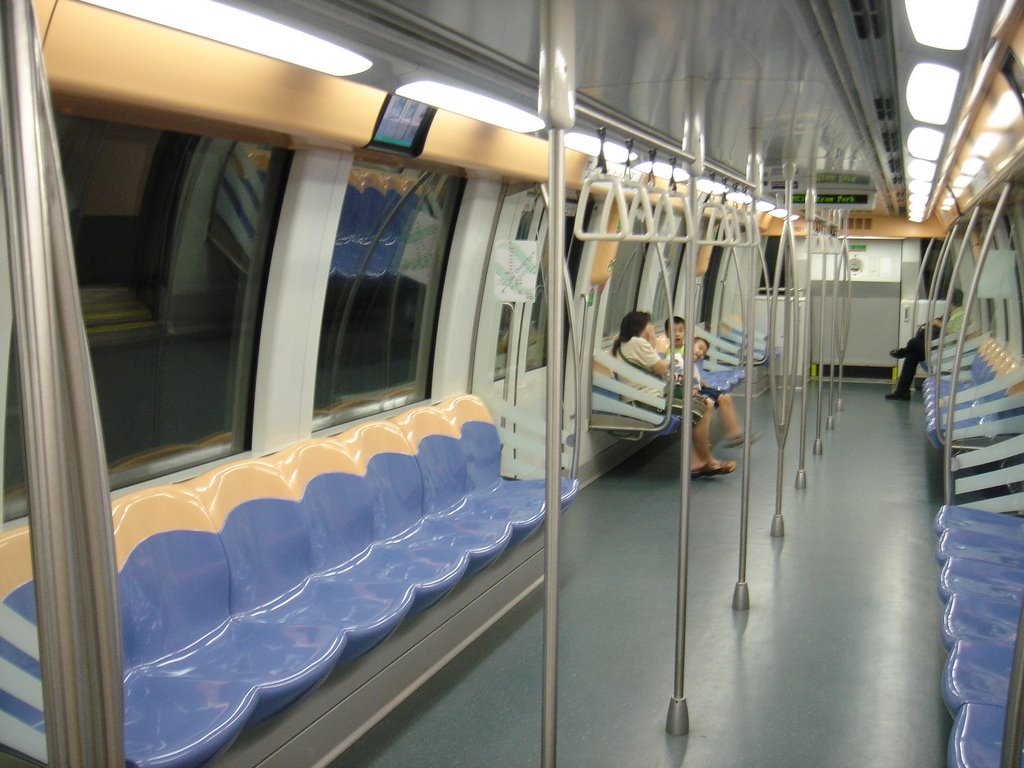
I am allowed taxi travel as per company norms but I decide to hitch train rides daily rather than go by the cab. One reason is my nostalgia associated with Mumbai and its train travel, though they are not comparable in the actual sense. Secondly, I feel that one of the best ways to know the people of a place is to travel in the most common mode of transport there. Not that I make a great job at it (which I realize later) as I stand in the train staring at the people while most of them are hooked to ipods and lost in their own world.


(View inside the Singapore MRT-Local Train)

Nevertheless, I buy a pass (an EZ-Link Magnetic Card) and load it with 30 Singapore dollars and proceed. You swipe the ticket at a fare gate while entering a station and swipe out at another at the place you get out and the fare is deducted for the distance covered. The amount of travel inside the stations is much more than the actual journey which is a dampener at times but then since some exercise has also to be factored in, I’m ok with that option.

One first hand observation I have is of the work culture prevalent here. It is something similar to India in terms of people working for long hours. The few Europeans I see here are more inclined to visit the evening pubs or maybe dash home unlike our hardworking Singaporean. I guess it’s not just an Indian mentality; an Asian work style though not as difficult as the Japanese culture of workaholism. With no girlfriends in store and no inclination towards bars, I decide I may as well be a part of this brigade which sits late (not necessarily office work though). The MBA in me of course makes me think - Good market for stress counselors, gyms, alternative lifestyles etc.???

I am told by one of my colleagues that the Maruti Swift which is modestly priced (ok, not modest for most of us) in India at about Rs 4-5 lakh is available at about Rs 18 lakhs here and that’s the Maruti 800 equivalent gaadi here. I am shocked at this apparently huge price difference but apparently, this is part of Government policy to curb the number of private vehicles on the roads to avoid traffic congestion. Interesting, isn’t it?

It brings to focus the larger question at stake – the role of governments in Free markets. Should governments allow markets to dictate terms by following a policy of laissez faire or be an interventionist keeping the larger picture in mind? Are free markets truly free or do they breed crony capitalism? I’ll not debate that at least in this post but would like to discuss this in detail later in some other post.

Even at the risk of being dismissed as a cliche, I’d like to reiterate that you can take the Mallu out of politics but not the politics out of a Mallu. So, I look around the place scanning for some political banners, forums or any other symbols of politics in Singapore. But I struggle to find any such demonstrative political paraphernalia around unlike in India, where we are all members (active or passive) of a larger political act.

I must confess that I do not ask Singaporeans themselves about it but go by what I see around which is not a very scientific way of drawing conclusions. But then the politics of a place can be felt in the air and the remarkable absence of it is a discerning factor (at least to me). So, I turn to my old faithful Google to find out more and realise that this is a one party democracy (???).Time to revisit my understanding of democracy???

I'm running out of time;I better stop.Will continue the discussion on the economic and political style in the next post……………

Friday, September 29, 2006

Singapore Diary - Part 1

(The view from my hotel room)

I am taking a brief hiatus from my general blogging to venture into personal terrain, during my brief stay in Singapore. To be honest, I am not very keen on spending money and travelling abroad but if your employer wants to show you the world, can you say no? And so here I am jotting down my thoughts in the tiny island of Singapore- lost and confused as usual.

I reach the shores of Singapore, after a few weeks of visa related delays, at about 6:30 (4 AM IST) in the morning, with about 4 hours of sleep in Singapore Airlines. The Airlines is quite comfortable and I am escorted across without too many security checks, unlike how I had imagined it would be. I step out hesitatingly out of the plane(my confidence is always at a premium in a new environment)and bump into an old acquaintance who clearly knows the place and guides me across to the foreign exchange counter and subsequently to the taxi stand.

The taxi driver is a jolly man and gives me his visiting card, in case I wish to go for city darshan (I did not have a visiting card myself, how offending!!!). Anyway, he drops me off at New Park Hotel which is at a place called Little India. After a few hours of rest, I am summoned to office to meet my boss for the first time. And in the evening, I’m back to the hotel in the local train (they it call it MRT here). I stay next to a mall kind of place called Mustafa which has everything under the sun available.

I am glad to find that the place is inundated with Indians, especially from the south. My food is happily taken care of and I hear Tamil words wafting across the place. The Mallu in me, however, searches for a Kerala connection but I do not find any. Is the stereotyped Nair chai kada (tea stall) or thattu kada (roadside stall) just a figment of someone’s fertile imagination?

Singapore is full of streets and alleys. Every road/ street I see carries a name -something very important for us to learn; I often why India does not have proper signboards and notices everywhere rather than leaving us to the mercy of the public. Nevertheless, I lose track of my hotel briefly before relocating it after some local help (speaks volumes about my sense of direction, I guess).

The transportation scene is good with trains being the main system in this small country. The local train travel is pretty comfortable and I am at ease on the first day itself. It is similar to Mumbai with three different tracks operating through the city but there ends the similarity. The train has automatic doors; is well lit and is an indoor travel for most of the journey. The arrival of the stations is announced and displayed both in English and Tamil. If only Mumbai tried to emulate a few of these things…..But Delhites have told me that the MRT there is equally good.I assume it is but I cannot vouch for it...

Taxis are prevalent but difficult to get after about 8 pm, except of course if you call their service and book a taxi. The taxis are fairly hi-tech in the sense that they accept cards, provide bills and are connected to the local network through an interactive device always. A couple of nights back, I am given a small treatise on the call girls industry in Singapore by a friendly cab driver who wonders why India does not legalize this profession as in Singapore or Thailand.

I also learn that call girls here carry yellow employment passes and that this industry contributes about 2% of the GDP in Thailand. Wow, maybe they should think about starting a few SEZs- Special Entertainment Zones- then ? That's the in thing; ask Kamal Nath.I do not endorse the cabbie’s views but decide not to argue in an alien country and smile approvingly.

I am surprised that the office has no canteen here but looks like that’s the norm here. Everyone eats outside and I wonder if the concept of a cooking housewife is a misnomer here. With lots of hotels and joints spread across, we are spared of this chore as bachelors. I do not come across any animals here except in hotels. Maybe, no one’s ever told them that there are even other creatures on this planet. Thank God, the Holy Cow is still safe in India…

Of course, the work is no great shakes except that we are in a foreign country but then are we not living our dream of working outside India?(The quintessential Andhraite’s perennial dream). I refuse to divulge further details on innocuous things like job profile and work but if someone were to ask me about my job, I would say check the monster.com ad – Caught in the wrong job???

But where’s the poverty of Singapore? Are there no poor people here? I do not know but then this world is so different from the world I know and have seen sometimes. Once a while as I enjoy this luxurious life, I ask myself is the world between the haves and the have-notes unbridgeable? Being the pseudo-socialist that I am, whose exposure to poverty is limited to Sainath’s articles, I soon forget this troubled question and become a part of the conformist elite that lives on, ignoring how the other half lives…

Anyway, it’s a week down and three more to go before I’m back in MY COUNTRY…

Thursday, September 07, 2006

Asian Travellers' Mid-Air Blues

A brown skin and a beard are not a felicitous (suitable) combination


– Rohinton Mistry, commenting on racial profiling

In about a month’s time, I would be travelling to Singapore on my first international trip. It’s an exciting prospect to see the world outside India but international travel worries me - I’m an Indian and these are troubled times for South Asians travelling in international flights. There have been quite a few incidents in recent times that have brought to focus racial profiling that Asians are being subjected to, in the name of national security and counter terrorism. The recent experiences of the 12 Mumbaikars who were returning via Netherlands, a Hyderabadi lad holed out in London on his way to US and two British Asians detained in an airport in Spain,after they were overheard conversing in Urdu, is unnerving.

The 12 Mumbaikars were innocuous businessmen who travelled frequently and had never got into any kind of trouble earlier. The Dutch side claims that these people exhibited suspicious behaviour on the flight – using mobiles on the plane, moving around frequently and talking in hushed tones. The Indian Government has asked for a full scale investigation into the incident and has just stopped short of asking for an apology. Maybe we were trying to be diplomatically nice with the Dutch authorities by not asking for an apology.

The public response has, of course, been much more vocal, accusing the Dutch officials of selectively targeting on the basis of race. Why would trained terrorists try to make their presence so evident in the flight? From when has fidgeting with mobiles become an international crime?Agreed that they did not exactly behave in the most gentlemanly fashion, but does that make them suspects who have to be handcuffed?

The West is pretty paranoid about this entire business of terrorists. I’m sure that it is a serious problem and we need to be very careful but when they get overboard as they have been doing in recent times, it gets to one’s nerves. It’s no one’s case that national security is to be treated with soft hands but when in the name of security, Asians who carry the stereotyped perceptions of terrorists, get grounded and often humiliated, it calls for serious concern.

Of course, not many remember that the most of the WTC accused were clean shaven, educated Islamic youth who would not have cleared the International Terrorism Exam, set by the Bush-Blair combine. How dumb would it be if terrorists were to stick to stereotypes and turn up at airports in the most conspicuous of manners? We are dealing with an intelligent group of terrorists who can outsmart the Pentagon and bring down WTC. A strategy which panders to such an ill-conceived notion and breeds on extreme Islamophobia is ridiculous. But then with the IQ of George Bush, should we even be surprised?

This situation is not going to change in the near future. To be fair to the airport authorities, we probably need to accept the fact that no one wants to take any chance and every possible danger is being addressed head on. Even for every 10 such incidents, if the authorities are successful in stopping at least one attempted sabotage, it is worth carrying out this effort.

But the flip side is that obviously, there would be a few people who would be rubbed the wrong way because of this. It has to be handled carefully and sensitively so that no one feels offended or atleast the offending factor is kept to minimum-something the Dutch did not do too well. Gallup poll surveys conducted post 9/11 have found that most people were uncomfortable with this blatant profiling of Middle Eastern or South Asian airline passengers; some sobering consolation for us, I guess.

Indians across have raised a hue and cry over this racial profiling, especially after the Mumbai incident, and quite rightly too. However, let’s step back for a moment and question our “holier than thou” attitude towards “cultural profiling”. We have our own set of prejudices that run deep down. We are a preachy nation who likes to tell others what’s wrong with their culture, while we wallow in a curious mix of self-pride and self-pity.

We also indulge in straitjacketing people here, probably not so much in terms of race but caste and religion (Of course there have been racial incidents here too like bars in Mumbai not allowing blacks on grounds of being suspected drug peddlers). There are so many people I have met who believe that reservations are bad for the simple reason that the backward castes are not good enough for studying and that any such idea will spell doom for us. So, while fretting and fuming is fine, it's also time for some self-introspection.

Maybe I should not be worrying too much. I do not fit the caricature of the terrorist designed by the West. I do not sport a beard (except for an occasional stubble) or wear a skull cap - supposedly, the latest fashion statement of all wannabe terrorists. I do not have a name with any religious connotations and do not speak Arabic/Urdu. Brown skin is the only dangerous sign I carry of being a terrorist.

P.S. I just came across a news item in BBC featuring the latest airport screener which shows passengers naked!!! This is really scary, wonder if this will enter the voyeuristic world of MMS someday. Time to bid goodbye to Right to Privacy???