A few days left before I am back in India and so my smileometer is beaming high signals in the midst of hazy Singapore skies (an annual haze in this part of the year caused by forest fires in Sumatra). A sign of confused times when you make money but wonder what exactly you want to do in life and is it worth troubling your mind but satisfying your pocket. As I ponder over this question and ask myself how much I can take all this, I decide to tread the conformist path of doing nothing but journeying along till you are forced to take up the less trodden path.
A vegetarian’s life is a difficult one outside India. Wherever I go, I find the meat of some animal or the other ornately decorated and put up for sale but very few restaurants catering to the needs of a herbivore like me (Fellow Indians think it blasphemous for a Keralite to even be a vegetarian). Since I stay in a predominantly Indian environment in Singapore, its fine but otherwise it can be a tough choice. Vegetables are at a pretty low priority here.
India is quite inclusive when it comes to such eating habits as it serves both the vegetarian and the non-vegetarian palate. I find it both amusing and outright crazy when I see a Kentucky Fried Chicken outlet in Singapore Zoo. How can a zoo which is meant to be a home for animals be a place for serving them hot? Of course, it may be a case of forward integration for the zoo!!!
I am shocked (an understatement) when I am told that it is a govt. policy that birds are not allowed into the city limits. Not allowed??? There are, supposedly, shooting squads to ensure this compliance. I cannot confirm the veracity of such a law/policy in force but honestly, I have never seen a bird here and the closest I have come to, is reading, in The Strait Times, of bird droppings being a menace for poor car owners. This would have been funny if not an example of insensitivity of the state towards anything that does not derive economic value.
We forget very conveniently that buildings and malls cannot substitute the beauty of nature and that co-habitation is the key to a greater and more fulfilling existence. Imagine a day when future generations here do not know what animals are and have to visit museums to see their remnants.
The Government plays an important role in the lives of people through the usage of subsidies. It taxes private transport and subsidizes the public transportation and housing sector. The railway tariffs are capped at a maximum value of about 3 Singapore dollars for a trip to encourage greater usage of the MRT. The surcharge on cars to increase the purchase and ownership costs (as mentioned previously), tolling on high congestion spots at peak hours (using Electronic Road Pricing) and Area Licensing Scheme (restricted zones in business areas) have eased the traffic which is fairly dense at peak hours. It has developed a system which even the Americans have tried to emulate but have not been able to do so far.
Urban development has not been given due importance in India and it is worthwhile for us to consider measures to reduce the movement of cars in cities and boost public transportation, like in London or Curitiba (in Brazil, considered as one of the best examples of urban development). Mumbai, Bangalore and other cities are all aiming to be Shanghai but they are all slowly choking and require urgent measures to get them back on track.
In the housing segment, there are two types of flats here – HDB (Housing Development Board) and Condors. The Govt. constructs and sells/leases out HDBs at lower than market rates and this serves a substantial portion of Singapore’s housing needs. Condors are private flats and are more elitist in nature. This is another example of the Govt.’s presence in a very commercial business which may be scoffed by believers of laissez faire.
A massive urban renewal programme which began in the 1960s resulted in the replacement of all slums with these housing units. The Govt. of that time required that a percentage of everyone’s wages be placed in a forced retirement account or be used to purchase a residence which resulted in everyone owning a property in the country. Slums and displacement is another serious issue that we face in India and there needs to be a further debate on how we address that issue.
Democracy is a virtue that we do not necessarily celebrate because we take it for granted. This is alien to Singapore but they do not mind it – probably a frog in the well syndrome. Singapore’s First Premier and principal architect, Mr. Lee Kuan Yew, believes that democracy is a primarily Western concept and not necessarily required for Asia and so they should not be judged on this yardstick. This has found its echo in various Asian countries with China, Malaysia and a few others endorsing this opinion. He had famously stated in a newspaper interview :
I am often accused of interfering in the private lives of citizens. Yes, if I did not, had I not done that, we wouldn't be here today. And I say without the slightest remorse, that we wouldn't be here, we would not have made economic progress, if we had not intervened on very personal matters - who your neighbour is, how you live, the noise you make, how you spit, or what language you use. We decide what is right. Never mind what the people think.
But as an Indian who sees and cherishes the ideals of a free world, I do not subscribe to this thought process. Economic freedom without political freedom is a very superficial freedom, something that has earned Singapore the dubious name of a “nanny state”. Policies like excessive fines, tax reliefs for sterilization, compulsory saving schemes, strong censorship and archaic draconian laws have diminished its position in terms of human rights but it's principle has been Greater Capitalism for Socialism, dubbed by Singapore University scholars as "meritocratic,elitist,Confucianist, bureaucratic state". The principle seems to work fine currently and the people are very much in favour of it but can it sustain in the long run??? Let's wait and watch.....
Tail piece: You would be surprised to know that chewing gum was banned in Singapore until a few years ago (2004) when the US Govt. negotiated, alongside the active lobbying of gum maker Wrigley’s, with the Singapore government for the lifting of the ban. Sticking of the gum in train doors and other public places was leading to a public nuisance, so the ban was imposed. Even now it is available here only in drugstores and that too on prescription!!!
Sitemeter
Friday, October 20, 2006


Sunday, October 15, 2006
Pyongyang Joins the Party
Imagine an exclusive executive club where a select group of powerful influential persons are members. These members enjoy rights denied to ordinary denizens and have a constitution which seeks to ensure that the club remains as elitist as possible. Their actions are highly questionable but they shroud it in morally hypocritical arguments of the greater good and preach the same to non-members. Persons who try to intrude are penalized and given stiff punishments so that the club maintains its status quo position. But there are always crazy plebeians who still manage to gatecrash bypassing the laws, something that represents North Korea’s entry into the World Nuclear Club.
North Korea had always been threatening to go the nuclear way (it withdrew from the NPT in 2003) and it was a more a question of when rather than if and so it did not surprise anybody except for a few news channels who had to feign surprise to give it that breaking news effect. For a number of years, the nuclear world was dominated by five countries who entrusted to themselves the task of protecting their existence and by extension, the world, till one fine day, two countries decided to no longer play ball. Pokharan and Chagai Hills pushed India and Pakistan into this club and now, North Korea has followed suit. Now there are renewed fears that Iran too would test the bomb.
Pyongyang going nuclear reveals a few things. It diminishes China’s assumed ability to leverage its relationship with North Korea and also undermines President Bush’s attempts to threaten it in terms of embargos. For countries to condemn it (including India) saying it threatens regional stability is a classic case of hypocrisy. But then, that’s a naive argument in the world of real politicking.
Even a militarily-passive Japan, which has always used the example of Hiroshima and Nagasaki to convey the sense of loss and destruction that nuclear weapons can bring, is under the US nuclear umbrella and so they can preach peace. Non-proliferation as a tool has not worked for more than half a century and is not expected to bring in any new dividends. What is required is a clear elimination of nuclear weapons and not reduction.
I was amongst the many jubilant voices in India when we went ahead with our Pokharan spectacle. There was this jingoistic feeling of having cocked a snook at the world-the Yankees could not stop us and now we are the super powers etc. But now, as the adrenaline levels have gone down and “Shining India” is almost a dirty word, I wonder what we achieved by going nuclear, except maybe an exaggerated sense of national pride for a few days (Of course, with exceptions like my Andhraite neighbour who was unhappy that the tests would lead to the cancellation of his son’s US visa). Does the theory of nuclear deterrence actually work? I don’t think so. The tests gave us a false sense of pride, a feeling that we are major players in the world and that the world will now listen to us. It probably does listen in many forums but that is due to our market size rather than our arsenals (Poor Shashi Tharoor is a casualty of that belief).
For a country like North Korea that stands almost at the bottom of the bottom of the economic pyramid in the world and has scores of people dying due to natural and state-sponsored schemes of disaster, you would wonder what nuclear weapons could do. Our knowledge about the country is quite limited because North Korea does not publish statistics (their own economists have no idea what their inflation rate is) except that it has the fifth largest military in the world, with the largest percentage of citizens enlisted. Maybe it gives them a sense of pride but since media is not given a proper access to the public domain; we do not even know that.
At a larger level, Kim Jong - II will leave North Korea a poorer country where hunger is fed by patriotic talk and Western phobias. Do the people have a future to look towards? A country that is so poor but believes that nuclearization will help it. Maybe, but from whom?? Let me quote the words of The XIVth Dalai Lama here which conveys all this and so much more:
Peace, in the sense of the absence of war, is of little value to someone who is dying of hunger or cold. It will not remove the pain of torture inflicted on a prisoner of conscience. It does not comfort those who have lost their loved ones in floods caused by senseless deforestation in a neighboring country. Peace can only last where human rights are respected, where people are fed, and where individuals and nations are free.
Such countries will probably perish under the might of their own contradictions and burdens in the long run. As Amartya Sen discusses in his article on Democracy, a democratic state with a free press ushers in a certain amount of administerial responsibility because of the constant focus of the media on it. He successfully argues how a democratic state can ensure that there are no famines and droughts, something that Pyongyang needs to realize.
Nuclearization is a greater political decision than a military one. For starters, we do not even know whether they actually conducted the test successfully, as being alleged in certain quarters. Suddenly, there are talks of South Korea and Japan reconsidering their proliferation options because they feel threatened in the presence of a nuclear neighbour. The nuclear issue has also whipped up a great deal of passion in the forthcoming US Senate polls with the Democrats alleging that the North Korea going nuclear is an example of the failure of Bush’s much vaunted diplomacy.
The Americans have threatened to impose fresh sanctions but will it help? History shows it has never done anyone any good except possibly companies that act as intermediaries (Food for Oil Program types). The recent Iraq experience has shown them to be a total failure but then since constructive diplomacy has never been the most common means of working, the same old strategy will continue. In retrospect, we know that Iraq did not have the alleged nuclear stockpiles but if it had, would history have been different? Did this influence North Korea when it decided to go nuclear?
What drives nations to nuclearization? Maybe a false sense of machismo- the chest beating and fist thumping variety where you cannot offer anything to your people and so camouflage it using false arguments of self-pride, deterrence and defence. Ask the average North Korean the significance of this (assuming one day you can see him expressing his views) and his blank face would convey all that peace activists have been trying to bandy about. Do I sound naive or foolish when I advocate peace? Maybe but I believe that the world can only survive with the philosophy of peace and not the politics of non-deterrence ballistics.
I end my post by quoting the renowned French philosopher Albert Camus’s famous words that rings so true:
Peace is the only battle worth waging
Sunday, October 08, 2006
Singapore Diary - Part 2
The second week starts and my office work increases. I do not perform anything earth shaking except a lot of Control C- Control V job in the last few days, mostly not even aware of what is happening but hey, my targets are achieved by this simple movement of my two hands. That’s all work life has become – a monotonous drole which pays you, to show off to your peers. Stop cribbing I tell myself but then Dil Hai Ki Manta Nahin and so I log in and decide to do a bit of my blogging work again – a necessary outlet for my incessantly wavering mind.
We plan to go to a place called Sentossa but the rain gods play spoil sport and we reschedule our tour itinerary to travel to a couple of museums in Jurong East. It’s all child’s play out there and we get bored pretty quickly though I manage to capture an IMAX viewing of “Mars Travel”. But the good thing is that I see industries in this part of the world and travel by the bus for the first time. The railway pass I had bought can be used in the bus (called LRT here) also. That’s nice; I had heard of plans of a similar integrated multi-transport system in India(useful info available in the Indian Economy Blog) also but wonder what happened to it.
I am not the most active temple goer while in India but I decide to check out a temple in this island city. And so here, I am in front of Sri VeeramaKaliamman Temple, next to Veerasamy Road in Little India. It’s a busy Saturday evening and lots of people around but it feels reasonably good. I have doubts if I can use my camera inside but I see a few Europeans taking photos, so I enter. Seeing me, a Japanese tourist (he reminds me of the tourist in Munnabhai MBBS) asks me in gestures if I can get his snap taken in front of the temple. I oblige hoping to get the favour returned .He's, however, not too pleased with my photography skills in my first two shots but settles on my third attempt . He’s satisfied and leaves but I forget to get my photo taken.
As I step out of the temple, I hear "Apadi Poddu Poddu" from one of the hotels. I take a walk around and realize that there’s not a single non-Indian store in the place (99% Tamil). You’d think I may as well be in Coimbatore as I see Ananda Bhavan, Komalas, Meenas and many other such hotels. A North Indian could be equally bewildered as a Westerner seeing Tamil sprayed around in such quantity.
I am allowed taxi travel as per company norms but I decide to hitch train rides daily rather than go by the cab. One reason is my nostalgia associated with Mumbai and its train travel, though they are not comparable in the actual sense. Secondly, I feel that one of the best ways to know the people of a place is to travel in the most common mode of transport there. Not that I make a great job at it (which I realize later) as I stand in the train staring at the people while most of them are hooked to ipods and lost in their own world.
(View inside the Singapore MRT-Local Train)
Nevertheless, I buy a pass (an EZ-Link Magnetic Card) and load it with 30 Singapore dollars and proceed. You swipe the ticket at a fare gate while entering a station and swipe out at another at the place you get out and the fare is deducted for the distance covered. The amount of travel inside the stations is much more than the actual journey which is a dampener at times but then since some exercise has also to be factored in, I’m ok with that option.
One first hand observation I have is of the work culture prevalent here. It is something similar to India in terms of people working for long hours. The few Europeans I see here are more inclined to visit the evening pubs or maybe dash home unlike our hardworking Singaporean. I guess it’s not just an Indian mentality; an Asian work style though not as difficult as the Japanese culture of workaholism. With no girlfriends in store and no inclination towards bars, I decide I may as well be a part of this brigade which sits late (not necessarily office work though). The MBA in me of course makes me think - Good market for stress counselors, gyms, alternative lifestyles etc.???
I am told by one of my colleagues that the Maruti Swift which is modestly priced (ok, not modest for most of us) in India at about Rs 4-5 lakh is available at about Rs 18 lakhs here and that’s the Maruti 800 equivalent gaadi here. I am shocked at this apparently huge price difference but apparently, this is part of Government policy to curb the number of private vehicles on the roads to avoid traffic congestion. Interesting, isn’t it?
It brings to focus the larger question at stake – the role of governments in Free markets. Should governments allow markets to dictate terms by following a policy of laissez faire or be an interventionist keeping the larger picture in mind? Are free markets truly free or do they breed crony capitalism? I’ll not debate that at least in this post but would like to discuss this in detail later in some other post.
Even at the risk of being dismissed as a cliche, I’d like to reiterate that you can take the Mallu out of politics but not the politics out of a Mallu. So, I look around the place scanning for some political banners, forums or any other symbols of politics in Singapore. But I struggle to find any such demonstrative political paraphernalia around unlike in India, where we are all members (active or passive) of a larger political act.
I must confess that I do not ask Singaporeans themselves about it but go by what I see around which is not a very scientific way of drawing conclusions. But then the politics of a place can be felt in the air and the remarkable absence of it is a discerning factor (at least to me). So, I turn to my old faithful Google to find out more and realise that this is a one party democracy (???).Time to revisit my understanding of democracy???
I'm running out of time;I better stop.Will continue the discussion on the economic and political style in the next post……………
We plan to go to a place called Sentossa but the rain gods play spoil sport and we reschedule our tour itinerary to travel to a couple of museums in Jurong East. It’s all child’s play out there and we get bored pretty quickly though I manage to capture an IMAX viewing of “Mars Travel”. But the good thing is that I see industries in this part of the world and travel by the bus for the first time. The railway pass I had bought can be used in the bus (called LRT here) also. That’s nice; I had heard of plans of a similar integrated multi-transport system in India(useful info available in the Indian Economy Blog) also but wonder what happened to it.
I am not the most active temple goer while in India but I decide to check out a temple in this island city. And so here, I am in front of Sri VeeramaKaliamman Temple, next to Veerasamy Road in Little India. It’s a busy Saturday evening and lots of people around but it feels reasonably good. I have doubts if I can use my camera inside but I see a few Europeans taking photos, so I enter. Seeing me, a Japanese tourist (he reminds me of the tourist in Munnabhai MBBS) asks me in gestures if I can get his snap taken in front of the temple. I oblige hoping to get the favour returned .He's, however, not too pleased with my photography skills in my first two shots but settles on my third attempt . He’s satisfied and leaves but I forget to get my photo taken.
As I step out of the temple, I hear "Apadi Poddu Poddu" from one of the hotels. I take a walk around and realize that there’s not a single non-Indian store in the place (99% Tamil). You’d think I may as well be in Coimbatore as I see Ananda Bhavan, Komalas, Meenas and many other such hotels. A North Indian could be equally bewildered as a Westerner seeing Tamil sprayed around in such quantity.
I am allowed taxi travel as per company norms but I decide to hitch train rides daily rather than go by the cab. One reason is my nostalgia associated with Mumbai and its train travel, though they are not comparable in the actual sense. Secondly, I feel that one of the best ways to know the people of a place is to travel in the most common mode of transport there. Not that I make a great job at it (which I realize later) as I stand in the train staring at the people while most of them are hooked to ipods and lost in their own world.
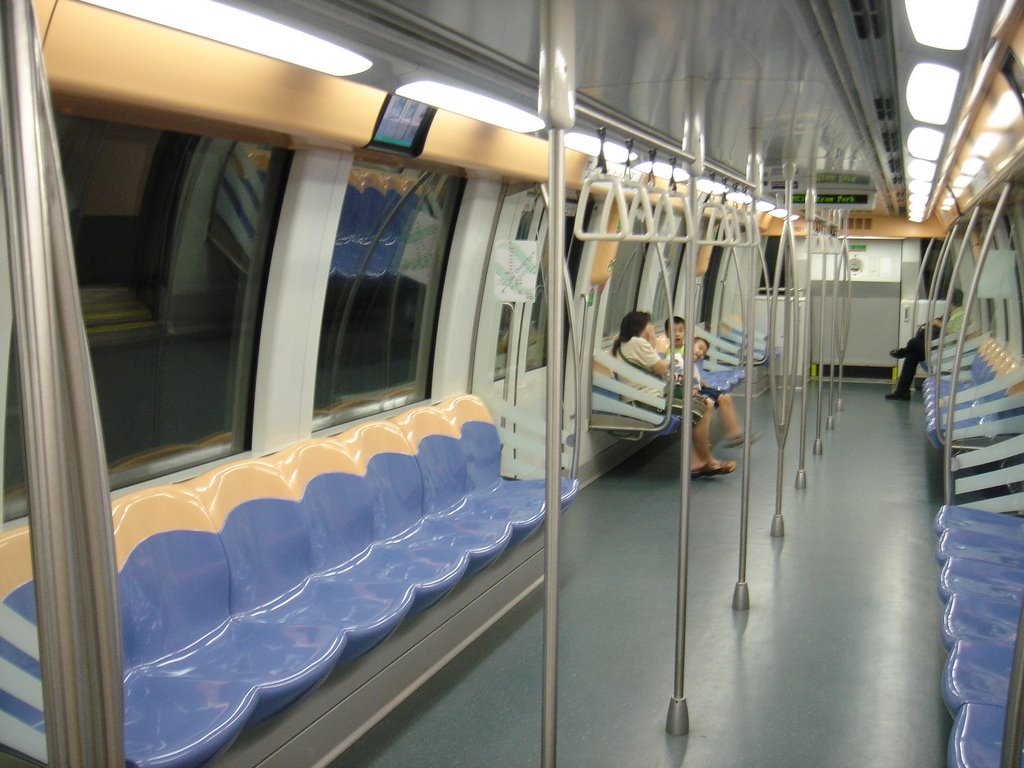
(View inside the Singapore MRT-Local Train)
Nevertheless, I buy a pass (an EZ-Link Magnetic Card) and load it with 30 Singapore dollars and proceed. You swipe the ticket at a fare gate while entering a station and swipe out at another at the place you get out and the fare is deducted for the distance covered. The amount of travel inside the stations is much more than the actual journey which is a dampener at times but then since some exercise has also to be factored in, I’m ok with that option.
One first hand observation I have is of the work culture prevalent here. It is something similar to India in terms of people working for long hours. The few Europeans I see here are more inclined to visit the evening pubs or maybe dash home unlike our hardworking Singaporean. I guess it’s not just an Indian mentality; an Asian work style though not as difficult as the Japanese culture of workaholism. With no girlfriends in store and no inclination towards bars, I decide I may as well be a part of this brigade which sits late (not necessarily office work though). The MBA in me of course makes me think - Good market for stress counselors, gyms, alternative lifestyles etc.???
I am told by one of my colleagues that the Maruti Swift which is modestly priced (ok, not modest for most of us) in India at about Rs 4-5 lakh is available at about Rs 18 lakhs here and that’s the Maruti 800 equivalent gaadi here. I am shocked at this apparently huge price difference but apparently, this is part of Government policy to curb the number of private vehicles on the roads to avoid traffic congestion. Interesting, isn’t it?
It brings to focus the larger question at stake – the role of governments in Free markets. Should governments allow markets to dictate terms by following a policy of laissez faire or be an interventionist keeping the larger picture in mind? Are free markets truly free or do they breed crony capitalism? I’ll not debate that at least in this post but would like to discuss this in detail later in some other post.
Even at the risk of being dismissed as a cliche, I’d like to reiterate that you can take the Mallu out of politics but not the politics out of a Mallu. So, I look around the place scanning for some political banners, forums or any other symbols of politics in Singapore. But I struggle to find any such demonstrative political paraphernalia around unlike in India, where we are all members (active or passive) of a larger political act.
I must confess that I do not ask Singaporeans themselves about it but go by what I see around which is not a very scientific way of drawing conclusions. But then the politics of a place can be felt in the air and the remarkable absence of it is a discerning factor (at least to me). So, I turn to my old faithful Google to find out more and realise that this is a one party democracy (???).Time to revisit my understanding of democracy???
I'm running out of time;I better stop.Will continue the discussion on the economic and political style in the next post……………
Friday, September 29, 2006
Singapore Diary - Part 1
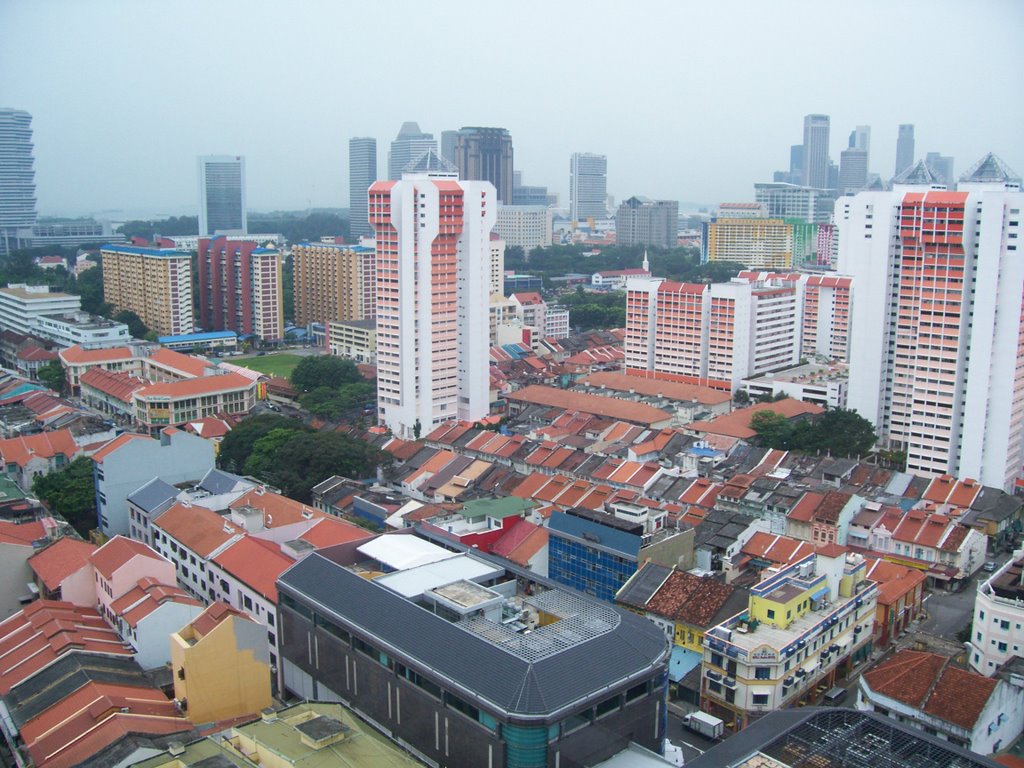 (The view from my hotel room)
I am taking a brief hiatus from my general blogging to venture into personal terrain, during my brief stay in Singapore. To be honest, I am not very keen on spending money and travelling abroad but if your employer wants to show you the world, can you say no? And so here I am jotting down my thoughts in the tiny island of Singapore- lost and confused as usual.
I reach the shores of Singapore, after a few weeks of visa related delays, at about 6:30 (4 AM IST) in the morning, with about 4 hours of sleep in Singapore Airlines. The Airlines is quite comfortable and I am escorted across without too many security checks, unlike how I had imagined it would be. I step out hesitatingly out of the plane(my confidence is always at a premium in a new environment)and bump into an old acquaintance who clearly knows the place and guides me across to the foreign exchange counter and subsequently to the taxi stand.
The taxi driver is a jolly man and gives me his visiting card, in case I wish to go for city darshan (I did not have a visiting card myself, how offending!!!). Anyway, he drops me off at New Park Hotel which is at a place called Little India. After a few hours of rest, I am summoned to office to meet my boss for the first time. And in the evening, I’m back to the hotel in the local train (they it call it MRT here). I stay next to a mall kind of place called Mustafa which has everything under the sun available.
I am glad to find that the place is inundated with Indians, especially from the south. My food is happily taken care of and I hear Tamil words wafting across the place. The Mallu in me, however, searches for a Kerala connection but I do not find any. Is the stereotyped Nair chai kada (tea stall) or thattu kada (roadside stall) just a figment of someone’s fertile imagination?
Singapore is full of streets and alleys. Every road/ street I see carries a name -something very important for us to learn; I often why India does not have proper signboards and notices everywhere rather than leaving us to the mercy of the public. Nevertheless, I lose track of my hotel briefly before relocating it after some local help (speaks volumes about my sense of direction, I guess).
The transportation scene is good with trains being the main system in this small country. The local train travel is pretty comfortable and I am at ease on the first day itself. It is similar to Mumbai with three different tracks operating through the city but there ends the similarity. The train has automatic doors; is well lit and is an indoor travel for most of the journey. The arrival of the stations is announced and displayed both in English and Tamil. If only Mumbai tried to emulate a few of these things…..But Delhites have told me that the MRT there is equally good.I assume it is but I cannot vouch for it...
Taxis are prevalent but difficult to get after about 8 pm, except of course if you call their service and book a taxi. The taxis are fairly hi-tech in the sense that they accept cards, provide bills and are connected to the local network through an interactive device always. A couple of nights back, I am given a small treatise on the call girls industry in Singapore by a friendly cab driver who wonders why India does not legalize this profession as in Singapore or Thailand.
I also learn that call girls here carry yellow employment passes and that this industry contributes about 2% of the GDP in Thailand. Wow, maybe they should think about starting a few SEZs- Special Entertainment Zones- then ? That's the in thing; ask Kamal Nath.I do not endorse the cabbie’s views but decide not to argue in an alien country and smile approvingly.
I am surprised that the office has no canteen here but looks like that’s the norm here. Everyone eats outside and I wonder if the concept of a cooking housewife is a misnomer here. With lots of hotels and joints spread across, we are spared of this chore as bachelors. I do not come across any animals here except in hotels. Maybe, no one’s ever told them that there are even other creatures on this planet. Thank God, the Holy Cow is still safe in India…
Of course, the work is no great shakes except that we are in a foreign country but then are we not living our dream of working outside India?(The quintessential Andhraite’s perennial dream). I refuse to divulge further details on innocuous things like job profile and work but if someone were to ask me about my job, I would say check the monster.com ad – Caught in the wrong job???
But where’s the poverty of Singapore? Are there no poor people here? I do not know but then this world is so different from the world I know and have seen sometimes. Once a while as I enjoy this luxurious life, I ask myself is the world between the haves and the have-notes unbridgeable? Being the pseudo-socialist that I am, whose exposure to poverty is limited to Sainath’s articles, I soon forget this troubled question and become a part of the conformist elite that lives on, ignoring how the other half lives…
Anyway, it’s a week down and three more to go before I’m back in MY COUNTRY…
Thursday, September 21, 2006
Lalu in Wonderland

Railway to Jersey gai ke tarah hai, jitna dhyan doge, utna hee doodh milega
- Lalu Prasad Yadav, in IIM-A
Not maybe the most memorable quote you want to store in your diary. But then being no expert in the field of Bovines, I guess I should reserve my comments on the Jersey cow and stick to the Railways and Lalu, arguably India’s most colourfully articulate politician (Down the Vindhyas, former Kerala CM , Late E K Nayanar is a close competitor for his memorable one-liners like where are there women, there will be rape). His visit to the IIM-A has generated enough media noise on how a rustic shepherd politician from the hinterland is giving lectures in management to India’s creamy layer of MBAs.
It’s been a classic Bollywood story for a small time man who entered politics, at the same time as Nitish Kumar and others, enthused by Jayaprakash Narayan’s call to fight Indira Gandhi’s political hegemony. He later on became the self-proclaimed “Poor Man’s Messiah” before getting mired in a flurry of scandals (Thanks to him, fodder is no longer a rural item).
He cocked a snook at democracy by getting his wife to take over his reins as he cooled his heels in jail. His popularity has still held him in good stead, though not the same way as earlier. His latest avatar as “Management Guru” is of course, undoubtedly his most successful one as critics have suddenly woken up wondering what is it that Lalu has done to put the Railways on track.
The Railways turnaround is a big story and Lalu’s become a management guru, teaching how to revive ailing companies (How about Bihar now?). There are, of course, divided opinions on whether this has anything to do with Lalu’s management skills or due to other reasons? Some have suggested that the economic boom has fostered greater train utility and that it was a case of being at the right place at the right time but there are also pro-Lalu versions.
It’s quite possible but then if it’s the minister in charge who receives brickbats in case things goes wrong, should we hide the bouquets if things go on the right track. To be honest, I am not very sure whether he has changed things (considering his track record of democraticising Bihar) but maybe I should not pass a judgment without actually finding out the truth. But then where are the media stories on what Lalu has actually done?
There’s a certain class hypocrisy when the only reporting that is done about him is his “starched kurta pyjama”, “outlandish language” and other not so proud mannerisms. Every time he appears on screen, the media is hell bent upon playing up his “buffoon” image. Be critical about him and I’m sure that there are any enough points to score doing that.
But reducing a man to mere caricature and making fun of him at a personal level does no credit to the NDTVs and CNN-IBNs. This is not a Lalu-specific mentality but a kind of reporting which measures people on their “so-called” civilizational attributes and blissfully ignores the actual work done by the person. Maybe the English speaking media just does not enjoy the other class doing something that the elite struggle to achieve.
Indian democracy, unlike the American one, is a very grass roots democracy. The people who vote are those who are on the sidelines but find no voice in the non-vernacular media. Wasn’t “Shining India” a triumph of our democracy when the entire press, out of touch with rural India and their aspirations, wrote off the Congress and unilaterally anointed the BJP as the victor?
There’s a certain arrogance in the media which fails to understand the pulse of the nation and paints itself in the colours of the rich and the famous. Slum displacement in the name of development is in “everyone’s interest” but try shifting the people of Cuff Parade and the same story becomes a story of human oppression (and ofcourse, an interview with the ever dependable Mahesh Bhatt).
CNN-IBN interviewed a few IIM-A students (in their early 20s) who were part of Prof. Lalu’s sessions and asked them if they were interested to join Indian Railways. One of them quipped that he would not be interested to join as a bureaucrat but was willing to join if he were invited to be a part of the top management!!! Yes, ofcourse how modest can you get with a tag like IIM-A (is it Arrogance) plaguing you? No stories have come till now of what they think of Lalu’s speech and whether his sound bytes are a value addition to jargons like “core competency” and “SWOT”.
Has the “poster boy” of political entertainment actually grown up or is it just another media entertainment story??? Whatever it is, it is a demonstration of the power of democracy where English savvy media is reduced to pour in tributes to a rustic pastoral leader, albeit reluctantly.
Hopefully, Lalu’s management gyan will give all of us fodder, sorry, food for thought….
Thursday, September 14, 2006
9/11: The Wounded Fraction
Sanjay Dutt is facing trial for the Mumbai blasts case and he may or may not be convicted but he’s done more than anyone else in recent times in making the Mahatma India’s star icon. For a simple man, ironically manifested in all our currency notes, it has been a glorious non-violent comeback (A lesson for our Saurav Dada). “Gandhigiri” is also becoming the most popular political phrase slowly, thanks to Munnabhai. What better occasion to highlight this than while talking about the fraction that has changed the world – 9/11 (It has overtaken 22/7 – the humble pi in the popularity charts). 9/11 is America’s baby out and out but until I watched NDTV/CNN-IBN a few days back, I did not realize that 9/11 was also the centenary of the Satyagraha movement.
The 1st 9/11 in 1906 was used by the apostle of non-violence, Mahatma Gandhi, to launch the Satyagraha movement and it had wide sweeping repercussions not just here but across the globe too. Martin Luther King and Nelson Mandela endorsed it later on making it a very powerful metaphor for non-violent retribution. It presented a powerful case for morally legitimate ways to fight for justice.
The last 9/11 also had sweeping global effects but on a greater negative scale. The world has not changed for the better but is more polarized now, echoing Bush’s infamous statement – “Either you are with us or against us”. That does not leave us with much of a choice then but to be against him.
I don’t even think we need to ask ourselves whether the world has been enriched by American follies – Lebanon, Iraq, Afghanistan and the rest are all landscapes which are testimony to the bleeding that has happened in the glorious name of “democracy” and “peace”. 9/11 was unfortunate but what about these countries and many other African republics which are rotting because of liberal America. Incidentally, 9/11 is also the day (in the 70s) when the democratically elected President of Chile was overthrown and General Pinochet took over the country in a bloody coup killing thousands of people, ably supported by US. Anyone ready to shed tears for them?
Most news channels commemorating the fifth anniversary of the WTC bombing have been repeatedly driving home the claim “The world was never the same”. Quite true, since Americans decide how the world should be. We tried coining dates like 13/12 (Parliament attack) and 12/3 (‘93 Mumbai blasts) but who remembers these poor fractions (I had to search through Google to find these dates).The life of an average Indian is probably not worth that of an American and so terrorist attacks in India do not change the face of the world and in some ways, even the country too; after all, Mumbai’s “resilience” hogged more headlines than the actual blasts.
But then, this is not an entirely an international phenomenon. A blast in Delhi which kills two is given more coverage than the death of 30-40 odd in Tripura. Only when something happens close to our home, we come to realize the potential problem in store, but till that time, token coverage and lip service is all that we can afford.
Has the world changed?
General Musharraf is the US poster boy leading the battle in the Global War on Terror. Whoever thought the perpetrator of the Kargil War would be US’s main weapon against terrorism. Even a suave IIM graduate could not have been able to reposition a losing brand like Pakistan with such elan.
After years of Blairism, UK is finally throwing Blair out after acting as Bush’s stooge for long. The law of averages has finally caught up with him and he is leaving the stage just like Ms.Thatcher did.
The Taliban is regrouping (thanks to a bountiful opium harvest also) and President Hamid Karzai’s power does not extend beyond the boundary walls of his castle.
Iran and North Korea are twitching to test their nuclear arsenals.
Iraq is wallowing in the midst of extreme lawlessness and chaos and the US Govt. has admitted that Saddam has nothing to do with AL-Qaeda or Taliban.
Osama makes guest appearances in videos keeping his halo intact and his foes guessing.
The West makes polite noises about development and democracy and continues its own way while the Rest of the World ambles along.
Who has benefited from all this?
Most of the European companies have bagged contracts (rather snatched) for Iraq rehabilitation – telecom, innovative Food for Oil schemes and of course oil.
India’s former Deputy National Security Adviser, Satish Chandra, was heard on TV the other day saying that “US is probably its own worst enemy by pandering to the likes of President Musharraf”. Once the poster boy’s role is completed, US will try to bring democracy back to Pakistan and then it would be curtains for Musharraf but till that time, its happy honeymoon for him.
Global terror has a wonderful economic side to it and who better to utilize all this than multinational companies dealing with arms (one of the most powerful industrial lobbies in US). More terror means more customers for their weapons and how can a Government who cares for its domestic industry ignore this concern?
The day is not far of when George Bush will win the Noble Prize for Peace due to his untiring efforts in bringing “democracy to the world”. And what about us? We’ll probably continue our journey with a blast here and there occasionally testing our democracy and reminding us that “An eye for an eye makes the entire world blind”. Maybe we should revive Gandhigiri then....
A fraction is mathematical representation of representing a quantity based on splitting it into a number of parts – something that 9/11 can make a rightful claim of having done.
Thursday, September 07, 2006
Asian Travellers' Mid-Air Blues
A brown skin and a beard are not a felicitous (suitable) combination
– Rohinton Mistry, commenting on racial profiling
In about a month’s time, I would be travelling to Singapore on my first international trip. It’s an exciting prospect to see the world outside India but international travel worries me - I’m an Indian and these are troubled times for South Asians travelling in international flights. There have been quite a few incidents in recent times that have brought to focus racial profiling that Asians are being subjected to, in the name of national security and counter terrorism. The recent experiences of the 12 Mumbaikars who were returning via Netherlands, a Hyderabadi lad holed out in London on his way to US and two British Asians detained in an airport in Spain,after they were overheard conversing in Urdu, is unnerving.
The 12 Mumbaikars were innocuous businessmen who travelled frequently and had never got into any kind of trouble earlier. The Dutch side claims that these people exhibited suspicious behaviour on the flight – using mobiles on the plane, moving around frequently and talking in hushed tones. The Indian Government has asked for a full scale investigation into the incident and has just stopped short of asking for an apology. Maybe we were trying to be diplomatically nice with the Dutch authorities by not asking for an apology.
The public response has, of course, been much more vocal, accusing the Dutch officials of selectively targeting on the basis of race. Why would trained terrorists try to make their presence so evident in the flight? From when has fidgeting with mobiles become an international crime?Agreed that they did not exactly behave in the most gentlemanly fashion, but does that make them suspects who have to be handcuffed?
The West is pretty paranoid about this entire business of terrorists. I’m sure that it is a serious problem and we need to be very careful but when they get overboard as they have been doing in recent times, it gets to one’s nerves. It’s no one’s case that national security is to be treated with soft hands but when in the name of security, Asians who carry the stereotyped perceptions of terrorists, get grounded and often humiliated, it calls for serious concern.
Of course, not many remember that the most of the WTC accused were clean shaven, educated Islamic youth who would not have cleared the International Terrorism Exam, set by the Bush-Blair combine. How dumb would it be if terrorists were to stick to stereotypes and turn up at airports in the most conspicuous of manners? We are dealing with an intelligent group of terrorists who can outsmart the Pentagon and bring down WTC. A strategy which panders to such an ill-conceived notion and breeds on extreme Islamophobia is ridiculous. But then with the IQ of George Bush, should we even be surprised?
This situation is not going to change in the near future. To be fair to the airport authorities, we probably need to accept the fact that no one wants to take any chance and every possible danger is being addressed head on. Even for every 10 such incidents, if the authorities are successful in stopping at least one attempted sabotage, it is worth carrying out this effort.
But the flip side is that obviously, there would be a few people who would be rubbed the wrong way because of this. It has to be handled carefully and sensitively so that no one feels offended or atleast the offending factor is kept to minimum-something the Dutch did not do too well. Gallup poll surveys conducted post 9/11 have found that most people were uncomfortable with this blatant profiling of Middle Eastern or South Asian airline passengers; some sobering consolation for us, I guess.
Indians across have raised a hue and cry over this racial profiling, especially after the Mumbai incident, and quite rightly too. However, let’s step back for a moment and question our “holier than thou” attitude towards “cultural profiling”. We have our own set of prejudices that run deep down. We are a preachy nation who likes to tell others what’s wrong with their culture, while we wallow in a curious mix of self-pride and self-pity.
We also indulge in straitjacketing people here, probably not so much in terms of race but caste and religion (Of course there have been racial incidents here too like bars in Mumbai not allowing blacks on grounds of being suspected drug peddlers). There are so many people I have met who believe that reservations are bad for the simple reason that the backward castes are not good enough for studying and that any such idea will spell doom for us. So, while fretting and fuming is fine, it's also time for some self-introspection.
Maybe I should not be worrying too much. I do not fit the caricature of the terrorist designed by the West. I do not sport a beard (except for an occasional stubble) or wear a skull cap - supposedly, the latest fashion statement of all wannabe terrorists. I do not have a name with any religious connotations and do not speak Arabic/Urdu. Brown skin is the only dangerous sign I carry of being a terrorist.
P.S. I just came across a news item in BBC featuring the latest airport screener which shows passengers naked!!! This is really scary, wonder if this will enter the voyeuristic world of MMS someday. Time to bid goodbye to Right to Privacy???
Subscribe to:
Posts (Atom)