Sitemeter

Friday, November 24, 2006

Riding the Chinese Dragon


A few days back I watched Karan Thapar’s show “India Tonight” on CNBC-TV 18 which discussed Indo-China relations and the presence of Tibet in our “cold” relationship. It set me thinking as to why despite all this hype about our catching up with China’s economic growth, we act like a “banana republic” ( that maybe harsh but that's a more emotional statement) in our foreign and political affairs. The two most crowded countries in the world cannot sit across the table as equals because we act in such a subservient fashion with the Chinese.

China’s supreme dictator. Hu Jintao, recently stepped on the Indian shores and a few days before that, we heard not-so subtle statements, emanating from Beijing, on Arunachal Pradesh and Tibet. And what is our response? We issue a press statement reiterating that Arunachal is an integral part of India but do not even reprimand the Chinese ambassador, Sun Yuxi, who told Indian television last week: "The whole of what you call the state of Arunachal Pradesh is Chinese territory, and Tawang is only one place in it, and we are claiming all of that." How diplomatic can an ambassador get and how pacifist can we be?

The position of Tawang, on the flanks of the Tibetan plateau, and its cultural affinity to Lhasa are at the root of a decades-old dispute between India and China. Historically, China says, the region was part of outer Tibet. Today it is part of the Indian state of Arunachal Pradesh - but China lays claim to it in its entirety.

India's Foreign Minister tersely responded by reiterating that Arunachal Pradesh was an "integral part of India". The Chinese say that Tawang is a part of Tibet and since Tibet belongs to them, by extension of that logic, they have control over the place. Thousands of monks stay there as they try to sustain its unique culture from being marauded by imperialistic designs of Mainland China.

One of the primary tenets of democracy is the right to dissent peacefully but democratic India decided, last week, that this is dispensable. First, the police ordered Friends of Tibet activist, Tenzin Tsundue, to stay put in Dharamsala until Hu Jintao returned to Beijing. Then, the police asked Tibetan exiles to stay away from the city centre, fearing them to be a security threat - “Atithi Satkar” of the highest level that will surely make the Chinese happy.

Not only has the Indian Govt. accepted the Chinese claim of recognizing Tibet as a part of China, but it is also bending backwards to make them feel at home. Should a democracy like ours stoop to such levels to curb the rights of civil society, from protesting against Chinese aggression? Just imagine - I can protest against Manmohan Singh and Co. in New Delhi but not against Hu and his mandarins.

Our foreign policy follows a simple policy of status quo. Therefore, we neither do anything remotely out of the box nor stand up for anything (WTO was an exception) for fear of ruffling feathers. This does not bode well for a country standing on the threshold of world leadership and desiring to stand up for developing nations.

When ex-Defence minister, George Fernandes, proclaimed China as India’s “Enemy No. 1” a few years back, he was echoing the truth. But he was pilloried for raising the China bogey unnecessarily (India Today’s headline was “George in the China Shop”). While Beijing goes about wooing Africa and the rest of the world, building rail links with Tibet, supplying arms to Pakistan and fanning anti-India sentiments in Burma and Bangladesh, the Indian polity rests in peace, unaware of the changing geo-political realities that are dictating various foreign policies world-wide. We have no policy on Kashmir even after all these years, no idea how to tackle Bangladesh population infiltration and a total ignorance on the problems in the North-East.

Our home grown communists’ romance with China, however, continues despite all these “friendly overtures” by China. They are quick to pounce upon any human right violations of the rest of the world but silent when it comes to the Chinese. Our comrades refuse to break from the umbilical cord joining them to China, though there has not been any reciprocation of such interests from the other side. Wonder what Comrade VS and Comrade Hu have in common? Beijing has shed all pretensions of Marxism and gone capitalistic in a big way but messers Raja and Yechury continue to go gung-ho about communism.

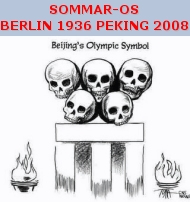
Despite all their evident economic progress, China has a morally bankrupt leadership. It has built its wealth on the altar of thousands of coffins, without shedding tears for any of them. It is among the fastest growing economies but is also the world leader in death penalties with a conviction record of about 99%.A country that is so heartless that it steamrolls tanks to mow down thousands of its students, when they protest, cannot bring peace in the world.

I found this article in the Amnesty International Site (dated May 2003) which mentions that in an effort to improve cost-efficiency, Chinese provincial authorities have introduced mobile execution vans and the article goes on to give the advantages of this system over general execution systems!!! Economies of scale in mass murder!!! It would have been funny if it were just not so tragic and perverse.

It’s not just India but the entire world that stops shy of dictating terms to them. In business circles, Walmart, the world’s largest company, had to bow down to official dictates in China and allow the creation of trade unions there (their only trade union in the world). Google, the champion of free information, had to submit itself to censorship and remodel itself to survive in China.

Despite the Dalai Lama’s popularity and the entry of celebrities espousing the cause of Tibet, the movement is losing its steam and His Holiness has himself toned down his demand from “independence” to “autonomy” for the region. Its human rights violations may hog headlines occasionally but it has not stopped the Chinese juggernaut from rolling and crushing all its detractors on its way to capitalistic freedom.

Hu’s next stop is Pakistan where he’s expected to further the nuclear relations between the two countries by announcing the sale of nuclear reactors to them. The West knows this but remains a passive spectator while continuing to urge India to maintain restraint (as if we needed someone to say that). The American electorate did to Bush what the Iraqis could not but who will stop the Communist Party of China's hegemonistic plans???

Wonder if I am a bit too paranoid about the entire thing. The Chinese have a strong leadership unlike us and so I fear they may succeed. God forbids that this will be emulated else where as a workable administration model....

Friday, November 17, 2006

The Fourth Estate Trials

Sometimes, real TV can be so much more thrilling and entertaining than “Reality TV”. So, forget Rakhi Sawant’s attempts to milk a bovine and watch Ram Jethmalani’s performance on CNN-IBN as he makes mincemeat of a hapless Sagarika Ghose during a Jessica Lal case interview. He raves, rants and goes berserk in a no holds barred performance which would do any octogenarian proud and get him to replace Big B as the “Angry Old Man”. Though he is known to be a controversial lawyer and a rabble-rouser, this time, his outburst attracted a fair deal of publicity, especially among the blogging and journo world (Who else would discuss?)

Ram Jethmalani, in the course of the interview, raised a few pertinent points, albeit in his own inimitable whiplash style. He pounced upon Sagarika’s lack of legal know-how and ridiculed her claim of going against public opinion. He also blasted the media for passing pro-active judgments and undermining the judiciary.

We all, probably, believe that Manu Sharma deserves to be punished but can we advocate that he does not deserve the best defence available because of our opinion. Whether he should stand for the accused or not is his prerogative and not the press’s. The strength of the Indian judicial system is in its ability to provide a free and fair trial to both the accused and the victim and not discriminate on the basis of “informed” public opinion.

The now forgotten ISRO spy scandal represents in many ways the worst example of a case that was created and sustained by an overzealous media. What started of as an innocuous arrest of a Maldivian woman, Mariam Rasheeda, went on to become the biggest spy scandal in the history of independent India. The media (especially the vernacular one) in association with the police and political class weaved a thriller script, adding dollops of sex, money and flesh to make it a scandalous affair. A few top scientists, an IPS officer and few others were implicated without any iota of evidence until the case was eventually handed over to the CBI.

After its report and the subsequent Supreme Court judgment, the matter was finally laid to rest and everyone was acquitted. But the tattered reputations and the mental agony of the people involved can never be restored. No one has ever apologized to the people whose dignity was stripped in the public and all this from the “educated free press of Kerala”.

Remember the arrest of His Holiness Jayendra Saraswathi, where the press hauled his reputation across the coals without any evidence at all to support the accusations hurled upon him. He was accused of being a womanizer, a corrupt god man and so much more that would have put any self-respecting man to shame. While the Tamil Nadu Government was vindictive about the entire affair, the scribes went all the way exhibiting their “secularism” by making a villain out of him. Can you imagine the Pope being subject to such abuse? And where’s the case now? The Andhra Pradesh High Court had remarked in its judgment that there is no prima facie evidence against the accused despite malicious attempts by the press and the Tamil Nadu Government to do so. The press continues to be silent about this.

Of course, it’s no one’s case that the Indian press plays only a “super-judicious” role in our democracy. For years the media snuggled upto the State and ignored its primary role. After the Emergency, L K Advani had famously told journalists “You were asked to bend and you chose to crawl”. But times have changed and a free global economic order has also seen the media get down and ask questions – some relevant and some which were hitherto considered as too sacred to touch.

The Jessica Lal, Priyadarshini Mattoo and Manjunath cases are there in the judicial space thanks to the active role of the media in bringing these issues to the public domain. A running democracy requires an active press that highlights issues and brings to focus all things hidden from public view. In fact, Amartya Sen says that a Free Press can play an important role in the mitigation of natural disasters by their active reporting. The RTI Act was not amended largely due to the role played by the media in highlighting the government’s intentions and attempts in sabotaging the law.

But what happens when the press decides to arrogate many of the State’s powers to itself. Many of us fed on a regular diet of news bytes do not question them and go by what is told to us by news anchors. We all know that there’s a thin line between bringing out an exclusive story and playing to the gallery. With so many channels fighting it out in the broadcasting and newsprint domain, there is always a temptation to go one up for exclusive “breaking news” at the expense of genuine news. Like various blogs, each channel carries its own subjective interpretation of facts and the casualty is the veracity of the news item. While everyone wants a well-researched story, what do you do in case it’s too tiresome to do so? Probably come up with “confidential leaks” or “reliable sources” and present it as “Flash News”.

The horrendous massacre of Dalits in Kherlanji went unreported for about a month till they took to the streets and lead massive protests in Nagpur. Is it that their stories do not carry the same shock value or they are not worth reporting? Sanjay Dutt has been accused of a very serious crime like possession of weapons but he gets a lot of sympathy in the media – recollect his visit to the Siddhi Vinayak temple and his “reformed” existence- but there are many others like Prof. Geelani (represented by Ram Jethmalani in the Supreme Court) who are subjected to the piercing eyes of media because they represent “no one”.

A vibrant democracy requires the media to act as a watchdog for the 3 legs of policy in India – the executive, the legislature and the judiciary. But it is tempting for the Fourth Estate to go overboard and try to dictate terms because of the unbridled power it has. This restraint is difficult to come by because at the end of the day, it is not answerable to anyone except maybe its shareholders. In defence of the press community, it must be stressed that is not enough to be fair but also important to appear to be fair, which is where many of our journalists have failed. Journalism should not be treated as an exercise in blogging where any smart alec who has an opinion (like me) decides to express it without checking out the facts of the case.

Tail piece: The sadistic streak in me enjoyed the Ram Jethmalani interview despite his haughty behaviour. I recommend it to people to watch it and judge for themselves the “entertainment” value in it, especially those tired of “Big Boss” antics.

Also watch the video of Ram Jethmalani's interview conducted by Karan Thapar in CNBC-TV 18 posted on Nov 19th for another slice of the action. The action never stops!!!

Friday, November 10, 2006

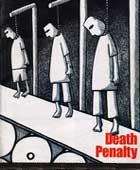
To Hang or not to Hang???

A young lawyer from Delhi, a Kashmiri militant and an Iraqi leader – nothing in common among themselves until very recently but now their fates are linked by the Hangman’s noose and a slender ray of hope. All of them have been convicted of different kinds of crimes and sentenced to the gallows. The circumstances relating to their punishment and their crime is quite different but most people agree with the verdicts decided in all the three cases ;what is not consensual is the sentence which has been given. These sentences have once again brought into focus the debate on capital punishments.

Afzal Guru, the militant, has been sentenced to death for his role in the attack on the Indian Parliament – an attack which not only disturbed the Indo-Pak peace talks (arguably) but also struck at the centre of India’s authority. It is a crime that we all agree deserves to be punished and other than his immediate family and supporters, there are no takers on his innocence (that aspect is of course beyond the scope of this post). Afzal has himself not asked for mercy; it is only the human rights groups have asked for clemency (wrongly reported in parts of the press as seeking pardon).

Santosh Singh, currently a lawyer in Delhi, had been stalking a young girl Priyadarshini Matoo for a long time before he finally raped and killed her. He was acquitted by a Sessions Court Judge saying that though he knows he’s guilty he cannot be punished due to the lack of evidence produced by the police and prosecution. The media uproar and the subsequent public outcry lead to the case being reopened at the higher court where he has now been convicted. He has been awarded “death penalty” for a crime which does not fit into the “rarest of cases”.

Saddam Hussain faced trial for his role in the slaughter of Shiites in 1982 in Dujail, in retaliation for the failed assassination attempt on him. The case was dogged by controversies right from the beginning. Two of Saddam’s lawyers were killed while the first judge quit. He was not given enough time and space to prepare his defence. Ironically, the conviction would have been welcomed had it followed proper legal and moral protocols and been conducted under the auspices of an international tribunal. The timing of the verdict – just before the Senate polls – and the judge’s conspicuous animosity towards the accused has also raised questions on the fairness of the trial.

The vast majority of democratic countries in Europe and Latin America have abolished capital punishment over the last fifty years, but United States, most democracies in Asia, and almost all totalitarian governments retain it. As per Amnesty International's latest figures, a total of 129 countries (including Canada, Mexico, Australia, Russia, South American nations and most European nations) have abolished the death penalty in law or practice. Of these, 88 countries and territories have abolished the death penalty for all crimes, 11 countries have abolished the death penalty for all but exceptional crimes (such as wartime crimes) and 30 countries can be considered abolitionist in practice, i.e., they retain the death penalty in law but have not carried out any executions for the past ten years or more and are believed to have a policy or established practice of not carrying out executions. Though 68 countries retain and use the death penalty, the number of countries which actually execute prisoners in any one-year is much smaller. In 2005, 94 percent of all known executions took place in China, Iran, the USA and Saudi Arabia (US and Iran on the same stage, interesting, right?)

Beyond the statistics, we need to ask ourselves what is the purpose of the death penalty?

--Is it to remove from society someone who would cause more harm?
-- Is it to remove from society someone who is incapable of rehabilitation?
-- Is it to deter others from committing murder?
-- Is it to punish the criminal?
-- Is it to take retribution on behalf of the victim?

Death is not merely a legal undertaking but has a strong social, religious and moral angle to it. It is not just priests or saints who look at birth and death as God’s handiwork; many of us also do so. There is also a strong religious notion that the act of suffering has a purifying effect on the human spirit allowing for salvation in God. The concept of death as a retribution for the sins committed is slowly losing ground. It has been argued that the person must be given an opportunity to repent for his sins and so death cannot be the way out. Is the idea behind a punishment to reform the person or to set an example in the society? Probably both and we need a more humane solution.

Death penalty supporters argue that it is a powerful deterrent to crime but there are no statistics to support this assertion. If death penalty were a proper deterrent, there would have been a reduction in crimes in such places and eventually their number would die out because the crime rate would have fallen to such an extent. On the contrary, these penalties seem to be on a rise in several countries, undermining the very rationale given for it. Death penalty sentences in India have been on the rise lately compared to the almost non-existent cases in the 60s and 70s. These are supposed to be given in the rarest of cases as per the Supreme Court ruling in 1983 but there’s a danger of the judiciary becoming “trigger free” in handing out capital punishments, especially under greater media glare (The Santosh Singh case is a clear example of that). Moreover, terrorist crimes, serial killer crimes or crimes of passion are not dictated by pure logic, so the rationale of using death as a deterrent does not work.

The next argument is one of infallibility of judgment and the irrevocability of the death sentence. The Liebman Report in 2000, concluding a 23-year study conducted by Columbia University, USA, found that 68% of all death sentences awarded were reversed due to serious legal error. In countries like India where the judiciary is over-burdened and cases drag on for years, would it be a surprise if the number of judicial errors is high. If a person is executed because of miscarriage of justice which is subsequently discovered the extinguished life cannot be restored. An innocent life lost due to callousness on the part of the law would be too heavy a price to pay.

Finally, at a slightly more emotional level, just think about the executioner who has to carry out the death penalty. It’s a profession which caries with itself the social stigma of killing someone but there are people who have to carry out this task. Leaders may take decisions but the final blood is in the hands of the executioner who has to act on behalf of the State. I strongly recommend readers to read Shashi Warrier’s soulful book “Hangman’s Journal” in which he brilliantly chronicles the agony that a hangman goes through when he has to carry out an execution. Similarly, Adoor Gopalakrishnan explores this theme in his movie “Nizhalkuthu”. In the words of Adoor, “The Hangman is conventionally considered to be one with no fine feelings. The public does not expect him to behave like a human being, the law wants him to be neutral, the State sees him just as an instrument of its operation.”

Should a civilized society use death as a tool to counter crime? It is arguable and when you consider the plight and sorrow of the victims, it is difficult to advocate the abolition of death penalty. It is an emotional issue but law must take a firm stance on this. In the Indian context, we could look at increasing the tenure of the life imprisonment since 12-14 years may seem on the lower side for extremely heinous crimes. The media must also be careful in its coverage of events. Repeatedly bombarding visuals of the crime and upping the ante for action can lead to public pressures on judiciary to hand out “populist” verdicts.

Is the Right to Life absolute? I certainly think so but then if I were to put myself in the shoes of Priyadarshini Matto’s father, would I feel the same??? Maybe yes or maybe no….

Monday, October 30, 2006

In the era of Cricket Jockeys

My earliest memories of watching cricket on television are of Australia lifting the World Cup in 1987 and a young strapping lad called Sachin hammering veteran leg spinner Abdul Qadir across the park in Pakistan in 1989. We had messers Dr Narottam Puri and Anupam Gulati as the commentators in those days – with their dull, dry flaccid bored to death voices, almost straight out of an Adoor Gopalakrishnan movie. And then, you had the likes of Sushil Doshi in Hindi with melodramatic moments of commentary like "Tendulkar ne tenduye ki tarah lapka". Commentary was incidental to the game; the action was only out in the middle.

The 1992 World Cup changed things a lot, for a viewer, as we saw Richie Benaud , Bill Lawry and members of their ilk crooning into the microphones and creating a niche for themselves. We were exposed to pyjama cricket and Channel 9’s innovations which made us realize that there was more to the game than the 22 players and 2 umpires on the ground. Dull presentations in the studios were replaced by interesting pre and post-match analysis with weather forecasts, predictions, viewer polls and pitch reports. The usage of stump cameras, coloured clothing, third umpires etc. and statistical measures (though Mohandas Menon continues to be the most reliable source) made the game more popular and helped in creating cricket experts amongst common people.

The 1996 World Cup witnessed a lot of ex-cricketers crowding the commentary box, especially with a plethora of channels waiting to pick up some ‘expert’ or the other. In many ways, the Wills World Cup was a broadcasting blockbuster and the BCCI was never the same again. Media rights and advertising now held greater premium and the game and the players finally started prospering economically even though there was no substantial increase in the playing strength across the world.

Commentators also became celebrities and so you had new guys jumping on to the band wagon. Remember the unsavoury Shaz and Waz show on ESPN-Star, which featured two middle aged commentators, flirting with babes, selected through SMS polls. Navjot Singh Siddhu became a pop star mouthing inane thoughts and testing the elasticity of the English language until one fine day, he crossed the barrier and was quietly shown the door, much to our relief. There were misfits like Kapil Dev, Saba Karim and others who made their exits from commentary panels fast enough but still did enough to remain in the studios.

With Zee and “Deewana Bana Dey” Sony Max entering cricket broadcast, we now have television anchors masquerading as sports presenters and reducing it to another form of Bollywood tamasha. But it was the 2003 World Cup, I think, that saw entertainment entering the game forcefully in the form of Ms.Mandira Bedi who has done more than the Tarun Tahilianis and Ritu Beris in spreading fashion consciousness through her infamous “noodle straps”. She earned a lot of ridicule with her strappy presence but then the marketing guys were happy that she managed to swing in non-fans of the game also. Some smart MBA’s idea of attracting women to the game but with 22 men sweating it out on the field, Mandira and Ruby Bhatia would be poor choices, surely.

Circa 2006, witness Mandira Bedi squirming and shrieking while referring to Abhishek Bachchan and Charu Sharma (whose fast receding hairline has gained more footage than his comments), blushing referring to Ash. Of course, she's been a bit more circumspect in her dressing sense this time(Sadly, for many of us).With luminaries like Boycott and Barry Richards taking a back seat in these events, it has become a free for all for these jockeys who have been mercilessly dumping us their humble pearls of wisdom. The horror undergone by the transition from watching Harsha Bhogle and John Dykes to Mandira Bedi and Rohit Roy cannot be matched by even readers of The Hindu forced to read the Deccan Chronicle. And then you have tarot reading, actors talking about their movies and you wonder what's going on? Where is the post-match analysis that ESPN-Star brought to the game??

The simple pleasure of watching the game, the replays and listening to the comments of commentators is now a luxury in the hands of these channels. With ads available at every possible break, it’s become a case of watching the game in the midst of all the ads. The last ball or first ball disappears from the screen and the channel makes a few lakhs. The advertiser is happy, the channel is happy while the viewer remains the passive spectator who has no say. Treating sports as yet another Bollywood masala saga may be tempting to channels but forgetting the legions of serious cricket fans and subjecting them to all this trash is quite unbecoming.

The marriage of Bollywood and cricket – the 2 most marketable products in India- is a great idea per-se but it must be treaded carefully so that it does not spill over into a comic vaudeville which is what it has become now. Cricket can sustain itself without wonderful bimbettes outdoing each other in “exposing” themselves (exposing their knowledge). With off-screen entertainment in the form of Warne’s (s)exploits with his balls, Shoaib’s drug antics and Hair’s tantrums, cricket has all the masala to sustain itself, so does it need the female quotient ( with exceptions like Donna Symonds, of course)?

Any day, give me the likes of Harsha Bhogle, Boycott, Ian Chappell, Sunny Gavaskar, Mark Nicholas, Tony Greig and a few others sitting out there and I am hooked on to the TV – straps or no straps. It's a big Thumbs Down to the Set Max brand of commentary...

Friday, October 20, 2006

Singapore Diary – Part 3

A few days left before I am back in India and so my smileometer is beaming high signals in the midst of hazy Singapore skies (an annual haze in this part of the year caused by forest fires in Sumatra). A sign of confused times when you make money but wonder what exactly you want to do in life and is it worth troubling your mind but satisfying your pocket. As I ponder over this question and ask myself how much I can take all this, I decide to tread the conformist path of doing nothing but journeying along till you are forced to take up the less trodden path.

A vegetarian’s life is a difficult one outside India. Wherever I go, I find the meat of some animal or the other ornately decorated and put up for sale but very few restaurants catering to the needs of a herbivore like me (Fellow Indians think it blasphemous for a Keralite to even be a vegetarian). Since I stay in a predominantly Indian environment in Singapore, its fine but otherwise it can be a tough choice. Vegetables are at a pretty low priority here.

India is quite inclusive when it comes to such eating habits as it serves both the vegetarian and the non-vegetarian palate. I find it both amusing and outright crazy when I see a Kentucky Fried Chicken outlet in Singapore Zoo. How can a zoo which is meant to be a home for animals be a place for serving them hot? Of course, it may be a case of forward integration for the zoo!!!

I am shocked (an understatement) when I am told that it is a govt. policy that birds are not allowed into the city limits. Not allowed??? There are, supposedly, shooting squads to ensure this compliance. I cannot confirm the veracity of such a law/policy in force but honestly, I have never seen a bird here and the closest I have come to, is reading, in The Strait Times, of bird droppings being a menace for poor car owners. This would have been funny if not an example of insensitivity of the state towards anything that does not derive economic value.

We forget very conveniently that buildings and malls cannot substitute the beauty of nature and that co-habitation is the key to a greater and more fulfilling existence. Imagine a day when future generations here do not know what animals are and have to visit museums to see their remnants.

The Government plays an important role in the lives of people through the usage of subsidies. It taxes private transport and subsidizes the public transportation and housing sector. The railway tariffs are capped at a maximum value of about 3 Singapore dollars for a trip to encourage greater usage of the MRT. The surcharge on cars to increase the purchase and ownership costs (as mentioned previously), tolling on high congestion spots at peak hours (using Electronic Road Pricing) and Area Licensing Scheme (restricted zones in business areas) have eased the traffic which is fairly dense at peak hours. It has developed a system which even the Americans have tried to emulate but have not been able to do so far.

Urban development has not been given due importance in India and it is worthwhile for us to consider measures to reduce the movement of cars in cities and boost public transportation, like in London or Curitiba (in Brazil, considered as one of the best examples of urban development). Mumbai, Bangalore and other cities are all aiming to be Shanghai but they are all slowly choking and require urgent measures to get them back on track.

In the housing segment, there are two types of flats here – HDB (Housing Development Board) and Condors. The Govt. constructs and sells/leases out HDBs at lower than market rates and this serves a substantial portion of Singapore’s housing needs. Condors are private flats and are more elitist in nature. This is another example of the Govt.’s presence in a very commercial business which may be scoffed by believers of laissez faire.

A massive urban renewal programme which began in the 1960s resulted in the replacement of all slums with these housing units. The Govt. of that time required that a percentage of everyone’s wages be placed in a forced retirement account or be used to purchase a residence which resulted in everyone owning a property in the country. Slums and displacement is another serious issue that we face in India and there needs to be a further debate on how we address that issue.

Democracy is a virtue that we do not necessarily celebrate because we take it for granted. This is alien to Singapore but they do not mind it – probably a frog in the well syndrome. Singapore’s First Premier and principal architect, Mr. Lee Kuan Yew, believes that democracy is a primarily Western concept and not necessarily required for Asia and so they should not be judged on this yardstick. This has found its echo in various Asian countries with China, Malaysia and a few others endorsing this opinion. He had famously stated in a newspaper interview :

I am often accused of interfering in the private lives of citizens. Yes, if I did not, had I not done that, we wouldn't be here today. And I say without the slightest remorse, that we wouldn't be here, we would not have made economic progress, if we had not intervened on very personal matters - who your neighbour is, how you live, the noise you make, how you spit, or what language you use. We decide what is right. Never mind what the people think.

But as an Indian who sees and cherishes the ideals of a free world, I do not subscribe to this thought process. Economic freedom without political freedom is a very superficial freedom, something that has earned Singapore the dubious name of a “nanny state”. Policies like excessive fines, tax reliefs for sterilization, compulsory saving schemes, strong censorship and archaic draconian laws have diminished its position in terms of human rights but it's principle has been Greater Capitalism for Socialism, dubbed by Singapore University scholars as "meritocratic,elitist,Confucianist, bureaucratic state". The principle seems to work fine currently and the people are very much in favour of it but can it sustain in the long run??? Let's wait and watch.....

Tail piece: You would be surprised to know that chewing gum was banned in Singapore until a few years ago (2004) when the US Govt. negotiated, alongside the active lobbying of gum maker Wrigley’s, with the Singapore government for the lifting of the ban. Sticking of the gum in train doors and other public places was leading to a public nuisance, so the ban was imposed. Even now it is available here only in drugstores and that too on prescription!!!

Sunday, October 15, 2006

Pyongyang Joins the Party

Imagine an exclusive executive club where a select group of powerful influential persons are members. These members enjoy rights denied to ordinary denizens and have a constitution which seeks to ensure that the club remains as elitist as possible. Their actions are highly questionable but they shroud it in morally hypocritical arguments of the greater good and preach the same to non-members. Persons who try to intrude are penalized and given stiff punishments so that the club maintains its status quo position. But there are always crazy plebeians who still manage to gatecrash bypassing the laws, something that represents North Korea’s entry into the World Nuclear Club.

North Korea had always been threatening to go the nuclear way (it withdrew from the NPT in 2003) and it was a more a question of when rather than if and so it did not surprise anybody except for a few news channels who had to feign surprise to give it that breaking news effect. For a number of years, the nuclear world was dominated by five countries who entrusted to themselves the task of protecting their existence and by extension, the world, till one fine day, two countries decided to no longer play ball. Pokharan and Chagai Hills pushed India and Pakistan into this club and now, North Korea has followed suit. Now there are renewed fears that Iran too would test the bomb.

Pyongyang going nuclear reveals a few things. It diminishes China’s assumed ability to leverage its relationship with North Korea and also undermines President Bush’s attempts to threaten it in terms of embargos. For countries to condemn it (including India) saying it threatens regional stability is a classic case of hypocrisy. But then, that’s a naive argument in the world of real politicking.

Even a militarily-passive Japan, which has always used the example of Hiroshima and Nagasaki to convey the sense of loss and destruction that nuclear weapons can bring, is under the US nuclear umbrella and so they can preach peace. Non-proliferation as a tool has not worked for more than half a century and is not expected to bring in any new dividends. What is required is a clear elimination of nuclear weapons and not reduction.

I was amongst the many jubilant voices in India when we went ahead with our Pokharan spectacle. There was this jingoistic feeling of having cocked a snook at the world-the Yankees could not stop us and now we are the super powers etc. But now, as the adrenaline levels have gone down and “Shining India” is almost a dirty word, I wonder what we achieved by going nuclear, except maybe an exaggerated sense of national pride for a few days (Of course, with exceptions like my Andhraite neighbour who was unhappy that the tests would lead to the cancellation of his son’s US visa). Does the theory of nuclear deterrence actually work? I don’t think so. The tests gave us a false sense of pride, a feeling that we are major players in the world and that the world will now listen to us. It probably does listen in many forums but that is due to our market size rather than our arsenals (Poor Shashi Tharoor is a casualty of that belief).

For a country like North Korea that stands almost at the bottom of the bottom of the economic pyramid in the world and has scores of people dying due to natural and state-sponsored schemes of disaster, you would wonder what nuclear weapons could do. Our knowledge about the country is quite limited because North Korea does not publish statistics (their own economists have no idea what their inflation rate is) except that it has the fifth largest military in the world, with the largest percentage of citizens enlisted. Maybe it gives them a sense of pride but since media is not given a proper access to the public domain; we do not even know that.

At a larger level, Kim Jong - II will leave North Korea a poorer country where hunger is fed by patriotic talk and Western phobias. Do the people have a future to look towards? A country that is so poor but believes that nuclearization will help it. Maybe, but from whom?? Let me quote the words of The XIVth Dalai Lama here which conveys all this and so much more:

Peace, in the sense of the absence of war, is of little value to someone who is dying of hunger or cold. It will not remove the pain of torture inflicted on a prisoner of conscience. It does not comfort those who have lost their loved ones in floods caused by senseless deforestation in a neighboring country. Peace can only last where human rights are respected, where people are fed, and where individuals and nations are free.

Such countries will probably perish under the might of their own contradictions and burdens in the long run. As Amartya Sen discusses in his article on Democracy, a democratic state with a free press ushers in a certain amount of administerial responsibility because of the constant focus of the media on it. He successfully argues how a democratic state can ensure that there are no famines and droughts, something that Pyongyang needs to realize.

Nuclearization is a greater political decision than a military one. For starters, we do not even know whether they actually conducted the test successfully, as being alleged in certain quarters. Suddenly, there are talks of South Korea and Japan reconsidering their proliferation options because they feel threatened in the presence of a nuclear neighbour. The nuclear issue has also whipped up a great deal of passion in the forthcoming US Senate polls with the Democrats alleging that the North Korea going nuclear is an example of the failure of Bush’s much vaunted diplomacy.

The Americans have threatened to impose fresh sanctions but will it help? History shows it has never done anyone any good except possibly companies that act as intermediaries (Food for Oil Program types). The recent Iraq experience has shown them to be a total failure but then since constructive diplomacy has never been the most common means of working, the same old strategy will continue. In retrospect, we know that Iraq did not have the alleged nuclear stockpiles but if it had, would history have been different? Did this influence North Korea when it decided to go nuclear?

What drives nations to nuclearization? Maybe a false sense of machismo- the chest beating and fist thumping variety where you cannot offer anything to your people and so camouflage it using false arguments of self-pride, deterrence and defence. Ask the average North Korean the significance of this (assuming one day you can see him expressing his views) and his blank face would convey all that peace activists have been trying to bandy about. Do I sound naive or foolish when I advocate peace? Maybe but I believe that the world can only survive with the philosophy of peace and not the politics of non-deterrence ballistics.

I end my post by quoting the renowned French philosopher Albert Camus’s famous words that rings so true:

Peace is the only battle worth waging

Sunday, October 08, 2006

Singapore Diary - Part 2

The second week starts and my office work increases. I do not perform anything earth shaking except a lot of Control C- Control V job in the last few days, mostly not even aware of what is happening but hey, my targets are achieved by this simple movement of my two hands. That’s all work life has become – a monotonous drole which pays you, to show off to your peers. Stop cribbing I tell myself but then Dil Hai Ki Manta Nahin and so I log in and decide to do a bit of my blogging work again – a necessary outlet for my incessantly wavering mind.

We plan to go to a place called Sentossa but the rain gods play spoil sport and we reschedule our tour itinerary to travel to a couple of museums in Jurong East. It’s all child’s play out there and we get bored pretty quickly though I manage to capture an IMAX viewing of “Mars Travel”. But the good thing is that I see industries in this part of the world and travel by the bus for the first time. The railway pass I had bought can be used in the bus (called LRT here) also. That’s nice; I had heard of plans of a similar integrated multi-transport system in India(useful info available in the Indian Economy Blog) also but wonder what happened to it.

I am not the most active temple goer while in India but I decide to check out a temple in this island city. And so here, I am in front of Sri VeeramaKaliamman Temple, next to Veerasamy Road in Little India. It’s a busy Saturday evening and lots of people around but it feels reasonably good. I have doubts if I can use my camera inside but I see a few Europeans taking photos, so I enter. Seeing me, a Japanese tourist (he reminds me of the tourist in Munnabhai MBBS) asks me in gestures if I can get his snap taken in front of the temple. I oblige hoping to get the favour returned .He's, however, not too pleased with my photography skills in my first two shots but settles on my third attempt . He’s satisfied and leaves but I forget to get my photo taken.

As I step out of the temple, I hear "Apadi Poddu Poddu" from one of the hotels. I take a walk around and realize that there’s not a single non-Indian store in the place (99% Tamil). You’d think I may as well be in Coimbatore as I see Ananda Bhavan, Komalas, Meenas and many other such hotels. A North Indian could be equally bewildered as a Westerner seeing Tamil sprayed around in such quantity.

I am allowed taxi travel as per company norms but I decide to hitch train rides daily rather than go by the cab. One reason is my nostalgia associated with Mumbai and its train travel, though they are not comparable in the actual sense. Secondly, I feel that one of the best ways to know the people of a place is to travel in the most common mode of transport there. Not that I make a great job at it (which I realize later) as I stand in the train staring at the people while most of them are hooked to ipods and lost in their own world.


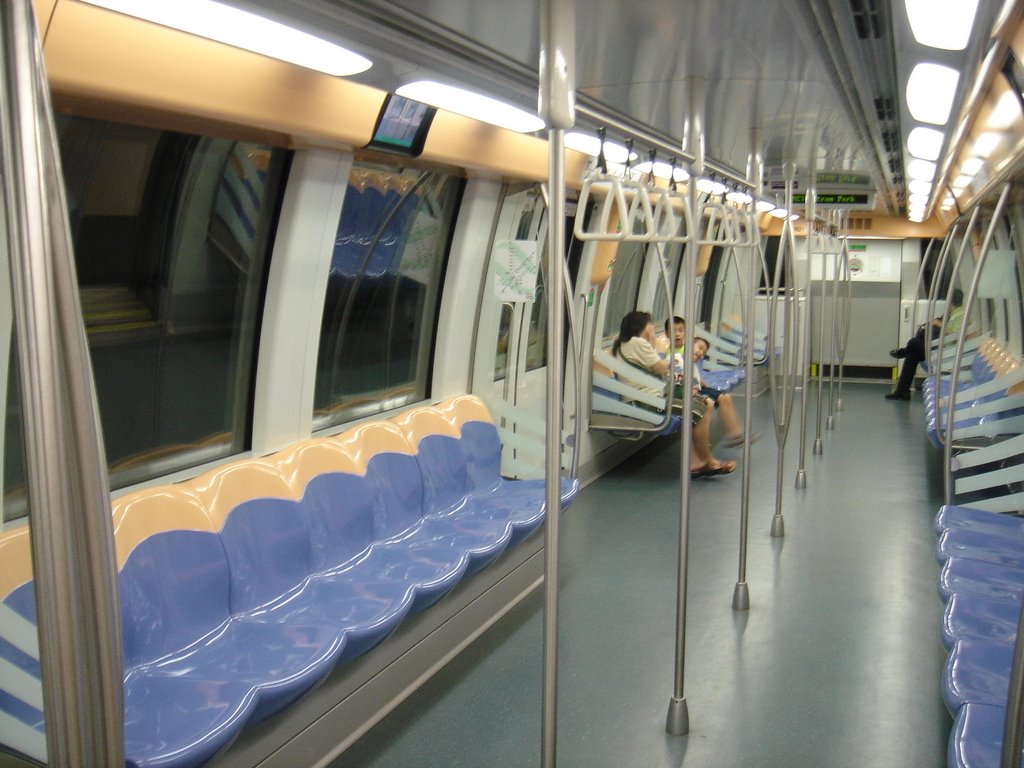
(View inside the Singapore MRT-Local Train)

Nevertheless, I buy a pass (an EZ-Link Magnetic Card) and load it with 30 Singapore dollars and proceed. You swipe the ticket at a fare gate while entering a station and swipe out at another at the place you get out and the fare is deducted for the distance covered. The amount of travel inside the stations is much more than the actual journey which is a dampener at times but then since some exercise has also to be factored in, I’m ok with that option.

One first hand observation I have is of the work culture prevalent here. It is something similar to India in terms of people working for long hours. The few Europeans I see here are more inclined to visit the evening pubs or maybe dash home unlike our hardworking Singaporean. I guess it’s not just an Indian mentality; an Asian work style though not as difficult as the Japanese culture of workaholism. With no girlfriends in store and no inclination towards bars, I decide I may as well be a part of this brigade which sits late (not necessarily office work though). The MBA in me of course makes me think - Good market for stress counselors, gyms, alternative lifestyles etc.???

I am told by one of my colleagues that the Maruti Swift which is modestly priced (ok, not modest for most of us) in India at about Rs 4-5 lakh is available at about Rs 18 lakhs here and that’s the Maruti 800 equivalent gaadi here. I am shocked at this apparently huge price difference but apparently, this is part of Government policy to curb the number of private vehicles on the roads to avoid traffic congestion. Interesting, isn’t it?

It brings to focus the larger question at stake – the role of governments in Free markets. Should governments allow markets to dictate terms by following a policy of laissez faire or be an interventionist keeping the larger picture in mind? Are free markets truly free or do they breed crony capitalism? I’ll not debate that at least in this post but would like to discuss this in detail later in some other post.

Even at the risk of being dismissed as a cliche, I’d like to reiterate that you can take the Mallu out of politics but not the politics out of a Mallu. So, I look around the place scanning for some political banners, forums or any other symbols of politics in Singapore. But I struggle to find any such demonstrative political paraphernalia around unlike in India, where we are all members (active or passive) of a larger political act.

I must confess that I do not ask Singaporeans themselves about it but go by what I see around which is not a very scientific way of drawing conclusions. But then the politics of a place can be felt in the air and the remarkable absence of it is a discerning factor (at least to me). So, I turn to my old faithful Google to find out more and realise that this is a one party democracy (???).Time to revisit my understanding of democracy???

I'm running out of time;I better stop.Will continue the discussion on the economic and political style in the next post……………